FMCG Distributors Seek Zero-MDR Policy for Merchant UPI Transactions
The All India Consumer Products Distributors Federation (AICPDF) has asked the government to maintain zero-MDR UPI transactions for merchants, saying the planned taxes could put pressure on low-margin FMCG businesses. The federation asked the Prime Minister for clarity on the INR 1 lakh barrier.
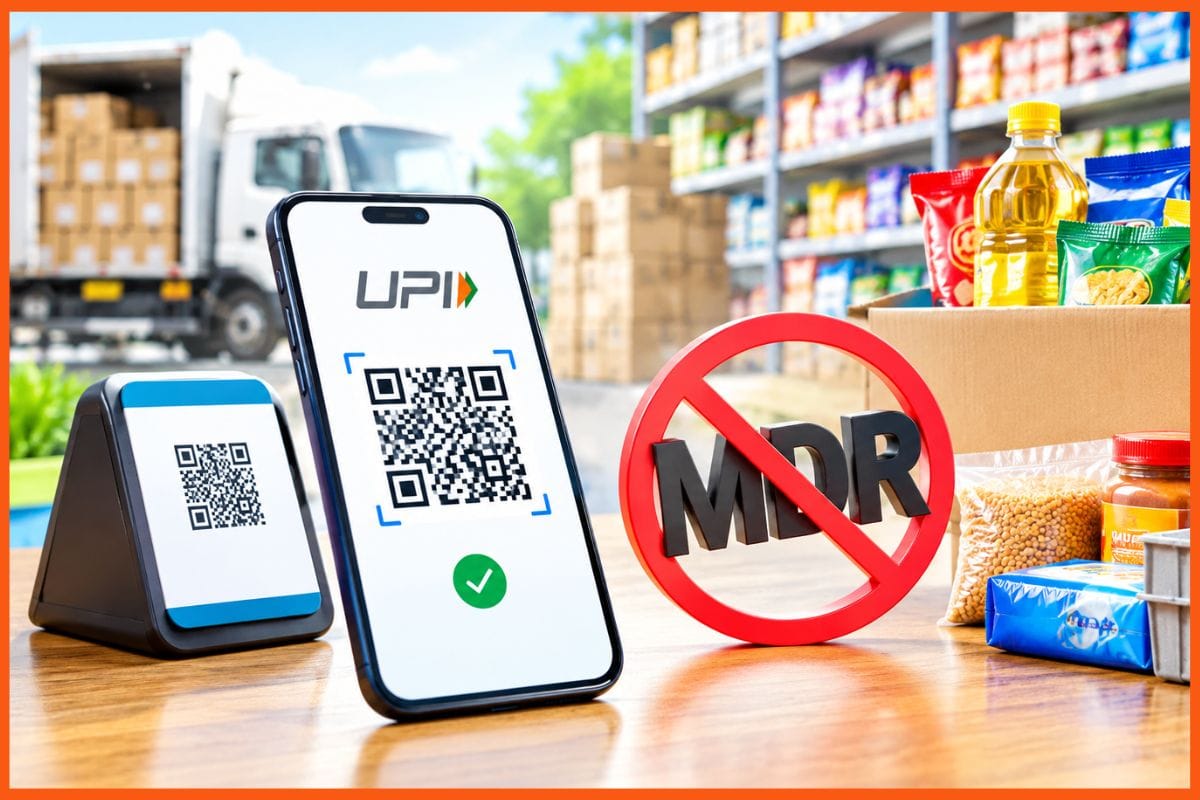
On September 18th, the All India Consumer Products Distributors Federation (AICPDF) voiced its strong opposition to the proposed Merchant Discount Rate (MDR) for UPI transactions. Millions of small wholesalers, merchants, and other low-margin firms will be hit the most by any increase to UPI's transaction costs, according to the federation. It has also formally asked the government to reverse its decision and keep UPI as a zero MDR payment system for retailers in a letter it sent to the Prime Minister.
AICPDF’s Recommendations on MDR to PM
The industry group has questioned why businesses are being asked to foot the bill for the entire digital infrastructure in its contribution. Simultaneously, it has requested that B2B supply-chain settlements within the FMCG supply chain not be subject to VAT. Additionally, it was stated that the government had to make sure there is no retrospective MDR obligation and provide a clear explanation of how the INR 1 lakh barrier works.
It has also requested that the government handle any cascading tax incidence that may occur as a consequence of determining MDR on the tax-inclusive gross payment. One of India's most notable indigenous technology accomplishments is UPI, according to Dhairyashil H Patil, National President of AICPDF. It revolutionised the country's payment system and made digital payments available to millions of buyers and sellers. The four pillars of UPI—its accessibility, affordability, simplicity, and universal acceptance—must be preserved, according to Patil.
AICPDF Highlights Serious Concerns on UPI Charges
The trade group has voiced its disapproval, asking why businesses should have to foot the bill for the entire digital infrastructure. The industry group says that if all UPI transactions are worth about INR 328 lakh crore and the whole cost to run and sustain the UPI ecosystem is about INR 20,700 crore, then the total cost is about 0.06% of the transaction value.
No one in the ecosystem, especially the trader who is already making razor-thin margins, should bear an undue burden of the expense of a sustainable financing mechanism if one is deemed essential. Patil elaborated by saying that UPI isn't just used by merchants; the whole economy does. Instead of having the merchant be the only one who has to pay to keep this massive digital infrastructure running, the government should look at a more systemic approach.
It is unfair to punish the merchant just because he takes digital payments. The FMCG retail and distribution industries have razor-thin profit margins, and when set against these costs, a 0.4% MDR can eat away at real profits, as noted out by AICPDF.
Fuel, insurance, telephones, railroads, and agricultural inputs are among the critical and thin-margin sectors that the government has acknowledged by allocating a flat INR 5 MDR rather than 0.4%. Since fast-moving consumer goods (FMCG) distribution and retail are likewise high-volume, low-margin businesses, it's puzzling that they haven't been given the same treatment, added AICPDF.