Government Removes Excise Duty on Ethanol-Blended Petrol Variants, Promoting Cleaner Mobility
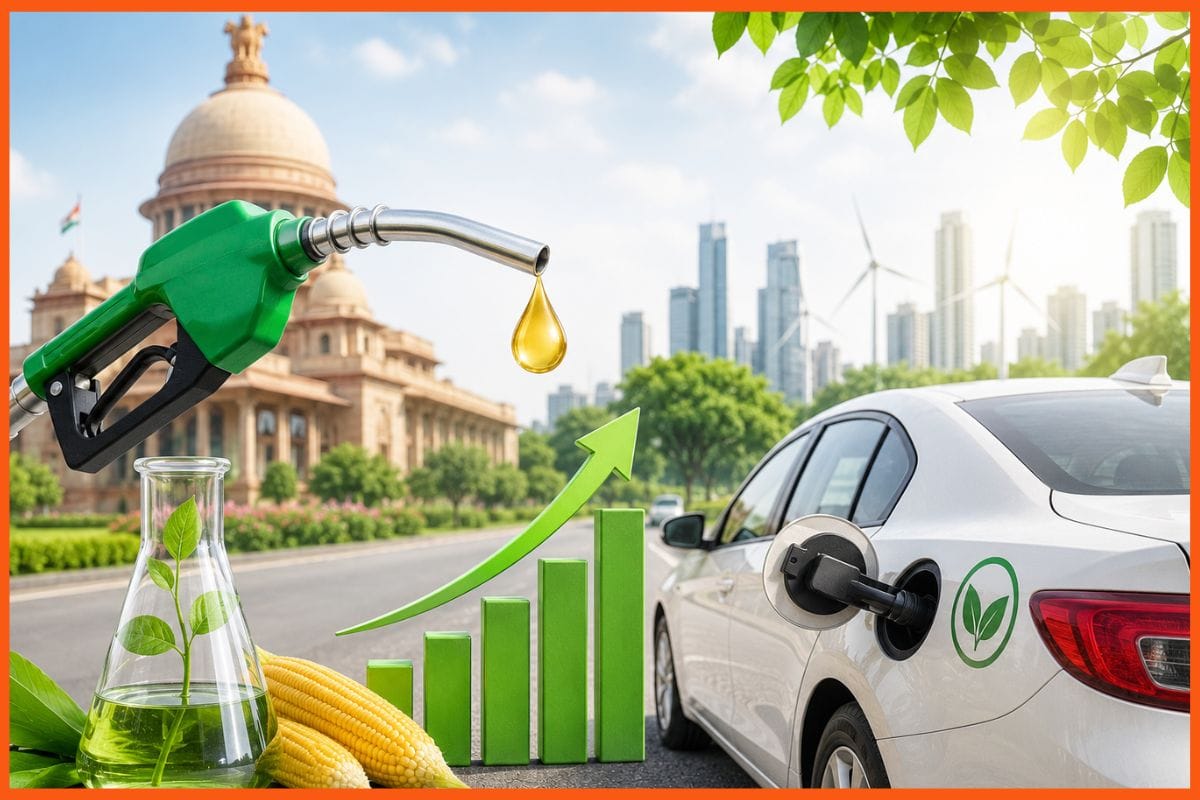
An increase in the percentage of ethanol in petrol has resulted in the elimination of excise taxes by the central government. This is a necessary step for the eventual widespread use of fuels with ethanol concentrations higher than 20%. This came to light at a time when India is actively working to reduce its reliance on imported crude oil and increase its usage of biofuels.
A government announcement states that petrol containing 22%, 25%, 27% or 30% ethanol blends are now exempt from excise charge. This action broadens the current exemption that applies to petrol combined with up to 20% ethanol.
Why Government is Promoting Ethanol Blending?
Officials have made it clear that this announcement does not signal the imminent arrival of retail fuel outlets offering higher ethanol mixes. Since mixing ethanol and petrol at fuel depots is considered a manufacturing activity that could otherwise be subject to excise duty, officials stated that the exemption is mainly a regulatory necessity. Up until E20, when petrol contained 20% ethanol, the Finance Ministry waived the tax requirement.
Some regard the expansion of the tax exemption to E22, E25, E27, and E30 blends as a stepping stone toward the eventual introduction of fuels with higher ethanol concentrations. E22 is a mixture of 22% ethanol and 78% petrol. Before implementing any deployment of these fuels, officials indicated that thorough testing and consultations would be conducted. This move is an attempt to get more people to fill up their gas tanks with ethanol. If India wants to diversify its energy sources away from imported crude oil and toward biofuels, this is an essential first step.
Akshay Modi, Managing Director of Modi Biotech Pvt Ltd., "India is now more ready for E22 to E30 than ever before. The successful roll-out of E20 in India shows that with the right mix of government policy, industry investment, and agricultural cooperation, energy transition processes can work well. The next step is to build trust among consumers and the automotive ecosystem to make the transition smoother. For E30, production capacity and feedstock availability are already in place. The gap is in the automobile sector, which must enable higher blends by testing and certifying the existing vehicle fleet for compatible blends (E22–E30 depending on age/materials)."
"In terms of supply, the country has demonstrated strong ethanol production capabilities through both sugarcane and grain. This creates significant opportunities for further advances in energy transition without facing energy shortages, given the volatile geopolitical situation. It is also important to keep investing in diversifying feedstocks, especially maize, which is scalable and uses less water than other options, without affecting the food basket much. Damaged grain is another key feedstock with zero impact on food or water," Modi added.
|
Some Interesting Facts of the Story |
|
1.Ethanol-blended fuels can help reduce harmful
tailpipe emissions, contributing to cleaner urban air quality. 2.The government's ethanol push has encouraged
investments in distilleries, bio-refineries, and agricultural processing
infrastructure across India. 3.Higher ethanol blending can improve energy
security, especially during periods of geopolitical tensions that impact
crude oil prices. |
India Crafting its Own Fuel Economy
Petrol blended with 22%, 25%, 27% or 30% ethanol will have an excise charge of 'zero', according to the ministry's announcement. To encourage consumers to switch to petrol combined with ethanol, the excise duty has been waived. Fuel price worries have prompted the notice. In March, in an effort to protect consumers from the rising global crude oil prices caused by tensions in West Asia, the central government decreased the excise charges on petrol and diesel by INR 10 per litre, forgoing over INR 1 lakh crore in annual revenue.
Diesel and gasoline prices increased by about INR 7.50 per litre in the second half of May, which is the backdrop against which the move is taking place. It should be mentioned that E20 vehicles are not meant to operate on E85 or other fuels with exceptionally high concentrations of ethanol. Additional engineering and validation work is required for vehicles to comply with E85 fuel standards. This work focuses on engine calibration, fuel-system durability, corrosion resistance, and material compatibility.
|
Quick Shots |
|
•The Centre has waived excise duty on petrol blended
with 22%, 25%, 27%, and 30% ethanol (E22, E25, E27, E30). •The move extends the existing excise exemption
available for E20 (20% ethanol-blended petrol). •The exemption is aimed at supporting India's
long-term biofuel and energy security strategy. •Officials clarified that the decision does not mean
immediate retail availability of higher ethanol-blended fuels. |