

Haryana Clears Rummy and Poker Rooms, With Conditions
Haryana has notified rummy and poker as games of skill, clearing physical card rooms in Gurugram and across the state, on conditions that include registration, KYC, CCTV and a bar on taking any rake. The Supreme Court's May ruling on GST leaves a separate question open.
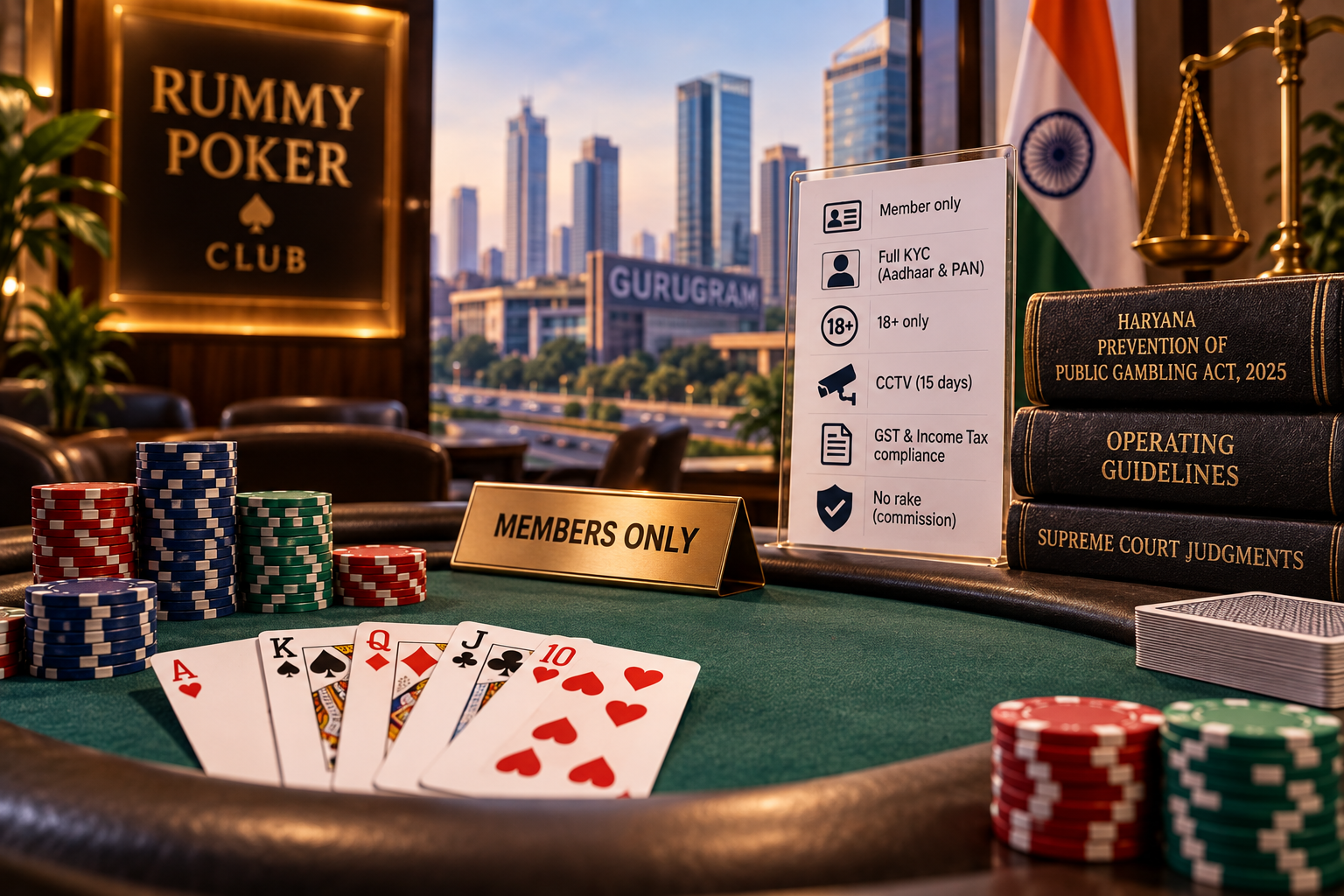
A rummy room can now open legally in Gurugram. What it cannot do is take a cut of the money on the table.
On 10 September the Haryana government notified rummy and poker as games of skill under Section 2 of the Haryana Prevention of Public Gambling Act, 2025. Five days later the Home Department issued operating guidelines setting out the conditions under which clubs may offer them.
Together the two documents do something no other north Indian state has done recently: they create a lawful route for a physical card room, and then hedge it with conditions.
What a club has to do
The conditions are not light. A club must register with the District Magistrate, admit members only, run full KYC with Aadhaar and PAN, and keep out anyone under 18. It must install CCTV and hold 15 days of footage available to police, accept periodic police visits, comply with GST and income tax, and apply responsible-gaming limits on deposits and transactions.
Miss any one of them and the notification stops protecting you. The penal provisions of the Act apply again, which is the part operators should read twice, because compliance here is not a licence condition with a fine attached. It is the thing standing between running a club and committing an offence.
The no-rake rule is nearly sixty years old
The guidelines bar the operator from taking a rake, a commission, or any share of the stakes. Clubs may charge for membership, food and the table. They may not take a slice of the pot.
That line comes almost directly from State of Andhra Pradesh v. K. Satyanarayana, decided by the Supreme Court in 1967 and reported at AIR 1968 SC 825. Police had raided a Secunderabad club and charged its officers with running a common gambling house, pointing to what the club collected: a charge for cards, a sitting fee, and a levy when play ran late.
The Court held rummy to be "mainly and preponderantly a game of skill" and acquitted them. On the charges, it reasoned that "just as some fee is charged for the games of billiards, ping-pong, tennis, etc, an extra charge for playing cards (unless it is extravagant) would not show that the club was making a profit or gain". Fees for running a room were ordinary club economics. A direct cut of the stakes would have been something else.
Haryana has taken that distinction and written it into an executive instruction. A club sells access to a table. It does not participate in the wager.
The question the notification does not touch
Here is where it gets complicated.
On 27 May 2026, a Supreme Court bench of Justices J.B. Pardiwala and R. Mahadevan held that for GST purposes the skill-versus-chance distinction is beside the point. What matters is whether money is staked on an uncertain outcome. The Court upheld 28% GST on the full face value of bets rather than on platform fees, and allowed it to run retrospectively, producing liabilities across the gaming industry estimated well above ₹1 lakh crore.
So one arm of the state has just said skill is what makes rummy lawful, while another has said skill is irrelevant to whether staking is taxed as gambling. Both statements can stand, because they answer different questions. The first is about whether an offence has been committed. The second is about what the tax authority may collect.
What that means for a Gurugram club is genuinely unsettled. The May ruling concerned online platforms that hold the pool, run the wallets and control the prize money, and the Court called them primary suppliers rather than intermediaries. A club barred from touching the stakes sits in a materially different position, because the money never passes through it. What is clear is that the club's own charges, for membership, food and the table, are ordinary supplies taxed in the ordinary way. The open question is whether anything attaches to the stakes themselves, and that is precisely the territory the no-rake rule keeps the club out of. Nobody has tested it, and no operator should assume the answer.
Online remains a different country
None of this reopens online play. Online money gaming, rummy and poker included, has been prohibited nationally since the Promotion and Regulation of Online Gaming Act came into force on 1 May 2026, and a state notification cannot override a central statute.
That ban is itself before the Supreme Court. A three-judge bench led by Chief Justice Surya Kant, with Justices Joymala Bagchi and V. Mohana, has petitions challenging the Act on the grounds that betting and gambling are state subjects and that a blanket prohibition offends the right to trade. Pleadings were still being completed in August. Until that is decided the ban stands, so the real-money gaming industry is operating under a law that is in force and unresolved at the same time.
What Haryana has changed is confined to the physical room.
Lawful in Gurugram, an offence in Chennai
This is a clearance in one state, not a national position, and the map is uneven enough to matter.
Physical card rooms operate openly in Goa, Sikkim, West Bengal and Nagaland, the states where gaming has long had a legal home. Telangana, Andhra Pradesh, Tamil Nadu and Gujarat prohibit real-money card play outright, skill or not. Karnataka sits somewhere in between, and Bengaluru police have shut down card rooms in large numbers. Haryana now joins the permissive column, with conditions attached that the older permissive states never imposed.
For Gurugram that border is unusually close. A club operating lawfully under a Haryana notification is a short drive from jurisdictions where the same table would be evidence. Anyone building a multi-city operation off the back of this should understand that they are building it one state at a time, and that the Indian gaming industry has spent a decade learning that lesson the expensive way.
Common questions
Are rummy and poker now legal in Haryana?
Physical rummy and poker are permitted, because the state notified them as games of skill on 10 September 2026 under the Haryana Prevention of Public Gambling Act, 2025. The exemption applies only where the club meets every condition in the Home Department's guidelines.
Can a club charge a rake?
No. The guidelines prohibit any rake, commission or share of the stakes. Clubs may charge for membership, food and the use of a table.
Does this apply to online rummy and poker?
No. Online money gaming is prohibited nationally under the Promotion and Regulation of Online Gaming Act, in force since 1 May 2026, and a state notification cannot override it.
The notification and guideline details come from the Haryana government's notification of 10 September 2026 and the Home Department's subsequent guidelines. Case details are from the Supreme Court's judgments in State of Andhra Pradesh v. K. Satyanarayana (AIR 1968 SC 825) and its GST ruling of 27 May 2026. This is a report of legal developments and not legal advice.