Hyundai Boosts EV Charging Access with 30,000 Charging Points on myHyundai App
Hyundai Motor India has increased its EV charging network to 30,000 charging points through the myHyundai app, providing EV owners of all manufacturers with easy access to charging stations across India. The platform allows for station discovery, prior booking and more.
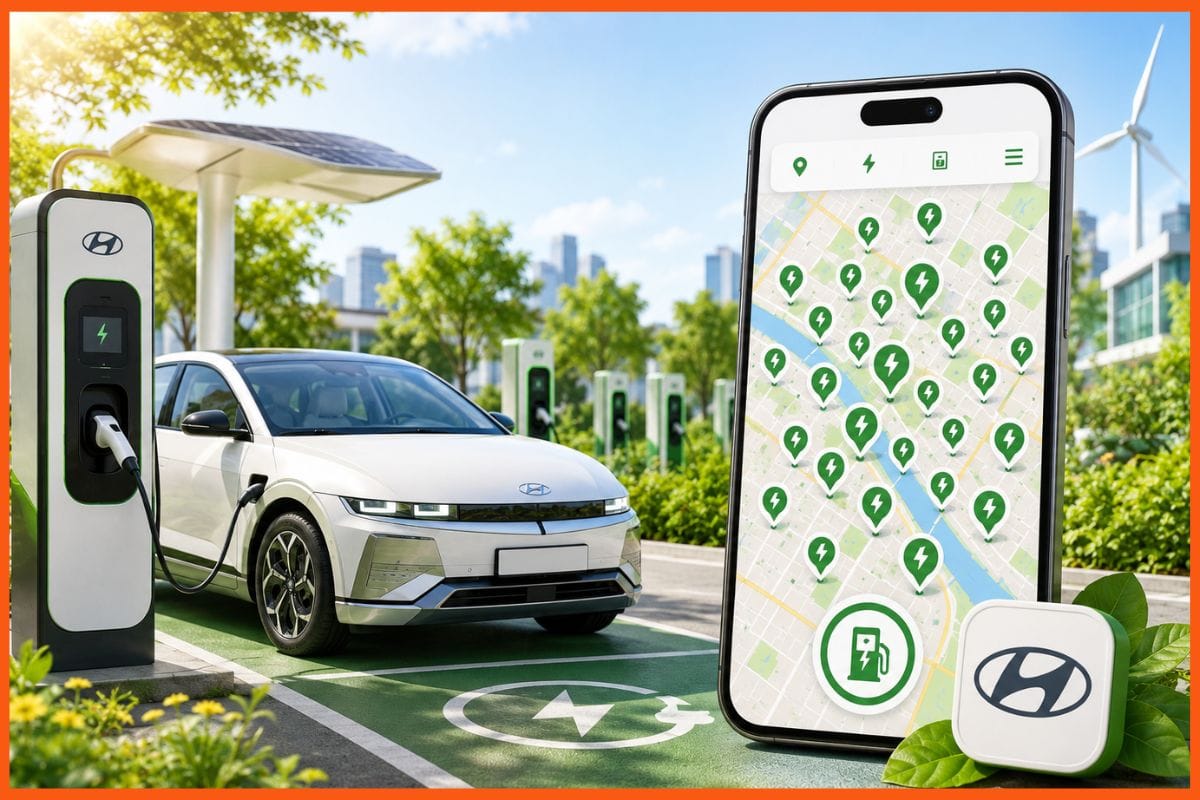
Hyundai is supporting India's electric vehicle (EV) goals by expanding its charging infrastructure. Thanks to the myHyundai app, customers of Hyundai Motor India (HMIL) electric vehicles now have access to over 30,000 charging stations nationwide. Thus, developing a unified platform that houses one of the biggest integrated charging networks in India.
The enhanced network is available to owners of electric vehicles of all brands and was built through collaborations with several Charge Point Operators (CPOs). On top of that, it shows that the corporation is serious about improving India's charging infrastructure. The move came in response to the fact that the availability of charging stations is still a major barrier to the country's rate of electric vehicle adoption.
How myHundai App Operates?
The software simplifies the process of finding and reaching charging stations, making advance reservations for charging times, and making digital payments, all in one place, says HMIL. On average, there are charging stations within 25 km, according to the firm. Additionally, it will make it easier for customers to confidently travel across significant roads from Kashmir to Kanyakumari. This network connects major highways in India, including those leading to and from Delhi, Gurugram, and Jaipur; Bengaluru, Pune, and Mumbai; Bengaluru, Vellore, and Chennai; and Bengaluru, Ratnagiri, and Goa. Hyundai has been and will be investing heavily in its own charging infrastructure in addition to forming relationships with other operators.
With an eye on expanding the network to 600 stations by 2030, the company is now operating 183 DC fast-charging stations throughout 105 cities. In order to facilitate quicker charging and enhance long-distance driving, chargers with capacities ranging from 60 kW to 240 kW are being placed at dealerships, urban centres, and key roads. With charging infrastructure being a critical enabler for electric vehicle adoption in India, Hyundai Motor India's managing director and chief executive officer Tarun Garg stated that the company is dedicated to developing an environment that enables electric mobility to be accessible, practical, and easy for everyone.
The myHyundai app now has more than 30,000 charging spots, giving EV users access to one of the biggest charging networks in India from a single location. Notably, the platform welcomes EV owners from all brands, highlighting HMIL's dedication to expanding India's electric vehicle ecosystem. Additionally, by 2030, the business plans to have 600 stations on its proprietary DC fast public charging network, which is more than treble its current number. This will bring India's charging infrastructure up to par with international norms.
Hyundai Reducing its Carbon Footprints Via Charging Stations
The corporation claims that almost 3.5 million kg of carbon dioxide has been saved because of the use of their charging network. Consequently, encouraging cleaner mobility and decreasing emissions caused by transportation. Additionally, Hyundai's product plan in India is enhanced by the expansion of the charging infrastructure. The company has announced its intention to introduce a new electric SUV to the market this fiscal year. Further, marking its entry into the mass-market electric vehicle segment.
In order to stay ahead of the competition in India's rapidly expanding electric car market, manufacturers are devoting more resources to both the introduction of new vehicles and the development of infrastructure to facilitate their widespread use. In India, the shift to electric mobility is being propelled by factors other than the cars themselves; the most recent push from Hyundai indicates that charging convenience is increasingly crucial.