

India Amends Motor Vehicle Rules to Permit Flex-Fuel Vehicles on E100 Ethanol
India has revised the Central Motor Vehicle Rules, 1989, to allow OEM built flex-fuel vehicles to operate on E85 and E100 ethanol. The Ministry of Road Transport and Highways on 23 October 2026 notified new testing, certification and emission criteria for high-ethanol automobiles.
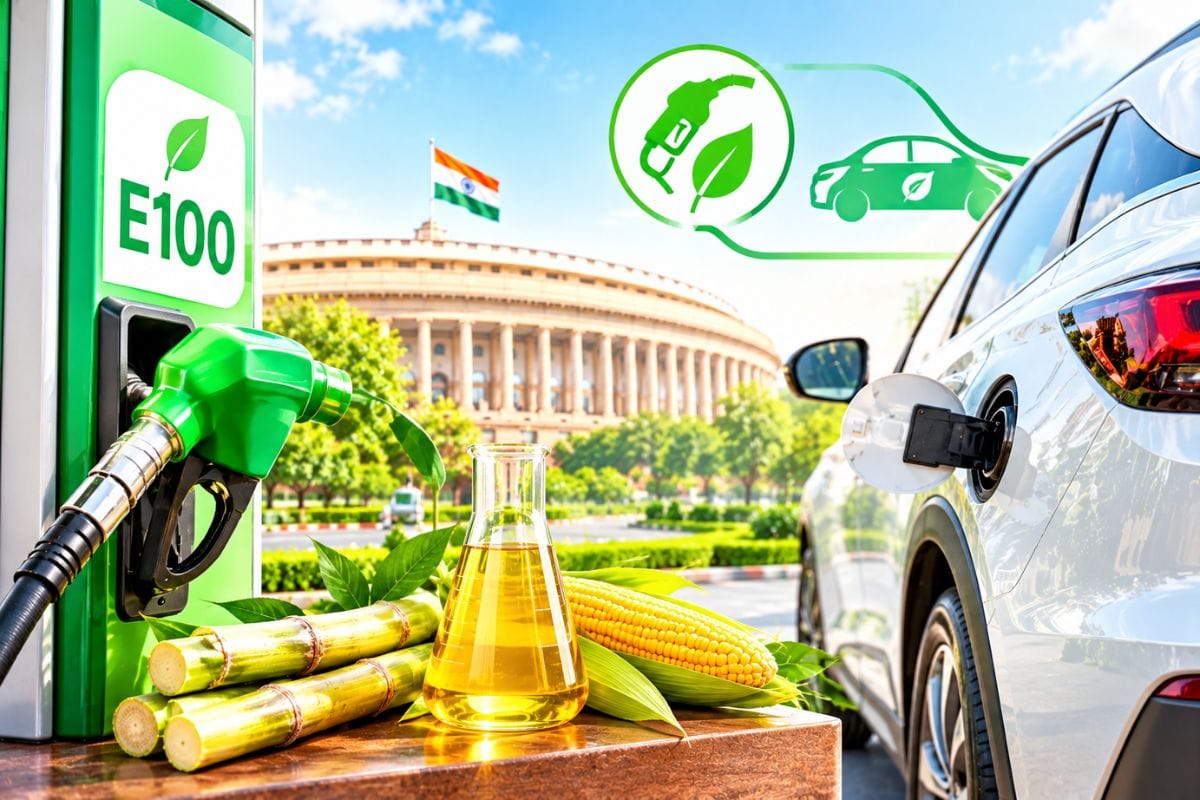
The Central Motor Vehicle Rules, 1989, were officially changed by the Ministry of Road Transport and Highways, formally approving the use of E100 fuel in flex-fuel cars. E100 and E85 are now part of the rule 115-outlined testing methodologies, fuel specifications, and emission criteria as of the formal notification on October 23, 2026. This ruling clears the way for OEMs to sell vehicles that are specifically designed to run on bio-ethanol.
Submissions of the New Framework
Several significant revisions to the Central Motor Vehicles Rules, 1989 have been detailed in an official notification released on October 23, 2026, by the Ministry of Road Transport and Highways (G.S.R. 911(E), File No. RT-11028/06/2025-MVL). There has been an increase from 3,000 kg to 3,500 kg in the gross vehicle weight limit in Table 2, per sub-rule (18)(i). An additional remark has been included clarifying that flex-fuel automobiles manufactured by Original Equipment Manufacturers (OEMs) are the only ones authorised to utilise E85 or E100.
Rule 115 table headings and columns now include references to standardising (B100) biodiesel parameters and (E10)/(E20) petrol mixes, as well as other new information. To make room for high-blend and 100% bio-ethanol testing methodologies, references to (E85) have been consistently changed to (E85) or (E100) throughout various sub-rules ((18), (19), (20), and (22)). Annexure SA has been formally amended from Annexure S as the special documentation tag for E100 automobiles, in accordance with regulation 115E, sub-rule (4).
India Shifting its Fuel Economy from Fossil to Bio-Fuel
India imports crude oil to meet about 88% of its energy needs; this policy extension is an effort to reduce that dependency while making better use of India's local ethanol production capabilities. The adoption of high-ethanol vehicles is in line with national decarbonisation goals to reduce emissions from tailpipes, and it also helps to reduce foreign exchange expenditures.
With the new testing and certification requirements in place, car companies planning flex-fuel passenger and commercial rollouts should release compatible vehicles in the near future. An important milestone in India's Ethanol Blended Petrol (EBP) Programme has been reached. Prior to the initial 2030 aim, the nation has already formally reached its 20% ethanol blending goal (E20) on a national level. In order to meet the base 20% mandate, oil marketing companies (OMCs) issue tenders surpassing 11 billion litres each year. Hence, bringing the total national ethanol production capacity to approximately 2,000 crore (20 billion litres).
A number of nations, India included, are at risk of an energy shortage as a result of the war in West Asia, hence flex-fuel automobiles have become more important. Hyundai Motor Company, Tata Motors, and Toyota Motor Corporation are among the major Indian automakers working on flex-fuel vehicles. Policymakers are taking this action in an effort to lower the cost of importing fossil fuels for the country.