

Why India Diagnoses Child Development Delays Too Late
Indian children are diagnosed with autism at around 4.6 years on average. Parents usually notice something at 26 months, then spend two years and 3.5 clinicians getting an answer. The founders of DeepConnection argue for a developmental screening calendar alongside the vaccination one.
Parents track vaccines to the week. Polio, MMR, hepatitis, each on a fixed schedule, each recorded. A child's speech, motor and social development gets no such calendar. It is left to guesswork and reassurance: he will catch up once school starts, boys talk late.
The consequence shows up in the research. Indian studies put the average age at which a child is diagnosed with autism at around 4.6 years, and in rural areas later still.
But the number that should trouble us more is a different one.
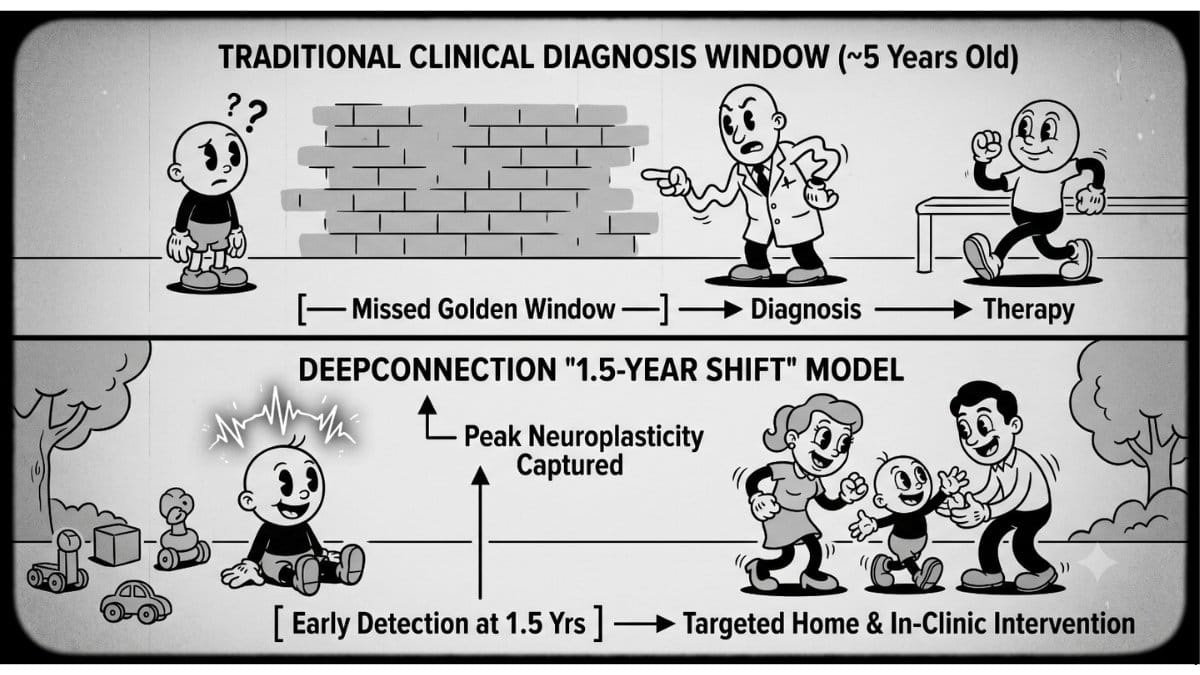
Parents in one Indian study reported first noticing something at about 26 months. They then spent roughly two more years, and consulted an average of 3.5 clinicians, before anyone gave them a reliable diagnosis. The delay is not parents failing to notice. It is a system taking two years to confirm what a mother already suspected before her child turned two and a half.
Why those years specifically
In the first few years of life a child's brain forms more than a million new neural connections every second, according to Harvard's Center on the Developing Child. This is the period of maximum neuroplasticity, when the brain is still laying down its basic architecture rather than working with what it has already built.
Shift detection from five years to eighteen months and the nature of therapy changes. You are no longer remediating an established deficit. You are shaping foundational wiring while it is still forming. That is the whole argument for early screening, and it is a biological one rather than a commercial one.
This is not only an Indian problem
England offers a warning about what happens when demand outruns assessment capacity. NHS figures for June 2026 recorded almost 295,000 people with an open referral for suspected autism, of whom 89.7% had been waiting longer than the 13 weeks NICE recommends. In some parts of the country children wait around three years from referral to diagnosis. For a two-year-old showing early signs, a three-year wait means the window closes before therapy begins.
Having worked in the Gulf before returning to India, we saw the other version of this problem. In Dubai and Abu Dhabi the diagnostic infrastructure exists, but out-of-pocket costs for paediatric therapies run between AED 15,000 and AED 60,000 a year, and insurance policies routinely cap or exclude developmental conditions altogether. Immigrant families end up choosing between the cost and the wait, far from the extended family who would otherwise help.
Long public waitlists in Europe, high private costs in the Gulf, low awareness in India. Three different causes, one identical outcome.
A screening calendar, alongside the vaccination one
Every household already follows an immunisation schedule. Development deserves the same treatment, with a small number of checkpoints parents actually know to look for.
- 6 months: visual tracking, social smiling, response to sound
- 12 months: joint attention, babbling, responding to their own name
- 18 months: functional vocabulary, imitating gestures, sensory processing, gross and fine motor coordination
Eighteen months is the marker that matters most, because it sits inside the window where intervention shapes rather than corrects.
A missed milestone is not a diagnosis and it is not cause for panic. It is a reason to screen. The correct response is to look properly, early, rather than to wait for a preschool teacher to raise it three years later.
What technology can and cannot do here
Our own platform uses multimodal AI, reading behavioural cues, motor patterns and continuous parental input, to act as a triage layer between a worried parent and a clinic. It is not a diagnosis and it is not a substitute for a paediatrician or a paediatric neurologist.
No screening tool is.
What it can do is turn a vague unease into structured observation a clinician can act on, which is precisely the gap that swallowed two years in that study. We are not alone in trying. Gabify raised pre-seed funding this year for AI-led screening and therapy management in speech and neurodevelopmental conditions, and a growing set of Indian healthcare startups are working on paediatric access. That is a good sign, because this problem is far too large for any one company, and the binding constraint is not really software. It is that most parents have never been told what to watch for, or when.
What to do if you are the parent reading this
If you are noticing something in your child's speech, movement or social engagement, the useful step is not to wait and it is not to panic. Note what you are seeing, at what age, and take it to a paediatrician who will screen rather than reassure. Ask specifically for a developmental screen. Write down specific examples rather than general worry: whether your child turns when you say their name, whether they point at something to show you rather than only to ask for it, how many words they use in an ordinary day. Those are the observations a clinician can work with. If the answer is that it is too early to tell, ask when to come back, and put that date in the calendar the way you would a vaccine.
Children are not checkboxes on a clinical form. Moving detection from five years to eighteen months is not a technology story. It is the difference between shaping a brain and repairing one.
Common questions
At what age is autism usually diagnosed in India?
Indian studies put the average at around 4.6 years, later in rural areas. Parents typically report noticing something at about 26 months, meaning roughly two years pass between first concern and diagnosis.
What should be checked at 18 months?
Functional vocabulary, imitation of gestures, sensory processing, and gross and fine motor coordination. Eighteen months is the most useful single checkpoint because intervention at that stage shapes development rather than correcting it.
Can an app diagnose autism or ADHD?
No. Screening tools, including AI-based ones, can flag that a child should be assessed. Diagnosis requires a paediatrician or paediatric neurologist.
Rishi Kant Upadhyay and Monika Sharma are co-founders of DeepConnection Innovation Pvt Ltd and Kiddicove Child Development Centers, which sell developmental screening and therapy services. This article reflects their views. Neural development figures are from Harvard's Center on the Developing Child. NHS referral data is from NHS England, June 2026. Indian diagnosis-age figures are from published studies in Indian medical journals.