TILT Launches ₹250 Crore Impact Fund For India's Next Billion
S4S Technologies was founded in 2008. It reached its Series B in July 2024. Sixteen years, building a food-processing business around women farmers, before a growth round arrived.
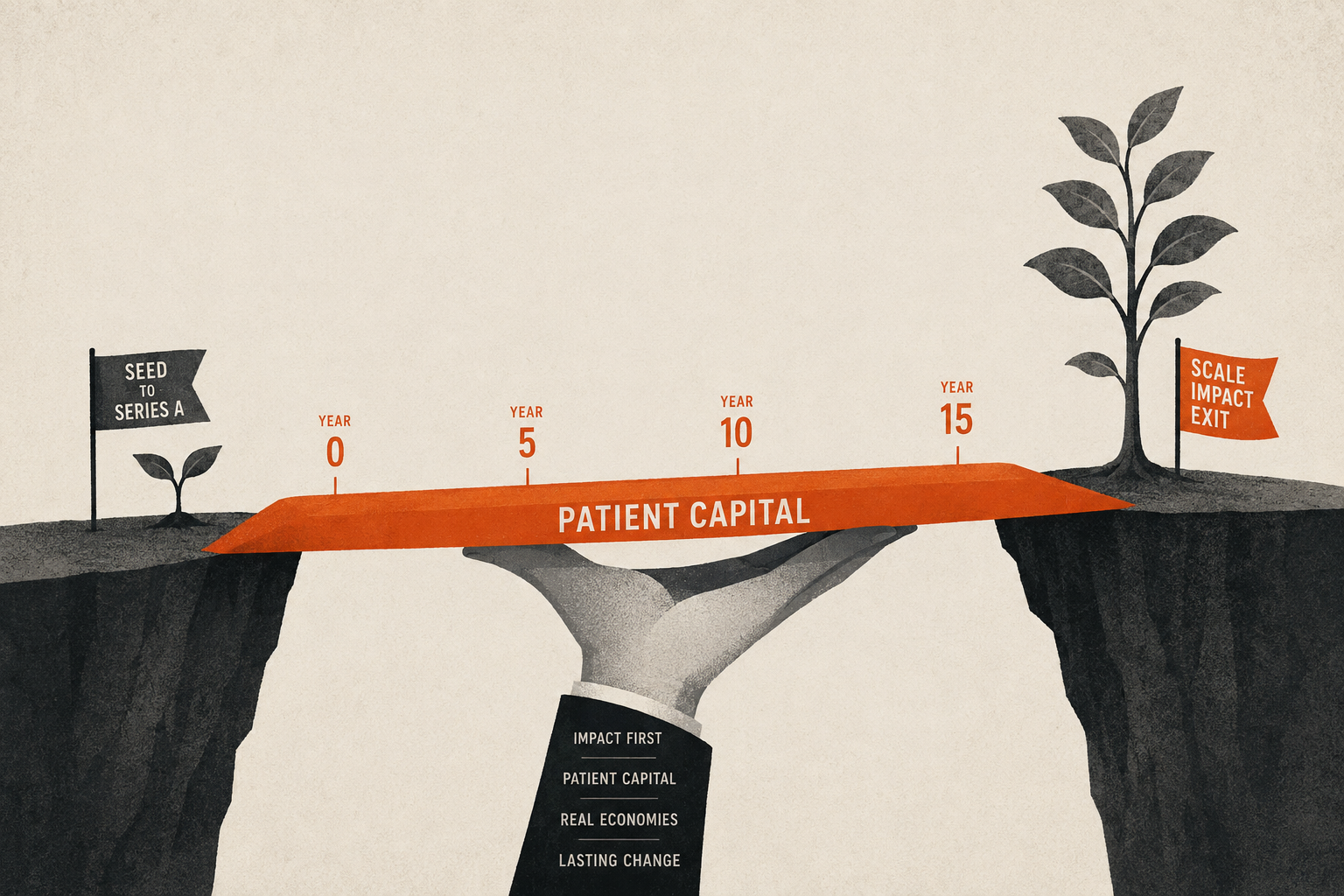
That timeline is the entire argument behind TILT, the impact-first investment platform from The/Nudge Foundation, which on 27 August 2026 announced a ₹250 crore venture fund for early-stage businesses serving what it calls India's Next Billion.
S4S is one of the ventures The/Nudge has supported. So is BioPrime, founded in 2015, which reached Series A in October 2025. Ten years. The fund exists because those timelines do not fit the instrument most investors are holding.
What TILT is putting on the table
The fund invests from seed to Series A, writing cheques of ₹2 crore to ₹16 crore, into science- and technology-led businesses. The stated areas are agricultural value chains, climate resilience, informal work and emerging employment models, MSME productivity, employability, financial inclusion, market access and distribution, and AI applied to livelihood problems.
It is anchored by the Livelihood Impact Fund, with Deep Kalra, Amit Gupta, Hari Menon, Binny Bansal, the Raj and Indra Nooyi Family Office and Vidit Aatrey among the backers. Kalra and Gupta sit on the investment committee, Bansal advises the fund.
The ambition attached to it is a fifteen-year one: back more than 150 startups and improve 100 million lives.
The portfolio already shows the timelines TILT is designing for
Four ventures from The/Nudge's ecosystem have gone on to raise institutional equity, and they have taken about $65 million between them. The interesting column is not the money. It is the years.
| Venture | Founded | Latest round | Years to get there | Total raised |
|---|---|---|---|---|
| S4S Technologies | 2008 | Series B, Jul 2024 | 16 | $21.3M |
| BioPrime | 2015 | Series A, Oct 2025 | 10 | $11.2M |
| EF Polymer | 2018 | Series B, Sep 2025 | 7 | $28.9M |
| Boomitra | 2017 | Series A, Sep 2022 | 5 | $4.0M |
A conventional Indian startup that is going to raise a Series A usually does it within three to five years of starting. Two of these four took ten and sixteen. They got there, and the businesses are real, with S4S last valued at about $54 million. But an investor working to a standard fund life would have struggled to hold either of them for that long.
The rest of the named portfolio is a different picture again. Rocket Learning, Karya, Adalat AI, Takachar and Mitti Café have been funded almost entirely by grants and prize money. Several are structured as non-profits, so that is by design rather than by failure. It does mean that organisations operating at real scale have been built without equity ever entering the picture.
That is the gap in the market TILT is describing, and it is visible in the funding records of the ventures it grew out of.
Why patient capital is a structural claim, not a soft one
Richa Singh, Co-founder and Managing Partner, TILT:
"At TILT, we believe markets move where capital points, and we want to reimagine how impact investing can work in India by directing capital towards opportunities that can create lasting value. India's Next Billion is increasingly ready for scalable market solutions, and our focus is on backing founders early, giving them the time to build resilient models and aligning capital more closely with the realities of the markets and communities they serve."
The operating logic is straightforward once you accept the timeline. Businesses selling to low-income customers take longer to find product-market fit, longer to build distribution into places where distribution is expensive and thin on margin, and longer to reach unit economics that hold without a subsidy underneath them. Mainstream capital tends to arrive once those questions have been answered by somebody else, which is a rational place for it to stand. TILT is proposing to arrive before that point and to accept, in exchange, that the exit sits further out than a conventional fund would tolerate. That is a structural claim about instrument design, not a softer standard of investing.
Atul Satija, Founder and Managing Partner, TILT:
"For the past eight years, The/Nudge has worked alongside hundreds of entrepreneurs building solutions across livelihoods and some of India's most complex challenges. TILT takes that work forward through a dedicated pool of patient, impact-first capital. Over the next 15 years, we aim to back 150+ startups and meaningfully improve 100 million lives. We hope to show what becomes possible when capital is designed around the realities of impact-led businesses."
Eight years of grant-making, turned into a fund
The/Nudge has supported more than 190 livelihoods-focused enterprises and deployed around ₹180 crore in grants, screening over 20,000 applications to do it. Its alumni include more than 20 Forbes 30 Under 30 founders, three Earthshot Prize winners and 18 Acumen Fellows. The portfolio spans agritech, climate tech, education, gig work, health and skilling.
TILT is a separate vehicle, not a rebrand. The/Nudge continues its incubator, accelerator and grand-challenge work. What TILT inherits is the pipeline, which is the part that is genuinely hard to buy.
The team is Satija and Singh as managing partners, with Ankur Sanghai as managing director for investments and Sreevidhya Prasanth as chief compliance officer.
The question I would hold onto is what happens at year eight. A fifteen-year ambition and a seed-to-Series-A cheque are easy to reconcile on day one and harder when the first vintage needs marking. TILT is explicit that it wants capital preservation alongside impact rather than market-rate returns, which is an honest thing to say out loud, and the number that will tell you whether it worked is not how many startups it backs but how many reach a round it did not have to lead.
Fund size, cheque range, sector focus, track-record figures and quotes come from TILT's announcement and media factsheet. Founding years, funding rounds and valuations for the portfolio ventures come from Tracxn, retrieved 27 August 2026. Where the announcement and factsheet gave different figures, the more conservative one is used here.