Purple Style Labs IPO: What the RHP Discloses on Losses, Litigation and Related-Party Deals

Buried in Note 62 of Purple Style Labs' restated financials is a sentence most readers will skip past: as of March 31, 2026, the company's current liabilities exceeded its current assets by ₹255.12 crore. That is a working capital gap, and it sits right next to a net loss that nearly doubled to ₹285.4 crore for the year. Neither number is hidden. Both are sitting in the RHP, in the company's own words, because SEBI requires this level of disclosure from every IPO-bound company.
Here is what three years of restated financials, an auditor's note, and a litigation annexure actually say about Purple Style Labs, and what they don't.
Purple Style Labs stayed EBITDA-positive in all three fiscal years under review, even as its net loss widened to ₹285.4 crore in FY2026, a gap that points to items below the operating line, not the core retail business, as the real driver of the loss.
Purple Style Labs' Revenue and Loss Trend, FY2024 to FY2026
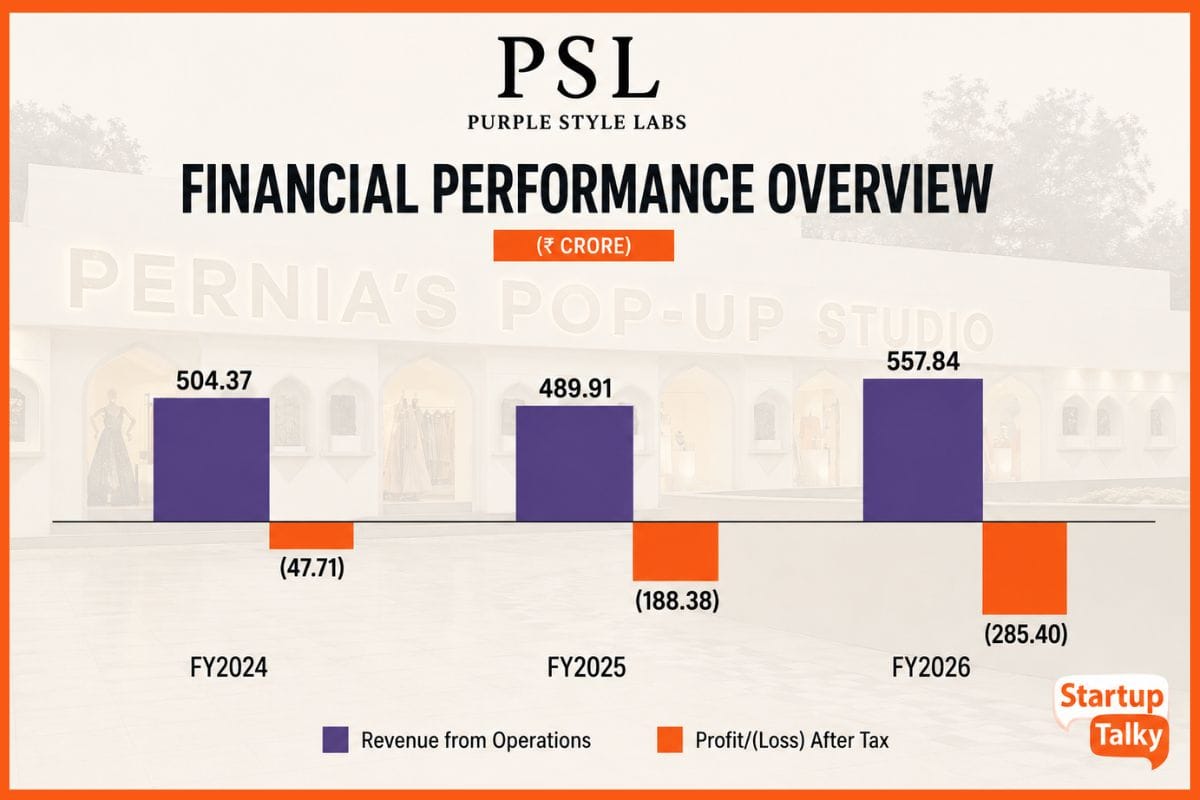
The restated consolidated numbers show an uneven revenue path alongside a widening loss.
| Particulars (₹ crore) | FY2024 | FY2025 | FY2026 |
|---|---|---|---|
| Revenue from operations | 504.37 | 489.91 | 557.84 |
| EBITDA | 31.63 | 41.99 | 30.37 |
| EBITDA margin | 6.27% | 8.57% | 5.44% |
| Profit/(loss) after tax | (47.71) | (188.38) | (285.40) |
| Basic and diluted EPS (₹) | (7.46) | (29.00) | (41.98) |
Revenue grew 13.9% year-on-year to ₹557.84 crore in FY2026, recovering from a dip the year before, while the net loss nearly doubled. What I find more telling than the loss itself is that EBITDA stayed positive across all three years. That means the widening bottom line isn't a story about stores losing money on the shop floor. It's a story about what sits below EBITDA.
Why Purple Style Labs' FY2026 Loss Looks Worse Than the Business Actually Is
Two line items explain most of the gap between a modest EBITDA and a ₹285 crore net loss, and the RHP names both directly.
- Finance costs of ₹97.09 crore in FY2026, up from ₹52.97 crore the year before, largely lease-related interest as the company added more Experience Centers and shifted toward larger-format stores.
- An exceptional item of ₹117.93 crore in FY2026 and ₹122.77 crore in FY2025, which the RHP's cash flow statement ties to share-based payment expense. That's a non-cash accounting charge tied to employee stock options, not money leaving the business.
Share-based payment expense attributable to directors and KMPs alone came to ₹58.07 crore in FY2026. Read the headline loss number with that in mind. It isn't a clean read on how the retail business is actually performing.
The Working Capital Gap: Purple Style Labs' Note 62 Explains
This is the part of the filing that a quick skim of the P&L will miss entirely. Note 62 to the restated financials discloses that Purple Style Labs' accumulated losses stood at ₹710.29 crore as of March 31, 2026, up from ₹424.25 crore a year earlier and ₹235.73 crore the year before that. More specifically, current liabilities exceeded current assets by ₹255.12 crore as of March 2026, and by ₹43.84 crore as of March 2024. FY2025 was the outlier, with current assets actually exceeding current liabilities by ₹25.60 crore.
| Particulars (₹ crore) | FY2024 | FY2025 | FY2026 |
|---|---|---|---|
| Accumulated losses | 235.73 | 424.25 | 710.29 |
| Current assets vs current liabilities | Deficit of 43.84 | Surplus of 25.60 | Deficit of 255.12 |
The RHP doesn't leave this hanging. Note 62 gives two separate justifications for preparing the accounts on a going concern basis, and they support two different things, not one combined argument. First, on revenue: the company opened new stores in Mumbai, Delhi and New York and expanded existing ones in Kolkata and Surat during FY2026, and management says these store initiatives specifically are expected to increase revenue and profitability in the coming years. Second, on liquidity: the company raised ₹411.30 crore in debt during FY2026, plus a further ₹137.37 crore between April 1 and June 17, 2026 after the reporting year closed, and expects to raise more as needed.
The RHP ties that debt to a narrower claim, that management believes the company will be able to meet its liabilities as they fall due, which is the specific basis for the going concern conclusion, not a claim about profitability. That's the company's own justification, not an auditor's finding, and it's worth reading in full if you're deciding whether to trust it.
What Purple Style Labs' Auditors Actually Said
Purple Style Labs changed one of its two joint statutory auditors partway through the three-year period covered here. Walker Chandiok & Co LLP audited all three years. Alongside it, Kedia & Agrawal was the joint auditor for FY2024 and FY2025, before Shah & Kathariya took over as the second joint auditor for FY2026. Both sets of auditors issued unmodified opinions on the restated financials, meaning no qualification, no adverse opinion, no disclaimer.
The RHP does carry an "Emphasis of Matter" note, but it says something narrower than it sounds. It clarifies that the underlying special-purpose financial statements, for the company and separately for its US subsidiary, were prepared solely for this RHP filing and shouldn't be used for any other purpose. That's a standard disclosure for IPO-bound companies, not a comment on accounting treatment or going concern.
Separately, the RHP discloses a goodwill impairment of ₹1.28 crore in FY2025, tied to two in-house brands, Hemant Trevedi and Wendell Rodricks, that the company decided to stop retaining after their revenue declined. The company states this did not have a material adverse impact on its business.
Purple Style Labs' Litigation, by Category
The RHP sets its materiality threshold for disclosing litigation at 2% of FY2026 net worth, which works out to roughly ₹1.05 crore, unusually low given the company's net worth is currently negative.
| Category | Against the company | Against directors | Against promoter | Against subsidiaries |
|---|---|---|---|---|
| Criminal | Nil | 4 matters (3 involving Non-Executive Director Harminder Sahni; 1 involving Independent Director Hrishikesh Bhalchandra Parandekar) | 1 matter, linked to the subsidiary matter at right | 1 matter, pending before the Chief Judicial Magistrate, Lucknow, against PSL Retail and promoter Abhishek Agarwal jointly, under the Legal Metrology Act |
| Regulatory or statutory action | 3 show-cause notices (Legal Metrology Department, Dehradun, Roorkee and Almora, all e-commerce disclosure compliance, all pending, no penalty amounts quantified) | Nil | Nil | 3 show-cause notices (Legal Metrology Department, Lucknow and Gautam Budh Nagar); the Lucknow one has since escalated to the criminal matter at left, with a hearing listed for August 27, 2026 |
| Material civil | Nil | 4 matters involving Non-Executive Director Rahul Garg, all arising from his past directorship at Future Retail Limited, ranging from ₹3.61 crore to roughly ₹14,809.4 crore (the larger figure is the total resolution-process claim, not an amount specifically against Garg) | Nil | Nil |
Separately, PSL Retail has filed eight FIRs over alleged theft from its Experience Centers, totalling ₹1.30 lakh, plus one further complaint over a single garment worth ₹9,000 that's now in mediation.
None of this is specific to Purple Style Labs. Every mainboard IPO carries some version of this annexure, e-commerce labelling notices, a director's past board seat at a company that later went through insolvency, small-value theft FIRs. None of it has been flagged by the company as likely to materially affect its business, and nothing in the annexure changes that read.
Purple Style Labs' Related-Party Transactions and Designer Brand Concentration
Director and KMP remuneration in FY2026 ranged from ₹0.15 crore to ₹0.84 crore across individuals, the highest going to Whole-Time Director and Chief Business Officer Abhinav Agarwal. Short-term borrowings from Whole-Time Directors Abhishek Agarwal and Abhinav Agarwal were fully repaid within the same year in each instance, and the company paid professional charges to Wazir Advisors Private Limited, a firm where a director also holds a directorship. None of it stands out against the company's overall expense base.
The bigger concentration sits on the supply side. The RHP doesn't disclose customer concentration, unsurprising for a platform selling to a broad individual customer base, but it does disclose vendor concentration: the top 10 Designer Brands accounted for 30.24% of total platform GMV in FY2026, up from 26.54% in FY2025 and 23.44% in FY2024. That's a rising number, and it matters more than usual here since Purple Style Labs' agreements with its Designer Brands are non-exclusive, meaning any of those top 10 could walk to a competing platform.
A Balanced Read of Purple Style Labs' Disclosures
Everything above comes from the company's own regulatory filing, the same disclosure standard SEBI applies to every mainboard IPO. Show-cause notices, a director's unrelated past litigation, routine related-party dealings- none of that is a signal that Purple Style Labs is unusually risky on its own. The operating picture is the part worth sitting with: three years of losses, a working capital deficit as of the most recent year-end, and heavy reliance on lease-funded store expansion, set against EBITDA that has stayed positive throughout and revenue growth that resumed in FY2026. Both things are true at once, and the RHP doesn't resolve which one matters more to your decision. That's yours to weigh.
 Muskaan Kapoor