What Quick Commerce Actually Costs D2C Brands
Blinkit, Zepto, and Instamart quote 15-25% commission. The real cost once listing fees, mandatory ad spend, and unsold-inventory returns are added runs closer to double that. Here's who the channel actually works for.
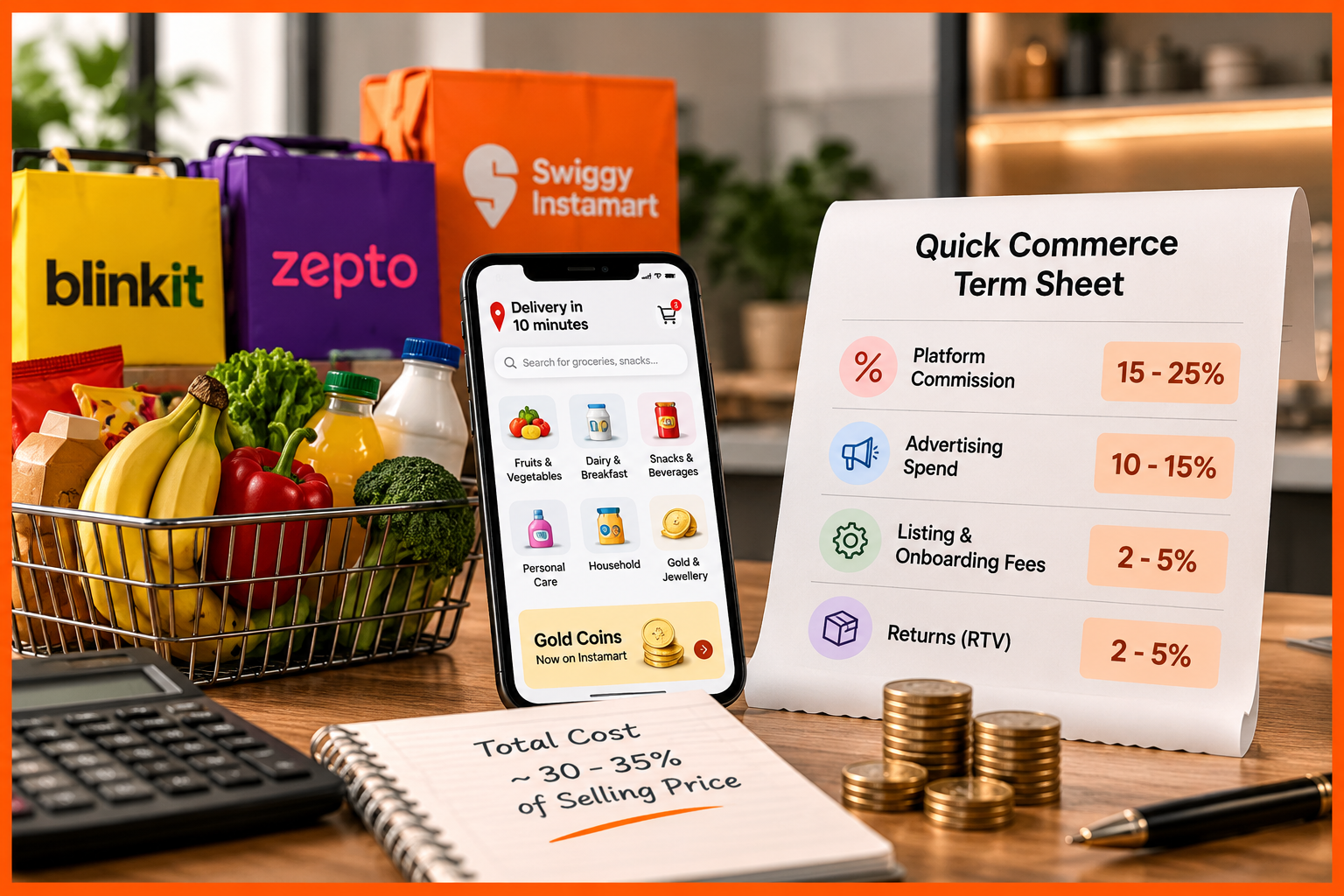
The commission line in a quick commerce term sheet is the smallest number on the page.
Quick commerce platforms, now adding categories as varied as gold coins alongside groceries, typically quote brands 15-25% commission on selling price. That's the headline figure founders compare against general trade or Amazon. It's also the one that matters least, because platforms now earn more from advertising than most brands budget for, and that spend has quietly become close to mandatory for a product to show up in search at all.
The real cost stack
A brand selling on Blinkit, Zepto, or Instamart is actually paying across four separate lines, not one:
| Cost | What it looks like |
|---|---|
| Base commission | 15-25% of selling price |
| Listing fees | Flat per-SKU charges, reported as high as ₹25,000 per SKU per state on some platforms |
| Mandatory ad spend | Quarterly ad-wallet commitments reported in the ₹8-10 lakh range for meaningful visibility |
| RTV (return to vendor) | Unsold stock returns to the brand after a fixed window, no shared risk with the platform |
Add commission and ad spend together and brands are commonly looking at 30-35% of selling price gone before a single rupee of COGS, according to agency and industry estimates. That's before packaging, logistics into dark stores, and the working capital tied up in inventory sitting on a shelf waiting to sell or bounce back.
Why the ad spend isn't really optional
Quick commerce platforms collectively pull in roughly ₹3,000-3,500 crore a year from advertising, now 9-11% of total platform revenue, with ad rates up more than 40% in the past year alone and doubling further during festival or cricket-season windows.
Devangshu Dutta, founder of retail consultancy Third Eyesight:
"As platforms scale their ad businesses to expand margins, ad load goes up and organic visibility declines."
That's the mechanism in one sentence. The more a platform leans on ads for revenue, the less a brand's product shows up for free, which pushes brands to spend on ads just to maintain the visibility they used to get for nothing. Brands are now routinely allocating 15-20% of their entire digital marketing budget to quick commerce alone, treating it less like a sales channel and more like a paid search engine with a 10-minute checkout.
Who actually carries the risk
RTV is the part that gets the least attention and does the most damage to a smaller brand. Platforms accept zero inventory risk: whatever doesn't sell in the return window comes straight back to the brand, packaging and all, while the brand has already paid listing fees and ad spend regardless of whether the product moved.
For a brand without credit facilities or deep working capital, that combination, upfront fees plus unsold stock bouncing back, is the actual trap. It isn't the commission rate. It's capital getting locked into dark-store shelves across dozens of cities with no guarantee any of it converts to cash.
The filter: who this actually works for
Industry estimates put the real threshold at 70% gross margin before this channel turns profitable, not just a nice-to-have cushion. That rules out most mass-market FMCG categories immediately and explains why the brands that talk about quick commerce as a genuine growth channel, not a trap, cluster in a narrow band: beauty, personal care, and premium snacking, categories with pricing power and high per-unit margin to begin with.
Conscious Chemist, a D2C skincare brand live on Blinkit, Instamart, and Zepto, reported 3X growth in its quick commerce segment, the kind of outcome the 70% margin threshold predicts for the right category. A low-margin packaged food brand running the same playbook is solving a fundamentally different, much harder equation.
The smarter framing
Veeba founder Viraj Bahl, whose own condiments brand gets just 8-10% of revenue from quick commerce against 70%+ from general trade, offered the framing that cuts through most of this at a recent industry summit. I think it's the single most useful sentence any founder weighing this channel could read:
"Use earnings from quick commerce to fund scale across margin-rich general trade."
That treats quick commerce as a cash and visibility engine for a bigger strategy, not the strategy itself. Sauce.vc's Manu Chandra made the complementary case for why it's worth doing at all: the channel offers clearer inventory visibility and faster payments than traditional distribution, real operational advantages that don't show up in a margin spreadsheet.
India's quick commerce market crossed $7 billion in GMV in 2025 and is on track for $14 billion by 2027, growing around 70% a year. That growth is real, and it's not going to slow down for brands that haven't done the margin math first. The platforms aren't hiding the costs. They're just not the number in the first line of the term sheet.
If you have information related to this story, contact us through StartupTalky's tips line. Anonymity is the default.