

SecureDApp’s Approach to Trust: Abhishek Singh on Scaling Blockchain Security
👨💻 StartupTalkers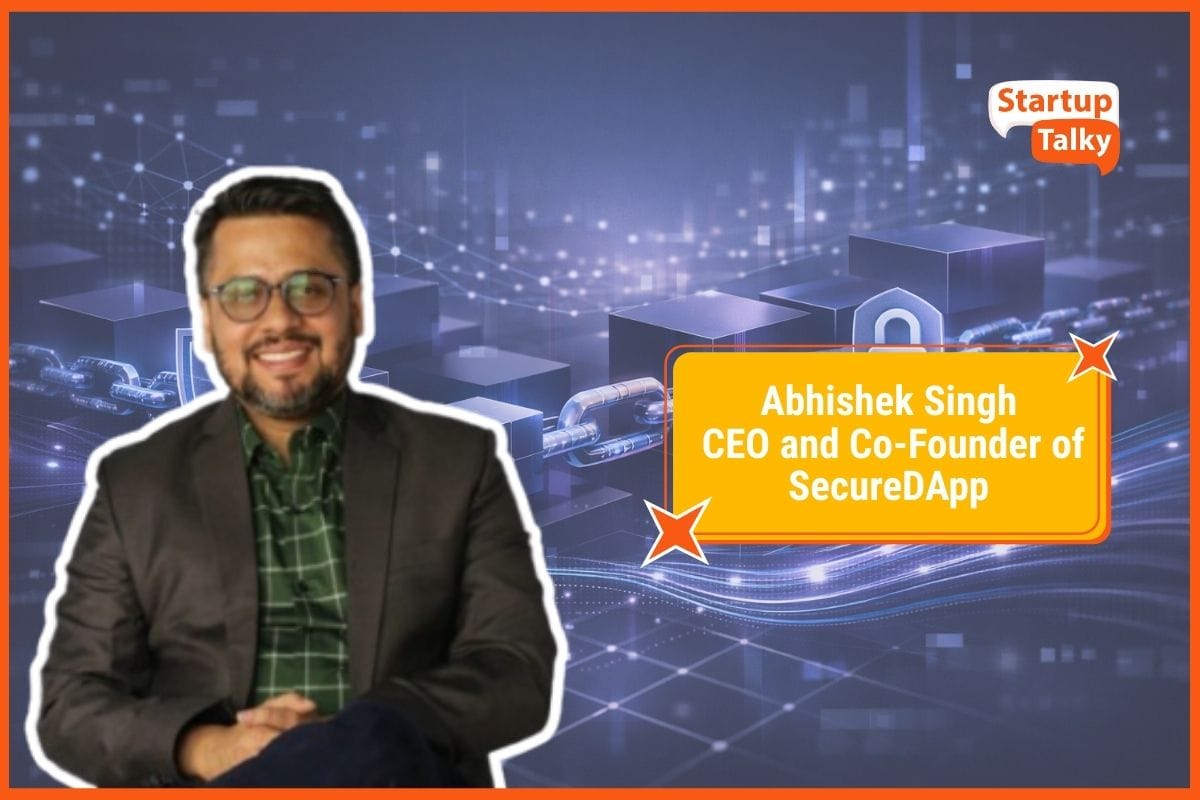
StartupTalky presents Recap'25, a series of exclusive interviews where we connect with founders and industry leaders to reflect on their journey in 2025 and discuss their vision for the future.
In this edition of Recap’25, StartupTalky speaks with Abhishek Singh, CEO and Co-Founder of SecureDApp, who reflects on a pivotal year shaped by the growing maturity of Web3, rising on-chain threats, and a fundamental shift in how blockchain security is perceived. Singh shares how real-world exploits after deployment exposed the limits of one-time audits, why continuous monitoring has become critical for user trust, and how AI-led tools like SecureWatch and Solidity Shield are redefining smart contract security. He also discusses the blockchain projects that drove the highest security demand in 2025, emerging vulnerability trends across DeFi and cross-chain systems, and SecureDApp’s vision for building scalable, trust-first security infrastructure in 2026—offering clear insights for founders navigating an increasingly complex decentralised ecosystem.
StartupTalky: Tell us what SecureDApp does and how your services help companies operating in the web3 and blockchain space stay secure.
Abhishek Singh: SecureDApp is a blockchain security solutions company for any project operating in the decentralised space. At SecureDApp, we help Web3 and blockchain companies protect their applications and users at every stage of their journey, from initial development to long after launch. Security isn’t just a checklist for us; it’s about embedding a culture of trust and resilience into every project we touch.
Before a project goes live, we work closely with teams to audit their smart contracts and architecture. One of our key solutions, Solidity Shield, utilises AI-powered analysis to detect over 150 types of vulnerabilities, ranging from reentrancy issues to unchecked transfers. This ensures contracts are secure, optimised, and compliant, giving teams the confidence to launch safely.
Once contracts are live, the landscape changes to real users, real value, and constantly evolving threats. That’s where our SecureWatch, the patented technology of SecureDApp, comes in. It provides continuous on-chain monitoring, alerts teams to unusual activity in real time, and helps prevent minor issues from escalating into major incidents. Combined with post-incident analysis and ongoing guidance, it enables projects to maintain strong, scalable security practices over time.
In short, SecureDApp acts as a long-term security partner, safeguarding users, assets, and trust throughout the full lifecycle of Web3 applications. While Solidity Shield addresses smart contract security, SecureWatch ensures continuous protection. Together, they form part of a broader ecosystem of solutions tailored to meet every client’s unique security needs.
StartupTalky: What inspired you to start SecureDApp, and what gaps or risks in blockchain security did you notice that led you to build the company?
Abhishek Singh: SecureDApp was born from seeing the same pattern repeat itself across Web3 projects, teams were building fast, shipping innovative ideas, and assuming that a one-time audit would be enough to keep them safe. But in reality, many serious incidents were happening after launch, when contracts were already live and holding real value.
The inspiration came from watching good projects suffer avoidable losses, not because the teams were careless, but because the security model itself was incomplete. Blockchain systems don’t behave like traditional software. Once something is deployed, it can’t simply be patched quietly in the background. Any small oversight can turn into a permanent, on-chain problem.
We also noticed a gap between how developers think about security and how attackers operate. Most security efforts focused on static checks before launch, while attackers were actively monitoring live contracts, waiting for the right moment to exploit edge cases, upgrades, or unexpected interactions.
That realisation shaped SecureDApp’s direction. The goal wasn’t just to find bugs before launch, but to help teams stay secure after launch, when the real risk begins. SecureDApp was built to close that gap by combining strong pre-launch audits with continuous, real-time monitoring so security becomes an ongoing responsibility, not a one-time checkbox.
At its core, SecureDApp started from a simple belief: Web3 can’t scale on innovation alone. It needs security systems that evolve alongside the applications they protect, and a mindset that treats user trust as something that must be actively earned and protected every day.
StartupTalky: In 2025, which types of blockchain projects or smart contracts saw the highest demand for your audits, and what trends did you notice in vulnerabilities or security needs?
Abhishek Singh: In 2025, we saw that projects handling high-value transactions and complex interactions were driving the most demand for audits. DeFi platforms like lending protocols, decentralised exchanges, and yield aggregation systems were at the top of the list. These applications often involve multiple interconnected smart contracts, which makes them powerful but also highly sensitive to errors or exploits. Teams increasingly recognised that even small vulnerabilities could have massive financial and reputational consequences.
Cross-chain bridges and Layer‑2 solutions were also seeing a lot of attention. Moving assets or messages across networks introduces new complexities, and developers want assurance that these interactions are safe under real-world conditions.
In terms of vulnerabilities, traditional issues like reentrancy or improper access control remain common, but the bigger trend we noticed is a rise in logic-level flaws, oracle manipulation risks, and subtle edge cases that only appear under specific user interactions. There’s also a growing expectation that audits aren’t just a one-time check before launch; they need continuous monitoring and post-deployment vigilance to keep up with evolving threats.
In short, security in 2025 is about thinking long-term, building resilience into code, and ensuring trust for users from day one and well beyond.
StartupTalky: SecureDApp goes beyond initial audits by offering ongoing protection. What are the key features or approaches that make your security solutions different from other blockchain audit providers?
Abhishek Singh: What sets SecureDApp apart is our belief that security doesn’t end at deployment. Many providers treat an audit as a one-time milestone: you hand over your code, get a report, and that’s it. In Web3, that approach simply isn’t enough. Once your smart contracts are live, they’re operating in a constantly evolving, adversarial environment.
Our solutions, like SecureWatch, are designed for continuous, real-time monitoring. SecureWatch, which is the patented technology of SecureDApp, doesn’t just alert teams when something unusual happens, it understands behaviour patterns, tracks anomalies across multiple chains, and even offers features like Auto-Pause to prevent suspicious transactions from escalating.
Then there’s Solidity Shield, which ensures contracts are robust before launch by scanning for over 150+ types of vulnerabilities, while SecureTrace and SecureX-DID provide deep forensic insights and decentralised identity protections. Together, they form a holistic security ecosystem that supports projects from development to long-term operation.
What really differentiates us is our philosophy: security should enable innovation, not slow it down. Teams can build and ship confidently, knowing there’s an active layer of protection watching over their assets and users around the clock. It’s this combination of pre-launch rigour, post-deployment vigilance, and actionable intelligence that makes SecureDApp different from any traditional audit provider.
StartupTalky: Smart contracts are complex and constantly evolving. How does SecureDApp ensure accuracy and trust while keeping up with new blockchain technologies and potential threats?
Abhishek Singh: Smart contracts are living pieces of software; they’re immutable once deployed, yet they operate in a dynamic environment with new integrations, protocols, and attack vectors emerging constantly. At SecureDApp, we approach this challenge on multiple levels.
First, our solutions combine automation with human expertise. Tools like SecureWatch continuously monitor on-chain activity in real time, spotting anomalies, unusual transaction patterns, or role misuse. AI and machine learning help us scale this monitoring across dozens of chains, processing thousands of transactions per second. But AI alone isn’t enough. Our security researchers validate critical alerts, analyse complex business logic, and interpret economic and behavioural risk factors that machines can’t fully understand.
Second, we invest heavily in R&D and ecosystem engagement. We study emerging blockchain technologies, Layer‑2 solutions, cross-chain protocols, and governance models so our tools and audit methodologies evolve alongside the ecosystem. This proactive approach helps us anticipate potential threats before they become real-world exploits.
Finally, we design our processes for transparency and trust. When we flag issues, we provide severity classifications, detailed context, and actionable guidance. Teams know exactly what’s happening, why it matters, and how to respond. Accuracy isn’t just about finding vulnerabilities; it’s about giving teams confidence to act decisively, knowing our assessments are grounded in rigorous analysis and real-world understanding.
In essence, we treat security as a continuous, evolving discipline: combining smart automation, expert judgment, and deep ecosystem knowledge to ensure projects remain trustworthy, resilient, and safe, no matter how fast the blockchain landscape changes.
StartupTalky: What was the biggest challenge your team faced in 2025, whether technical, operational, or market-related, and how did you overcome it?

Abhishek Singh: In 2025, our biggest challenge was building trust at scale in a market moving faster than its security maturity.
Technically, threats in Web3 evolved rapidly, from sophisticated smart contract exploits to identity-led fraud, often outpacing standardised security benchmarks. Operationally, we were scaling a deep-tech team while ensuring audit quality was never diluted. Market-wise, many projects still view security as a compliance checkbox rather than a business enabler.
We addressed this by staying grounded in first principles. We doubled down on product-led security, strengthening platforms like SecureWatch and SecureX-DID, while investing heavily in research, automation, and internal review rigour. Equally important, we shifted our communication from fear-driven narratives to trust and credibility-driven conversations, helping founders and enterprises see security as a growth catalyst.
The outcome was clarity, resilience, and stronger long-term partnerships—exactly what SecureDApp was built for.
StartupTalky: Based on your experience in blockchain security, what is one practical piece of advice you would share with other founders or developers launching web3 projects?
Abhishek Singh: If I had to give one piece of advice, it would be this: treat security as a continuous commitment, not a one-time checkbox. In Web3, smart contracts are immutable once they’re live; you can’t just patch them like a traditional app. That means every design decision, every integration, every dependency has to be considered through the lens of risk and resilience.
Founders and developers often focus on getting to launch, which is understandable, but that mindset leaves blind spots. The projects that thrive are the ones that plan for ongoing monitoring, implement robust operational security, and build layered defences from day one. Tools like SecureWatch or Solidity Shield aren’t just optional; they’re part of a discipline that ensures your contracts remain safe even as usage scales, new attack vectors emerge, or market conditions change.
In short, launching fast or slow doesn’t matter, but protect continuously. Security should enable innovation, not slow it down, and the sooner you embed it into your culture and workflow, the more resilient and trustworthy your project will be.
StartupTalky: Looking ahead to 2026, what are SecureDApp’s key priorities or new offerings to stay ahead in blockchain security and smart contract auditing?
Abhishek Singh: As we move into 2026, our focus is on anticipating the next wave of Web3 innovation, not just reacting to threats. The ecosystem is becoming increasingly complex—more chains, cross-chain protocols, DeFi composability, and Layer‑2 scaling solutions are creating both opportunities and new security challenges.
Our priorities are threefold. First, continuous innovation in product R&D. SecureWatch, our patented post-deployment monitoring solution, will expand to cover more blockchains with smarter anomaly detection and automated response features. Solidity Shield will continue evolving to provide deeper logic-level audits and contextual insights for increasingly sophisticated contracts.
Second, identity and compliance. SecureX-DID is central to this vision, enabling privacy-preserving, decentralised identity verification that scales across enterprises and applications. We see identity as a foundational layer of trust—critical for developers, users, and regulators alike.
Third, we aim to make security accessible at every stage of growth. From small startups to large enterprises, teams should be able to adopt enterprise-grade protections without heavy overhead, integrating seamlessly into their workflow.
Ultimately, 2026 is about proactive, multi-layered security: empowering teams to innovate confidently while ensuring users, assets, and data remain safe. Our goal is to make SecureDApp the invisible backbone of trust across Web3, much like SSL certificates for the web, so users can interact safely without thinking about security, and builders can ship with confidence. Building from India for the world remains core to our growth philosophy going forward.
Explore more Recap'25 interviews here.