Shark Tank India's Real Scoreboard: Almost Everyone Grew. Almost Nobody Makes Money
We pulled the financials of 500+ companies tied to Shark Tank India. The pitch was never the hard part. The profit is.
Most of the brands that walked onto Shark Tank India are bigger today than they were three years ago. That much is true, and it is the part everyone already believes.
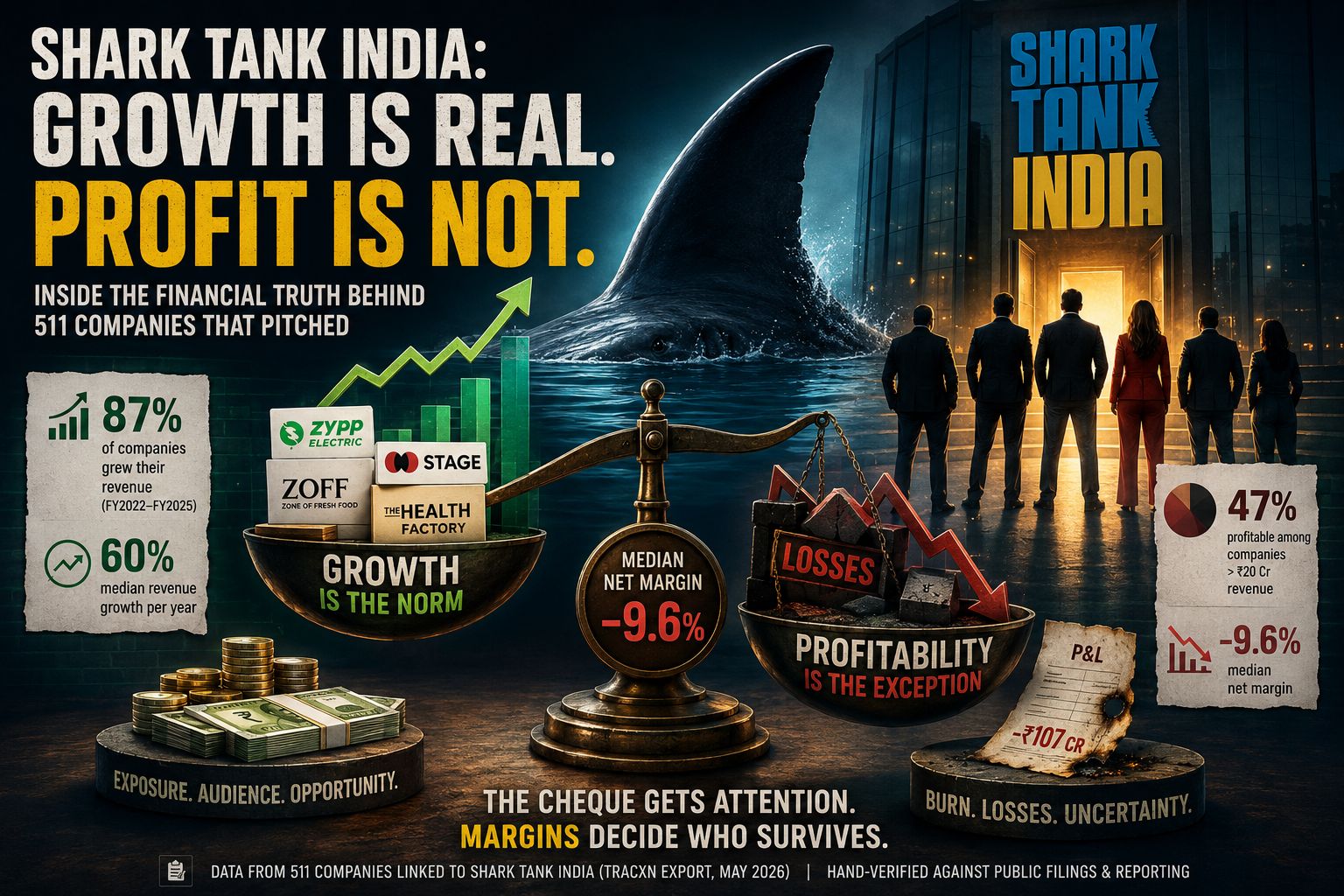
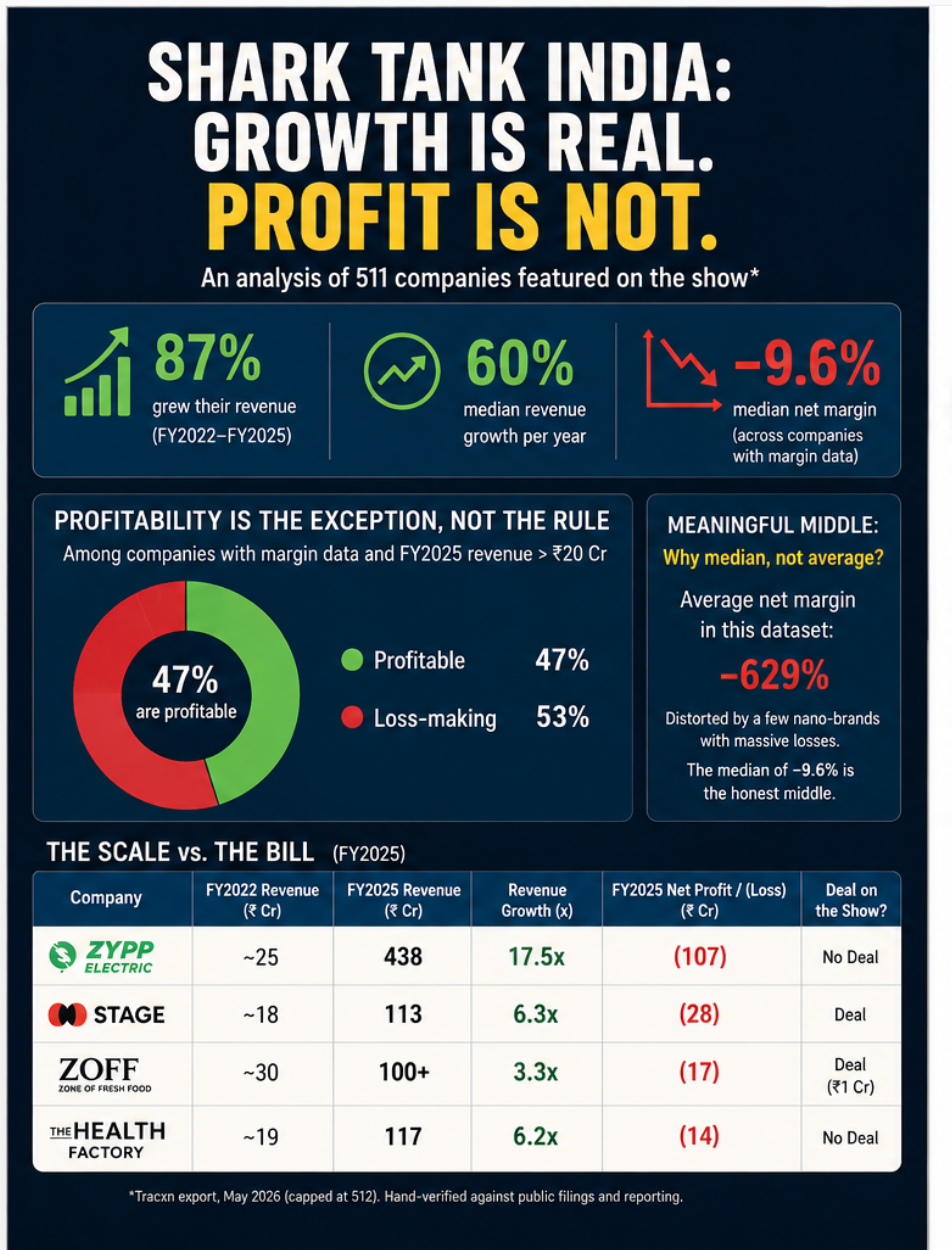
Here is the part nobody shows you. Of the companies with comparable revenue on both ends (239 of them), roughly 87% grew their topline between FY2022 and FY2025, at a median pace of about 60% a year. Growth is the norm. Profit is not. Across the companies with margin data, the median net margin is −9.6% — and even if you throw out the tiny brands and look only at companies clearing ₹20 crore in revenue, fewer than half (47%) make money. The TV cheque, the handshake, the valuation that flashes on screen — none of it settled the question that actually decides who survives. That question is margin, and most of these companies still haven't answered it.
A note on method, because it matters here. We started from the whole sample, not from a list of interesting names — measuring the medians and the spread first, then pulling out companies only to show what the aggregate already proves. We use the median throughout, not the average: the average margin in this data is a nonsensical −629%, dragged there by a few nano-brands losing many times their revenue. The median is the honest middle. We went through a dataset of 511 companies linked to the show (Tracxn, exported May 2026 — an export Tracxn capped at 512, so a large sample, not the entire universe), then hand-verified the headline numbers for every company named below against public filings and reporting. Several raw figures turned out to be company projections rather than audited actuals; we flagged those and used the verified numbers instead.
The growth is real, the profit isn't
Start with the brand that scaled the hardest: Zypp Electric, the EV delivery-fleet company. Revenue went from about ₹25 crore to ₹438 crore in FY25. That is a genuine scale story. It is also a company that lost ₹107 crore in the same year. Zypp pitched on Season 1 and, for the record, walked away without a deal.
That pattern repeats at the top of the table. STAGE, the regional-language OTT platform, grew revenue sixfold to ₹113 crore in FY25 — and posted a ₹28 crore loss. ZOFF, the spice brand that took ₹1 crore from Aman Gupta, crossed ₹100 crore in revenue and slipped into a ₹17 crore loss doing it.
Across the full dataset, the median net margin sits at roughly −10%. The biggest names aren't the exception to that — they're the clearest example of it. Growth was bought, not earned, and the bill shows up on the loss line.
The companies that quietly figured it out
The more interesting list is the short one: the brands that grew and made money.
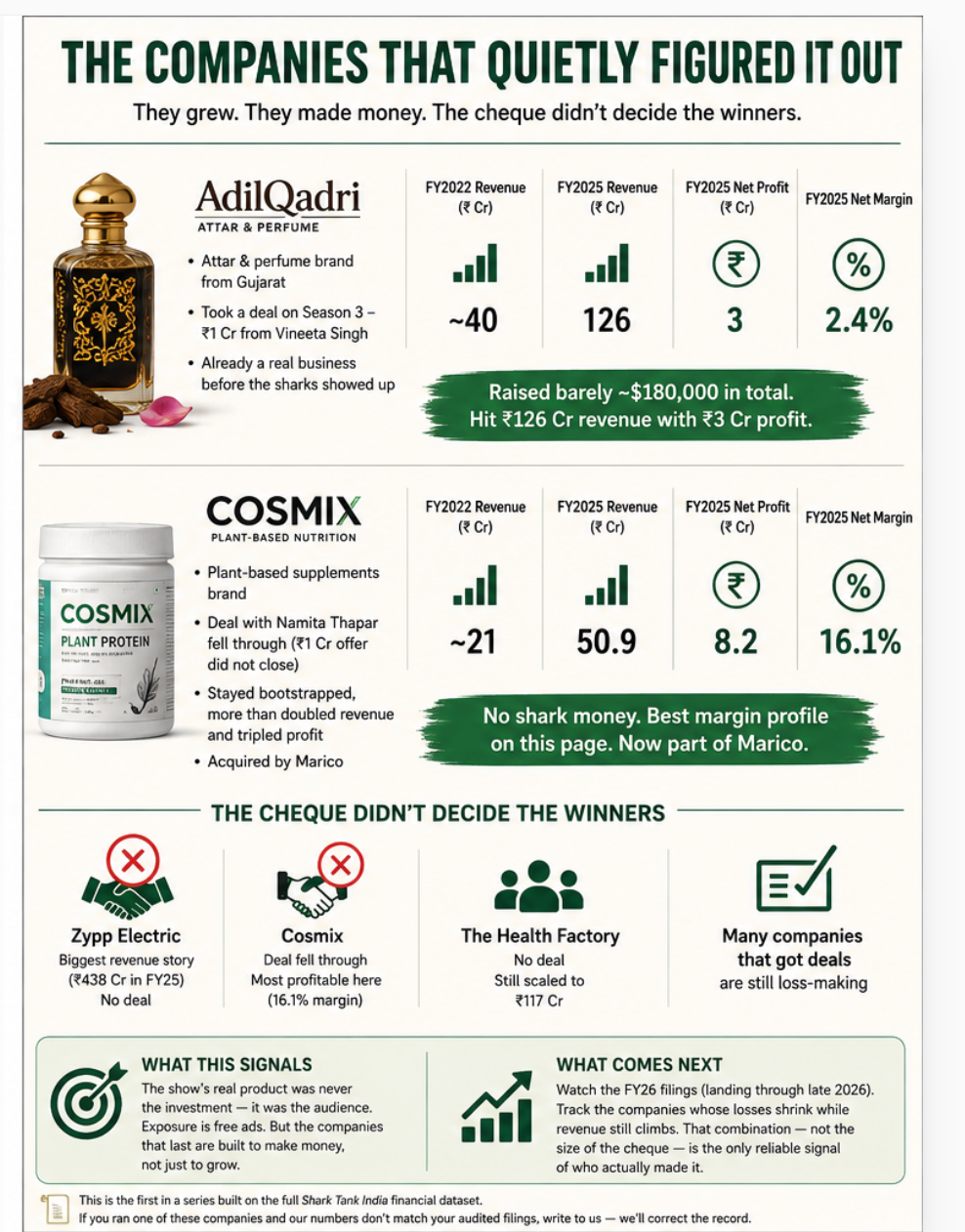
AdilQadri, the attar and perfume brand from Gujarat, is the standout. It raised barely $180,000 in total — a rounding error by startup standards — and still hit ₹126 crore in revenue in FY25, with a ₹3 crore profit. It did take a deal on Season 3 — ₹1 crore from Vineeta Singh — but the company was already a real business before the sharks showed up.
Then there's Cosmix, the plant-based supplements brand. Its Shark Tank deal actually fell through — Namita Thapar's ₹1 crore offer never closed. The company stayed bootstrapped, more than doubled revenue to ₹50.9 crore, and tripled profit to ₹8.2 crore in FY25. It has since been acquired by Marico. No shark money, best margin profile on this page.
What gets me about these two is that neither one needed the cheque. The exposure helped — being on the show is free national advertising — but the underlying business was already built to make money, not just to grow.
The cheque didn't decide the winners
Here is the finding I keep coming back to. If you line up the companies that scaled the most against whether they actually got a deal, the correlation is weak to nonexistent.
The single biggest revenue story, Zypp, got no deal. The Health Factory, the protein-bread company, left Season 2 empty-handed and still grew to ₹117 crore. Cosmix's deal collapsed and it became the most profitable name here. Meanwhile plenty of companies that did close a deal are still deep in the red.
The lesson isn't that the sharks have bad judgment. It's that the show's real product was never the investment — it was the audience. A few crore of shark money is small against a D2C brand's burn. Ninety seconds in front of the entire country, on the other hand, is the cheapest customer acquisition any of these founders will ever get.
What this signals
Shark Tank India sold the country a story about valuations and equity haggling. The data tells a quieter, harder story about unit economics. The brands that will still be around in 2030 aren't the ones that got the best on-air valuation — they're the ones, like AdilQadri and Cosmix, that learned to grow without lighting cash on fire.
For the rest, the next two years are the test. Zypp, STAGE, ZOFF and the others have proven they can grow. Now they have to prove they can do it while narrowing the loss line — and in a funding market far stingier than the one that backed them. Revenue growth was the easy win. Everyone got that. The profit is where the field will actually separate.
What comes next
Watch the FY26 filings, which start landing through late 2026. The companies to track aren't the loud ones — they're the ones whose losses shrink while revenue still climbs. That combination, not the size of the on-air cheque, is the only reliable signal of who actually made it.
This is the first in a series built on the full Shark Tank India financial dataset. If you ran one of these companies and our numbers don't match your audited filings, write to us — we'll correct the record.