

Shikha Agnihotri Interview on Building Right Side Story and Reforming School Safety in India
startuptalkers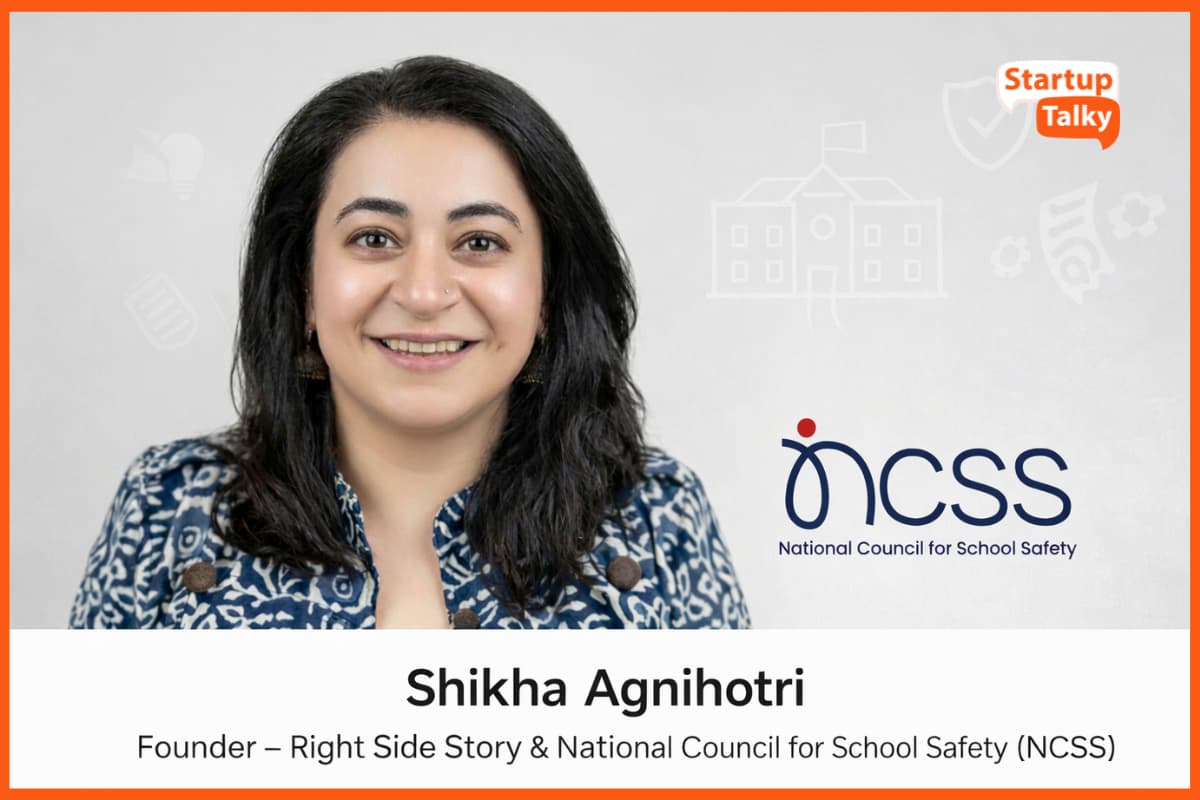
Shikha Agnihotri is the founder of Right Side Story and the force behind the National Council for School Safety. She works to transform school safety in India through structured governance systems aligned with the POCSO Act and national guidelines. In this interview with StartupTalky, she shares the mission behind building legally compliant safeguarding frameworks and her vision for strengthening school safety across the country.
StartupTalky: What inspired you to take on this mission, and what was the founding story behind Right Side Story?
Shikha Agnihotri: School safety in India was always treated as a reaction, never as a system. After years of research with school leaders, police officials, child psychologists, and medical professionals, I realized something alarming: most schools had intent, but not legally defensible systems. Incidents were being managed emotionally, not structurally.
That gap led to the birth of Right Side Story, not as a training company, but as a governance reform movement. We introduced compliance-first frameworks aligned with the POCSO Act, NCPCR guidelines, board mandates, and criminal law provisions.
Later, the National Council for School Safety (NCSS) was established to institutionalize this movement nationally bringing structured audits, accreditation, and measurable compliance systems, building India’s school safety architecture.
StartupTalky: What have been the biggest challenges in getting schools, parents, and policymakers to prioritize safety?
Shikha Agnihotri: Three major challenges emerged:
1. Denial Culture – Many institutions believe that the absence of an incident meant safety. Safety is not the absence of crisis; it is the presence of systems.
2. Compliance Fatigue – Policies existed on paper but lacked implementation. We shifted the conversation from ‘Do you have a policy?’ to ‘Can your policy defend you in court?’
3. Budget Prioritization – Infrastructure and branding were funded; safeguarding rarely was. We positioned safety as risk mitigation, legal protection, and institutional reputation insurance.
StartupTalky: As a woman founder in the education and safety space, how has your gender shaped your leadership?
Shikha Agnihotri: Being a woman in the safeguarding space has been both an advantage and a test.
Advantage: Mothers open up. Girl students disclose concerns more comfortably. Teachers share sensitive realities honestly.
Challenge: Boardroom negotiations and financial conversations often require having to prove authority repeatedly.
My leadership style is firm but compassionate, policy-backed, structure-driven, and boundary-conscious. Trust is built when systems are stronger than personalities.
StartupTalky: How have Right Side Story and NCSS developed their methodology for making schools safer?
Shikha Agnihotri: Our proprietary governance model is built on the 4Ps of Safety:
Policy – Legally aligned child protection frameworks
Process – Incident reporting matrices and escalation protocols
People – Defined roles, POCSO committees, accountability structures
Practice – Drills, reviews, continuous compliance monitoring
Through NCSS, we implemented 360° safeguarding audits, infrastructure risk mapping, governance dashboards and structured accreditation pathways converting safety from awareness to measurable governance.
StartupTalky: How do you balance the emotional weight of this work with operational demands?
Shikha Agnihotri: Safeguarding work carries emotional intensity. Disclosures, institutional resistance, and systemic gaps are realities.To sustain this mission, I operate through structure, rather than sentiment. Every case is handled through protocol, not impulse. Institution building requires revenue discipline, team accountability, and scalable systems. You cannot protect children sustainably if your organization lacks stability.
StartupTalky: What has your experience been in building credibility and securing support in an impact-driven sector?
Shikha Agnihotri: Impact sectors often face two biases: ‘Is this profitable?’ and ‘Is this scalable?’School safety is a preventive infrastructure. Our success is often invisible because crises are prevented.We built credibility through structured audits, advisory alignment, measurable frameworks, and impact across 1500+ institutions and 3.5 lakh+ students. Credibility in governance sectors is earned through consistency and compliance strength not hype.
StartupTalky: What is your vision for the future of school safety in India, and what message would you share with women entrepreneurs?
Shikha Agnihotri: My vision is clear: Every school in India must operate with legally defensible safeguarding systems, mandatory annual audits, digital compliance dashboards, and board-level safety accountability. School safety must move from moral narrative to statutory governance culture.
To women entrepreneurs: Do not chase trends. Build what the country needs. Purpose-driven sectors are slower but deeper. Leadership is not about visibility; it is about responsibility.
 Sakshi Jadhav