

Subarna Mukherjee on Women Leaders Shaping India’s Retail Strategy
startuptalkers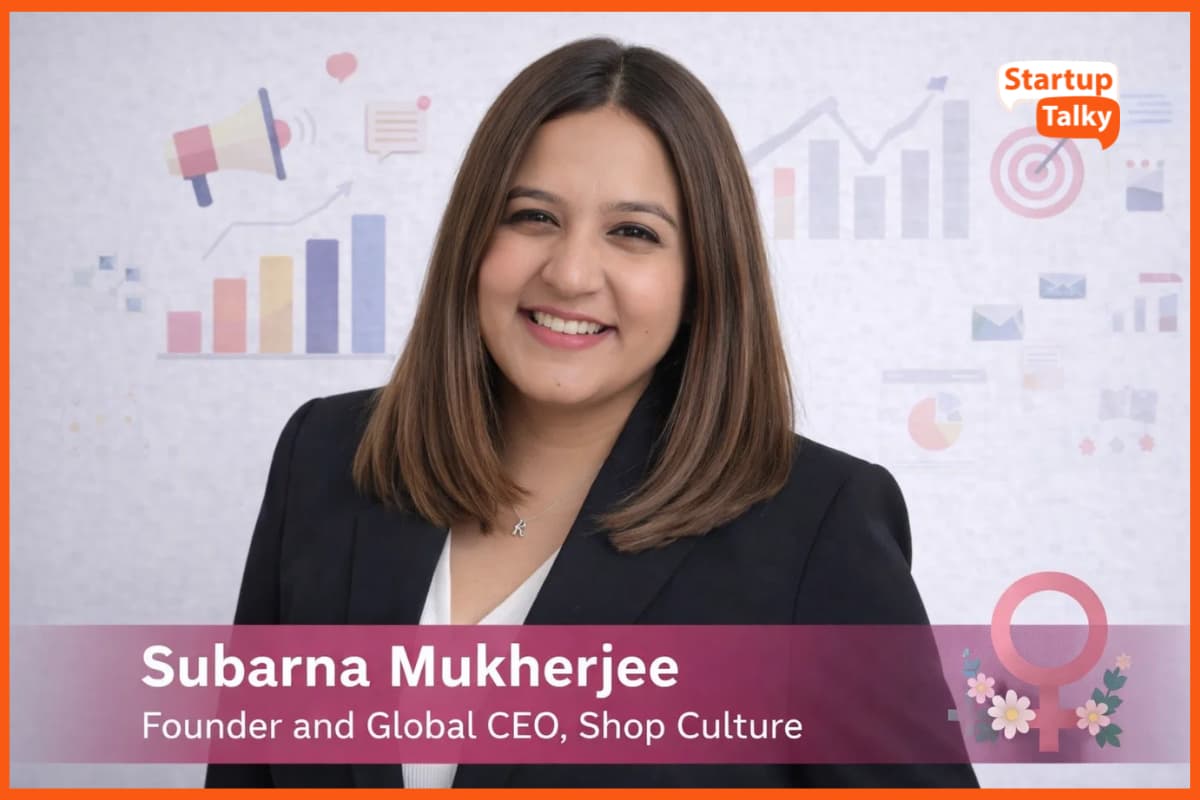
As India’s retail landscape evolves, women are not only the primary consumers but also powerful cultural and economic influencers shaping purchasing decisions across households. Yet leadership representation in retail strategy and brand-building remains limited. In this conversation with StartupTalky, Subarna Mukherjee, Founder of Shop Culture, discusses how women-led strategy teams can bring deeper consumer insights, how Shop Culture is building a more inclusive leadership structure, and why understanding women as complex decision-makers is critical for brands that want to succeed in the modern consumer economy.
StartupTalky: Shop Culture operates at the intersection of retail and consumer experience. In India's rapidly evolving retail landscape, women consumers now drive an estimated 70-80% of household purchasing decisions, yet women remain underrepresented in retail leadership and store management roles. How is Shop Culture working to bridge this gap and ensure women are not just customers but also leaders shaping the retail experience?
Subarna Mukherjee: Here's an uncomfortable question the retail industry rarely asks out loud: if women influence 70-80% of household purchasing decisions in India, why does almost every brand strategy room still look like a 1990s cricket team photo?
At Shop Culture, our work sits upstream of the store, in brand strategy, positioning, and ecommerce architecture. And what we've noticed, working across categories and markets, is that the brands losing money on customer acquisition are often the ones who built their strategy without a single senior woman in the room. That's not a value problem. That's an insight problem.
Today, over 80% of our team is women, and many of our core strategy and client leadership roles are held by women. That’s not a diversity initiative; it’s a business decision. When your primary consumer is female, having women shaping the brand strategy is the most basic form of market intelligence.
We also operate as a remote-first organization, which allows experienced women professionals, many of whom would otherwise drop out of traditional corporate structure, to stay in leadership roles and continue shaping how brands understand and serve their customers.
StartupTalky: Building a brand culture that resonates with modern consumers requires empathy, inclusivity, and authenticity, qualities often associated with women-led teams. How does Shop Culture incorporate diverse perspectives, particularly those of women, into its brand strategy, product curation, and customer engagement approach?
Subarna Mukherjee: At Shop Culture, 80% of our workforce is women. This is not by design but by necessity. We've found consistently that the most commercially effective brand strategies are built on granular empathy, understanding not just who the consumer is, but what she's quietly approving or resenting about the category she's shopping in. Women-led strategy teams tend to surface that frustration faster, because they've often lived it.
Our approach goes beyond traditional personas or demographic profiles. We run continuous voice-of-customer conversations with real shoppers, many of them women, to understand what drives purchase decisions, cart abandonment, and peer recommendations.
There’s an entire invisible influence economy in consumer markets: women who recommend products to friends, family, and communities without ever posting publicly. Many brands overlook that layer of influence. Our job is to design brand and ecommerce strategies that tap into it.
StartupTalky: The retail industry in India employs millions of women, yet many face challenges around workplace safety, career progression, and equal pay. What specific initiatives has Shop Culture implemented to create a supportive and equitable work environment for its women employees across all levels of the organization?
Subarna Mukherjee: The strategy and consulting industry has a pipeline problem it rarely talks about honestly. Women enter in strong numbers, perform exceptionally well, but too often get filtered out before they reach P&L ownership and senior leadership roles.
At Shop Culture, we’ve tried to interrupt that pattern in three ways.
First, women don’t just work on accounts; they lead them. They hold client relationships, manage budgets, and drive strategic decision-making. That kind of exposure is what builds real leadership careers.
Second, we run compensation reviews not just across levels but within them. Pay gaps often appear quietly within the same role, and we actively monitor for that.
Third, flexibility isn’t a perk in our organization; it’s a structural design choice. As a remote-first company, we allow high-performing professionals to structure their work around life responsibilities without sacrificing career progression.
None of these systems are perfect, but acknowledging the structural barriers is the first step to changing them.
StartupTalky: International Women's Day 2026 is centered on the theme of accelerating action for gender equality. What is one bold, measurable step Shop Culture is taking in 2026 to advance women's empowerment, whether through hiring practices, leadership development, community partnerships, or consumer-facing campaigns?
Subarna Mukherjee: One measurable step we are taking is ensuring that women continue to hold the majority of senior strategic leadership roles across our client portfolio.
Today, women lead a significant share of our core strategy engagements, and by December 2026 we aim to maintain that majority while expanding our leadership pipeline further.
Because we operate with a globally distributed and largely remote team, the real challenge isn’t hiring women, it’s ensuring collaboration, visibility, and leadership growth in a flexible work structure. In 2026, we are investing in stronger internal systems for mentorship, leadership exposure, and cross-team collaboration so that talented women at different life stages can continue progressing into senior roles.
The goal isn’t a quota. The goal is to build a leadership structure that reflects the consumer markets our clients operate in.
StartupTalky: Consumer culture in India is increasingly shaped by women entrepreneurs, content creators, and community builders who influence how people discover and engage with brands. How does Shop Culture collaborate with or support women-led businesses, creators, or communities as part of its broader brand ecosystem?
Subarna Mukherjee: Women-led businesses in India are growing at nearly twice the rate of the broader MSME sector, yet they still receive a disproportionately small share of brand-building investment and ecommerce infrastructure support.
At Shop Culture, we actively partner with and advise women-founded consumer brands, not as a diversity initiative but because they are often building in the white spaces larger companies overlook.
Many women founders understand their customer with extraordinary clarity because they’ve experienced the problem themselves. What they often need is support translating that intuition into a scalable brand strategy and ecommerce growth engine.
Some of our most interesting strategic work over the past few years has been helping women entrepreneurs and senior women leaders turn that instinctive consumer understanding into structured brand positioning, marketplace strategy, and international expansion.
StartupTalky: Retail brands have a unique opportunity to shape cultural narratives through their storefronts, marketing, and the experiences they create. In your view, what responsibility does a brand like Shop Culture have in using its platform to champion gender diversity and challenge stereotypes in how products are marketed and consumed?
Subarna Mukherjee: When a brand asks us to help them reach “the Indian woman consumer,” the first question we ask is: who wrote this brief, and have they spent real time with her, not in a focus group, but in her life?
At Shop Culture, we believe strategy firms have a responsibility to challenge oversimplified narratives about women consumers. Too often, marketing reduces women to a demographic segment, when in reality they are financially powerful, culturally influential decision-makers shaping entire categories.
We push brands to move beyond outdated tropes whether that’s pink packaging, anxiety-driven beauty messaging, or campaigns that mistake aspiration for pressure.
The brands that will matter in the next decade are the ones that recognize women not as a niche audience, but as complex consumers whose influence shapes the entire retail ecosystem.
Our job is to help build those brands.
StartupTalky: If you could share one piece of advice with a young woman in India who dreams of building her own retail or consumer brand, someone who wants to create a culture-driven business that makes a real impact, what would it be, and what mindset shift do you believe is most important for aspiring women entrepreneurs today?
Subarna Mukherjee: Build the business as if you already belong in the room even before you feel completely ready.
One pattern I’ve seen hold many brilliant women back is the instinct to over-prepare and wait for perfect certainty before stepping into authority. Meanwhile, plenty of founders build companies on a pitch deck and an idea.
The mindset shift is this: stop treating your lived experience as anecdote and start treating it as primary research.
If you’ve experienced a gap in a category (a product that doesn’t exist, a customer experience that feels slightly off, a brand that talks at you instead of to you) that frustration isn’t personal. It’s a market signal.
The consumer economy in India is being rewritten right now, and the women who understand these shifts from the inside are sitting on some of the most valuable strategic intelligence in the market. The real question is whether they’ll act on it before someone else does.
 Sakshi Jadhav