

Dr. Sunder Raju on Powering India’s Farms with Sunlight: The Agrivoltaics Revolution
Can solar panels and farming thrive on the same land? Dr. Sunder Raju shares how Project Chittoor is combining renewable energy, agriculture, and technology to build a new income model for Indian farmers.
India’s agrivoltaics sector is gaining attention as the country looks for ways to expand renewable energy without competing with agricultural land. The global agrivoltaics market is projected to grow from $20.29 billion in 2026 to $182.04 billion by 2034, registering a CAGR of 31.56%. In India, an earlier market forecast estimated the agrivoltaics market to grow at a CAGR of 12.3% between 2023 and 2029, while newer 2026 research highlights significant potential for the technology across the country.
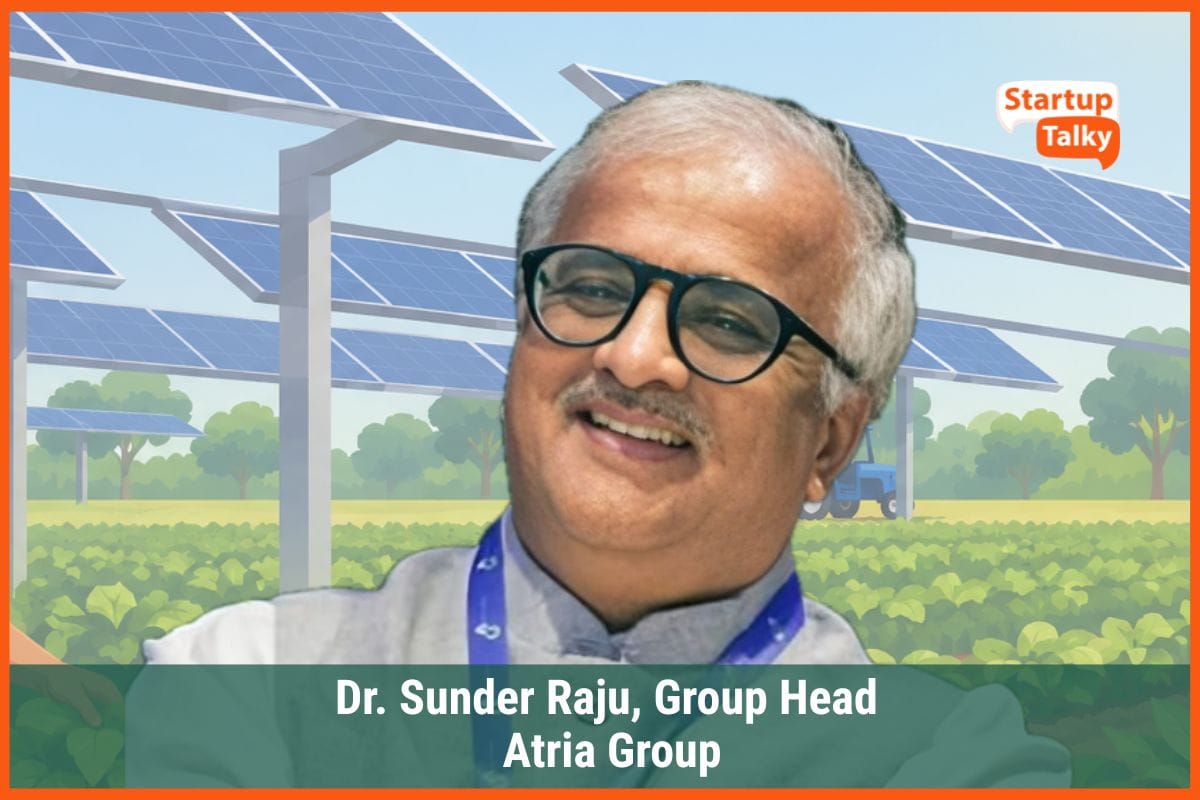
Against this backdrop, Dr. Sunder Raju, Group Head of Atria Group discusses how Project Chittoor is developing a 600-acre agrivoltaic farming model in Andhra Pradesh, combining solar power with crops, livestock, shared infrastructure, and technology. He explains which crops are performing best, how the project plans to scale to 60,000 acres by 2028, why workforce availability is a bigger constraint than financing, how the model creates multiple income streams for farmers, and how technology and policy could help replicate the model across India.
Project Chittoor Is Testing Crop Compatibility Under Agrivoltaic Solar Panels
StartupTalky: Project Chittoor places solar panels above active farmland so crops and energy generation share the same acre. What crops have you found work best under the panels so far, and which assumptions about crop compatibility turned out to be wrong once the system was running?
Dr. Sunder Raju: Project Chittoor has adopted a field-integrated agrivoltaic model where solar panels are installed above active farmland, allowing crops and clean energy generation to coexist on the same acre without reducing cultivable land. The project spans 600 acres with a planned agrivoltaic capacity of 6 MW, and the integrated farming model includes 22 crops, 8 fruit varieties and 4 different species, alongside livestock, to maximise productivity and diversify farmer incomes. The elevated panels also provide partial shading, helping reduce heat stress and evaporation for certain crops during hotter months.
Among these, the crops that have performed best under the agrivoltaic system are super napier and ash gourd. While the partial shading has created favourable growing conditions for certain crops, we are still experimenting and iterating to see what works best. We are working with the professors in the life sciences COE in Atria University to provide us insights on what crops may work in those conditions after analysing water and soil samples. With these insights we have planted the first set of crops.
Shared Solar Power Is Being Integrated With Farming Infrastructure
StartupTalky: Power from the agrivoltaic blocks is used to run shared infrastructure including pumps, borewells, cold storage, and packhouses within farming clusters. How do you allocate that power fairly across farmers in a cluster when their needs peak at different times?
Dr. Sunder Raju: Since the 600 acres is managed as a single integrated unit rather than divided and operated by individual farmers, power allocation isn't a multi-party negotiation, it's a scheduling decision made centrally across the block. As our agrivoltaic setup scales and shared infrastructure like cold storage and packhouses comes into the picture, the approach is to schedule by activity type rather than by fixed quotas: irrigation pumps run on time-of-day windows tied to crop water needs, cold storage draws a continuous baseline load, and packhouse/processing equipment gets scheduled batch windows during peak solar generation hours.
The goal is to sequence high-value, time-sensitive loads like cold chain against predictable, schedulable loads like drying batches, so power isn't contested at peak demand. This is the model being designed into the block structure as each cluster's infrastructure matures.
Workforce Availability Is the Biggest Constraint to Project Chittoor’s Expansion
StartupTalky: You are targeting 60,000 acres by 2028, starting from 600 acres in 2026. What is the single biggest constraint on that pace of expansion: land aggregation, financing, farmer trust, or something else?
Dr. Sunder Raju: Project Chittoor is being developed in phases, beginning with a 600-acre pilot in Andhra Pradesh and targeting 60,000 acres by 2028. The model is built around community-led land pooling, integrated farming, renewable energy and shared infrastructure. The project has also worked to reduce redevelopment costs from approximately ₹7–8 lakh per acre to ₹2.5–3 lakh per acre, with a long-term target of bringing this down to ₹2 lakh per acre. Financing for key infrastructure, including the agrivoltaic systems, is also being enabled through third-party investment models to minimise the upfront financial burden on farmers.
The single biggest constraint on that pace isn't financing or land aggregation, it's people. Finding farmers willing and able to actually work the land has been harder than expected. The younger generation has largely migrated to cities for work, and the people who've stayed behind in the villages are often too old to take on the physical demands of farming at scale. So even where land is available and capital is in place, execution slows down because the on-ground workforce isn't there in the way the model assumes. This is actually central to why we designed the project the way we did, creating high-income, dignified farm work is meant to reverse that migration pattern, but it also means workforce availability, not capital, is the real pacing constraint on expansion.
Integrated Farming Creates Multiple Income Streams for Farmers
StartupTalky: Project Chittoor uses livestock and timber species like red teak and mahogany alongside agrivoltaics to create earlier and more predictable cash flows. How long does a farmer typically wait before they see the first meaningful income from the integrated model?
Dr. Sunder Raju: The model layers income so a farmer isn't waiting years for a first return. Vegetables and short-cycle crops on the drip-irrigated blocks produce cash flow within a single growing season. Sheep, with fast breeding cycles, start generating income within the first year, and we're already running 800+ head. Dairy adds a smaller but immediate weekly income stream. Solar drying layers in value-added income once processing volume builds.
Timber species sit at the far end of that same stack, a long-horizon asset, typically maturing over 15-20+ years, that provides a large payout later as the model matures rather than contributing to the early cash flow. So meaningful income starts within the first year, driven by vegetables, livestock, and dairy, with timber compounding value over the long run as a later layer on top.
Project Chittoor Uses a Collective Model to Create More Stable Farmer Incomes
StartupTalky: Business Standard reported in June 2026 that families who had left the village to work in cities are returning because of sustained income from Project Chittoor. What specific income guarantee or structure makes that return economically rational rather than just sentimental?
Dr. Sunder Raju: Project Chittoor is structured around a collective development trust model, through which farmers contribute their land for development while retaining ownership. In return, they commit to remaining within the project for at least seven years, which allows the investment made in the land to be recovered. Revenue generated from agricultural activities is distributed among farmers based on two factors, the extent of land they have contributed and the number of work hours they put into daily farm operations, which are assigned through the project's technology system. The broader model is targeting annual farmer incomes of over ₹1 lakh per acre.
The income structure is designed to provide farmers with layered and staggered cash flow rather than a single fixed payout. Animal husbandry generates the first income even before crops are harvested, solar energy generation provides a steady stream that isn't dependent on rainfall, agricultural revenue is distributed based on land contributed and work hours logged, and longer-maturing assets like timber are held in reserve for major life milestones, a child's education or marriage, so families have a source of value to draw on at key moments rather than relying on debt. This combination of early, recurring, and long-term income is what makes the return economically rational rather than a leap of faith.
Families have reportedly begun returning to their villages as the model creates more stable and diversified livelihood opportunities. Early examples are already visible on the ground, a gardener and a domestic worker who had left their village years ago for city work have returned home, and the project anticipates more families following suit by the end of the year as sustained income continues to build confidence in the model.
Voice-Based Technology Is Making Digital Farm Management More Accessible
StartupTalky: The operating model is being codified into a mobile-based system. What does the mobile system need to track and communicate to a farmer who may have limited digital literacy but is making real decisions about their land based on it?
Dr. Sunder Raju: Technology forms a key part of Project Chittoor's integrated farming model, with the ecosystem incorporating IoT sensors, drones, satellite imagery, remote sensing, AI/ML-based analytics and digital dashboards to support farm planning, crop monitoring, yield estimation, soil health assessment and carbon measurement. The broader digital ecosystem also includes farm-to-city logistics, clean energy monitoring and data-driven decision-making across the farming clusters.
The farmer-facing mobile platform is expected to communicate to the farmer what they need to do on the farm on a daily basis. We have used a voice based system that speaks to the farmer in their local language. We have broken down the process and system to a daily activity that is early and simple for the farmer to follow. The system also allows for the farmer to give feedback though images and voice id there any issues they see on ground.
Community Land Pooling Could Help Replicate Agrivoltaic Farming Across India
StartupTalky: India has over 100 million farmers with less than two hectares of land. Project Chittoor is built for small, fragmented landholdings. What structural changes in land leasing, credit access, or government policy would most accelerate this model's replication across other districts?
Dr. Sunder Raju: Project Chittoor has demonstrated that fragmented landholdings can be transformed into productive farming ecosystems through community-led land pooling, shared infrastructure and institutional partnerships, without requiring farmers to give up ownership of their land. The model also leverages third-party financing for agrivoltaic infrastructure, reducing the capital burden on individual farmers, while seeking to build partnerships with government bodies, research institutions, CSR partners and impact investors to support implementation at scale.
The single biggest policy intervention that would accelerate replication is formal recognition of long-term community land-pooling arrangements, a standardized legal framework for multi-year land aggregation that protects farmer ownership while giving institutions the certainty needed to invest in shared infrastructure. Today, these arrangements are structured contractually on a project-by-project basis, which works at the scale of a few hundred acres but becomes harder to replicate quickly across districts without a recognized legal template that reduces negotiation and legal risk on both sides.
In addition, easier convergence of existing government schemes would meaningfully speed up replication. Programs like the Agriculture Infrastructure Fund, PMFME, and PM Krishi Sinchayee Yojana already support individual pieces of this model, drip irrigation, processing infrastructure, credit access, but they operate as separate applications with separate timelines. A pathway that lets an integrated project apply once and draw across multiple schemes, along with clearer state-level policy support for agrivoltaics (open access and grid interconnection processes), would reduce the time it takes to stand up a new cluster from scratch. Addressing these structural barriers would help replicate the model across other districts while making integrated farming more accessible to India's small and marginal farmers.
 Vivek Dev Jacob