

Swiggy to Transition Instamart to Inventory Model Within Three Quarters
Swiggy wants to move Instamart to an inventory-led strategy in the next three quarters, which could enhance working capital by 8-10 days and increase contribution margins by 80 basis points. The move will offer Instamart more say over price, product selection and availability.
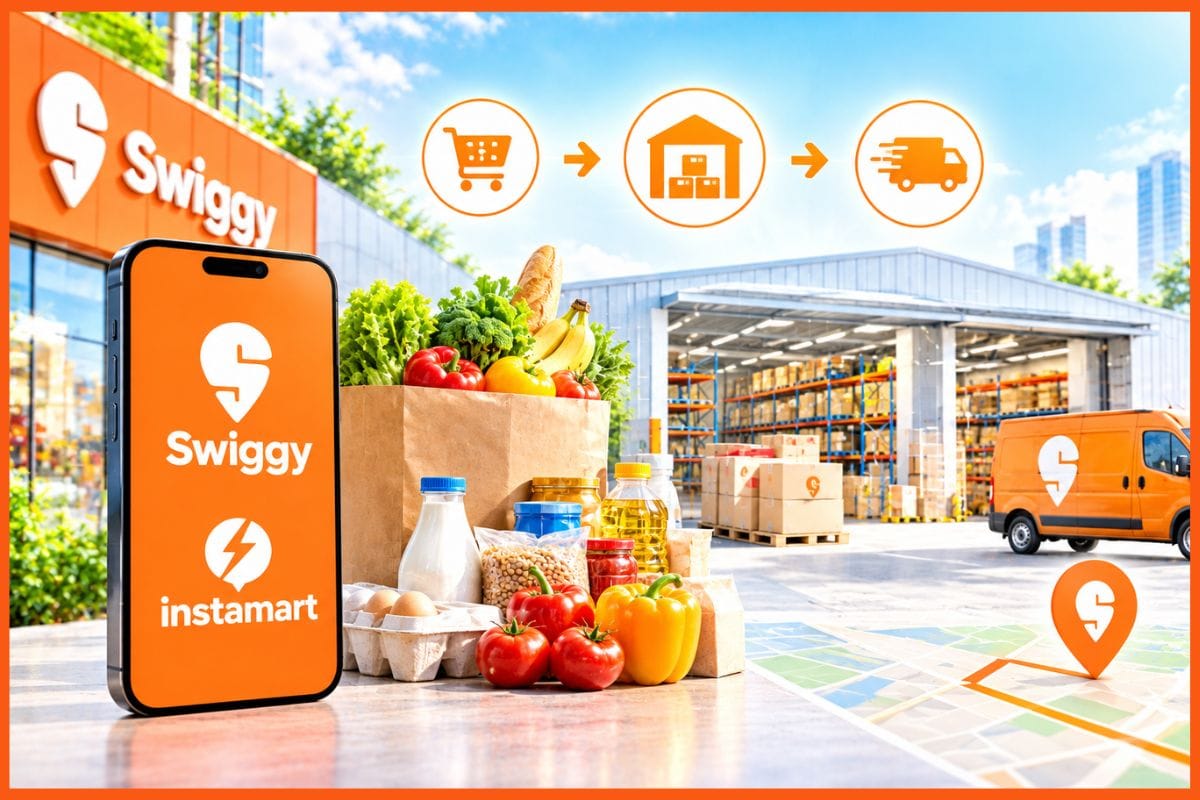
Over two months after receiving the IOCC (Indian-Owned and Controlled Company) designation, Swiggy said that it will soon begin transforming its rapid commerce operation, Instamart, to an inventory-led model. The announcement was made in the company's Q2 shareholder letter. By mid-Q3 FY27, Instamart will be shifted to the inventory model.
Two or three quarters should pass before the changeover is finished. Swiggy anticipates an 8-10 day improvement in Instamart's working capital cycle after the changeover. According to the company, this may potentially increase Instamart's contribution margin by 80 basis points if completely implemented. However, it will also provide the firm with more control and flexibility over selection, price, availability, and day-to-day operations.
Why Swiggy Shifting Instamart to Inventory Model?
Unlike its existing strategy, where it functions as a marketplace hosting vendor entities, the inventory model will allow Instamart to have more control over product assortment, pricing, availability, and day-to-day operations. Blinkit, Eternal's fast commerce branch, is the pioneer in completing the shift to an inventory-led approach. Since then, the company's bottom line has improved significantly. With a contribution of INR 19,152 Cr (or 24.138 Cr) to Eternal's overall operational revenue in Q2 FY27, Blinkit has surpassed all other revenue contributors.
For a while now, Swiggy has been putting out bids to make a comparable change. Although 72.36% of shareholders voted in favour of the company's inaugural special resolution to become an IOCC in May 2026, it fell short of the necessary 75% mark. In early August, it was able to secure shareholder permission to facilitate the change. The corporation announced recently that its domestic ownership had surpassed 58%.
Financial Dynamics of Instamart
In the September quarter (Q2 FY27), Swiggy's rapid commerce margins saw a further nosedive. The fast-commerce company's contribution margin was -1% of GOV in Q1 FY27, down from -0.2% in Q1 FY26, as a result of increased investments in pricing and client retention. Compared to the previous quarter, Instamart's adjusted EBITDA loss increased to INR 895 Cr in Q2 FY27. With the addition of 69 net dark stores during the quarter, Swiggy's network reached 1,240 outlets across 133 locations, and its net order value climbed 34.8% year-on-year to INR 6,594 Cr.
The contribution margin was -1.0% of GOV, which is within the range that was previously guided, according to the management. The firm added 69 net outlets. Thus, investing in a differentiated variety, availability, and service quality. Despite a 13.4% sequential growth to INR 6,594 Cr in Instamart NOV and a 29.3% year-on-year increase in orders to 130 Mn, the adjusted EBITDA loss increased to INR 895 Cr in the quarter. In the second quarter of fiscal year 27, Swiggy's consolidated income from operations jumped 36.1% year over year, reaching INR 7,571 Cr. The company's net loss shrank by 15.6% year-on-year to INR 922 Cr; however, it rose from INR 791 Cr in the first quarter of FY27.