The AI Boom Just Hit Your Laptop Bill: Why Apple Raised Mac and iPad Prices
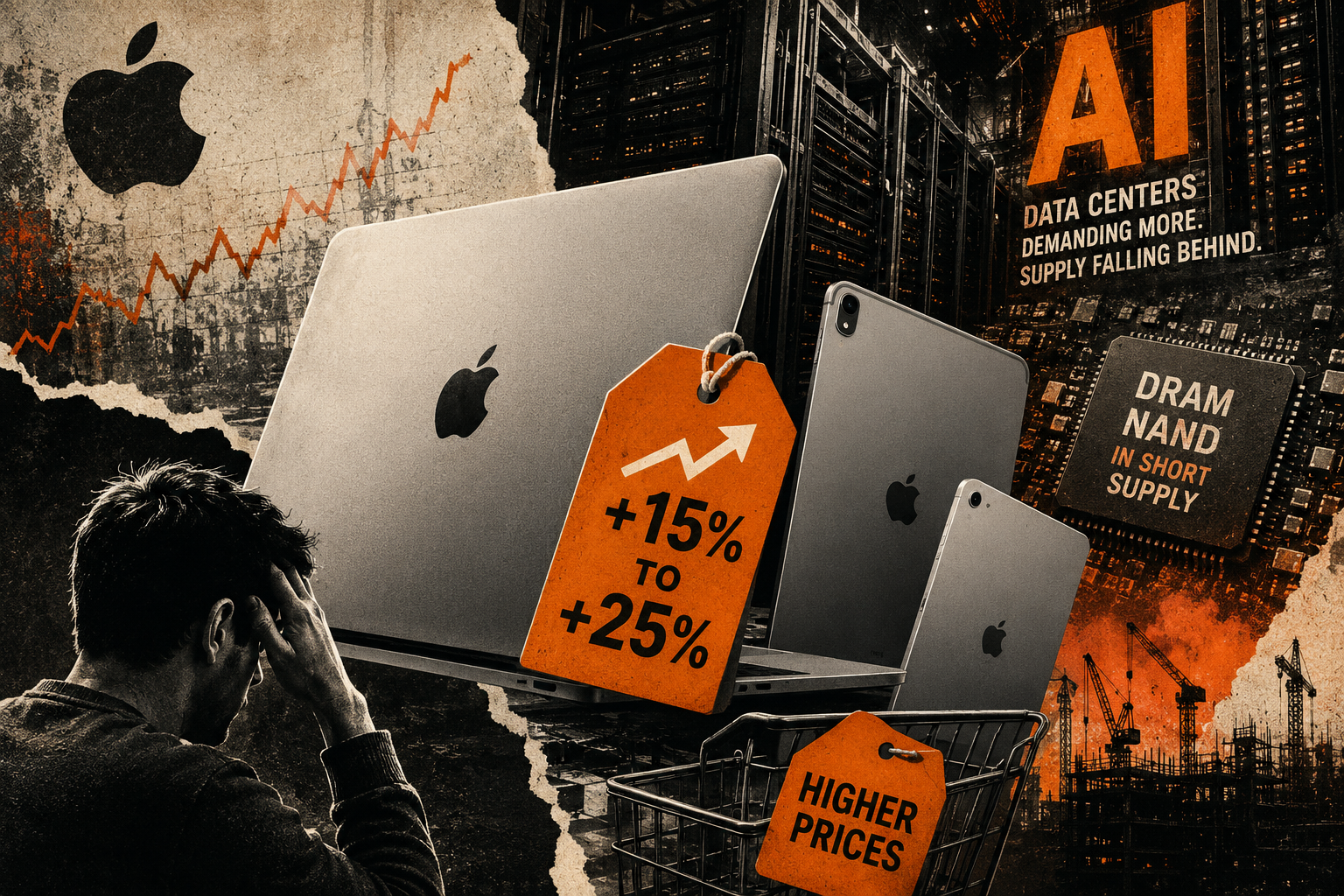
On 25 June 2026, Apple raised MacBook and iPad prices by 15% to 25%, its first formal move to pass the AI-driven memory shortage on to consumers. The stock fell more than 6%. For years the AI boom was a data-centre story. Today it became a price tag on your desk.
For three years, the artificial-intelligence boom has been someone else's story: hyperscalers spending hundreds of billions on data centres, Nvidia minting trillions, power grids straining. It was abstract, and it was far away.
On 25 June 2026, it landed on the Indian consumer. Apple raised the price of MacBooks and iPads across its India lineup, by roughly 20% to 42%, with the steepest single jump a ₹70,000 rise on the MacBook Pro. The reason, in Apple's unusually blunt words: the same memory chips that go into your laptop now go into AI servers, and AI is winning the fight for them. Apple's shares fell more than 6% on the news, their worst day since April 2025.
What changed in India, and by how much
| Model | Old price | New price | Increase |
|---|---|---|---|
| MacBook Neo (entry) | ₹69,900 | ₹79,900 | +₹10,000 (~14%) |
| MacBook Air (M5, 13-inch) | ₹1,19,900 | ₹1,49,900 | +₹30,000 (~25%) |
| MacBook Air (15-inch) | ₹1,44,900 | ₹1,79,900 | +₹35,000 (~24%) |
| MacBook Pro (M5, 14-inch) | ₹1,69,900 | ₹2,39,900 | +₹70,000 (~41%) |
| iPad Air (11-inch, M4) | ₹64,900 | ₹89,900 | +₹25,000 (~38%) |
Source: Apple India store, via Indian tech media, 25 June 2026. Revised prices are already live online and at authorised resellers.
Across the range, hikes run from about ₹5,000 to ₹70,000, or roughly 20% to 42% on the worst-hit models. These are not the quiet, generational nudges Apple makes when it refreshes a product. They are mid-cycle increases on devices already on sale, which almost never happens.
What Apple said
Apple framed it as a cost it could no longer absorb. CEO Tim Cook had warned a week earlier that increases had become "unavoidable." In its statement, the company said: "The consumer electronics industry is facing an unprecedented challenge. The rapid expansion of AI data centers has created an extraordinary surge in demand for memory and storage," adding that it had "never seen a component price increase this much, this quickly."
The key phrase is that this is Apple's first formal move to pass the cost on. It had been eating rising component costs to shield its prices. The June hike is the moment it stopped, and it has hinted that more may follow.
Why: AI is eating the world's memory
The cause is a global shortage in the most boring, most essential component in electronics: memory.
Generative AI runs on enormous quantities of high-speed memory (DRAM) and storage (NAND flash). As hyperscalers race to build AI data centres, they are buying memory at a scale and urgency no consumer-device maker can match, and they are diverting supply away from laptops, tablets and phones. The result is a price spike with few precedents:
- DRAM prices rose as much as 98% in the first quarter of 2026.
- They are set to climb a further 58% to 63% in the current quarter.
When the input doubles in three months, even a company with Apple's scale eventually has to pass it on. A MacBook is, in significant part, a box of memory and storage wrapped in aluminium, and the box just got far more expensive to fill.
Why India's hit is harder
The same machines rose by less in the United States, roughly 15% to 20% for Macs and 15% to 25% for iPads. In India, the increases reach 42%. The gap is structural.
Apple products entering India already carry import duties plus 18% GST, stacked on top of the base price before any global component surcharge is added. So when a worldwide memory crunch lifts the underlying cost, India's buyers pay a surcharge on top of a premium that was already there. The AI memory crunch is global; India's tax-and-duty structure amplifies it. A device category already expensive relative to local incomes gets pushed further out of reach, and the festive-season buying window later this year will be the real test of demand.
The winners and the losers
This is a transfer of value, and it is easy to see in whose direction.
The winners are the memory makers. Chipmaker Micron just reported quarterly revenue more than quadrupling, the memory crunch showing up directly in its financials, and its peers Samsung and SK Hynix are riding the same wave. For them, AI demand plus tight supply is the best pricing environment in years.
The losers are buyers and device margins. And Apple, despite being one of the supposed beneficiaries of the AI era through its software and services, is also a victim of it on the hardware side: the same boom that lifts its AI narrative is squeezing the economics of the machines it sells. The 6% share drop says investors noticed the squeeze, not just the headline price rise.
Not just Apple
This is an industry event, not an Apple one. The memory shortage hits everyone who builds with DRAM and NAND, and Apple is simply the most visible name to formalise the pass-through. Microsoft and other hardware makers have moved on pricing in the same window, and PC and server vendors face the identical input squeeze. When the most cost-disciplined, supplier-powerful company in consumer tech says it can no longer hold the line, smaller players have even less room to.
So what
The lasting significance is not the price of one MacBook. It is that the AI capital-expenditure supercycle now has a consumer price tag. Until now, the cost of the AI build-out was borne by investors funding data centres and the companies buying GPUs. Today it is being paid, in part, by anyone in India buying a laptop or tablet, because consumer electronics and AI infrastructure draw from the same finite pool of memory, and infrastructure has the deeper pockets.
This will not resolve quickly. New memory fabs take years to come online, so the supply-demand gap, and the upward pressure on prices, is likely to persist well beyond this quarter. For Indian buyers, who already pay the most for Apple hardware anywhere, the AI boom has reached the checkout counter, and it is not leaving soon.