

Top AI Tools for Workforce Planning in 2026 (Features, Pricing & Comparison)
📚 LearningDiscover top AI workforce planning tools that help businesses predict hiring needs, analyze skills, and optimize team performance with data-driven insights.

AI tools for workforce planning help companies identify skill gaps, design shifts, and hire more effectively by leveraging data. They take into account work hours, attrition, and performance to find clear patterns.
With this, they budget future staffing needs and align people to the right roles. The tools can also recommend training to address the gap early. Live dashboards provide real-time updates of workload, costing, and team balance.
Managers can create hypothetical plans before implementing changes. Simple reports flatten the learning curve for insights. Overall, teams become more efficient, adaptable, and resilient in achieving targets.
Key Benefits of AI Workforce Planning Tools
AI workforce planning tools offer several advantages:
- Better forecasting – Predict hiring needs and costs accurately
- Improved efficiency – Reduce manual work and errors
- Skill gap analysis – Identify and fix talent shortages early
- Scenario planning – Test different workforce strategies
- Real-time insights – Make faster, data-driven decisions
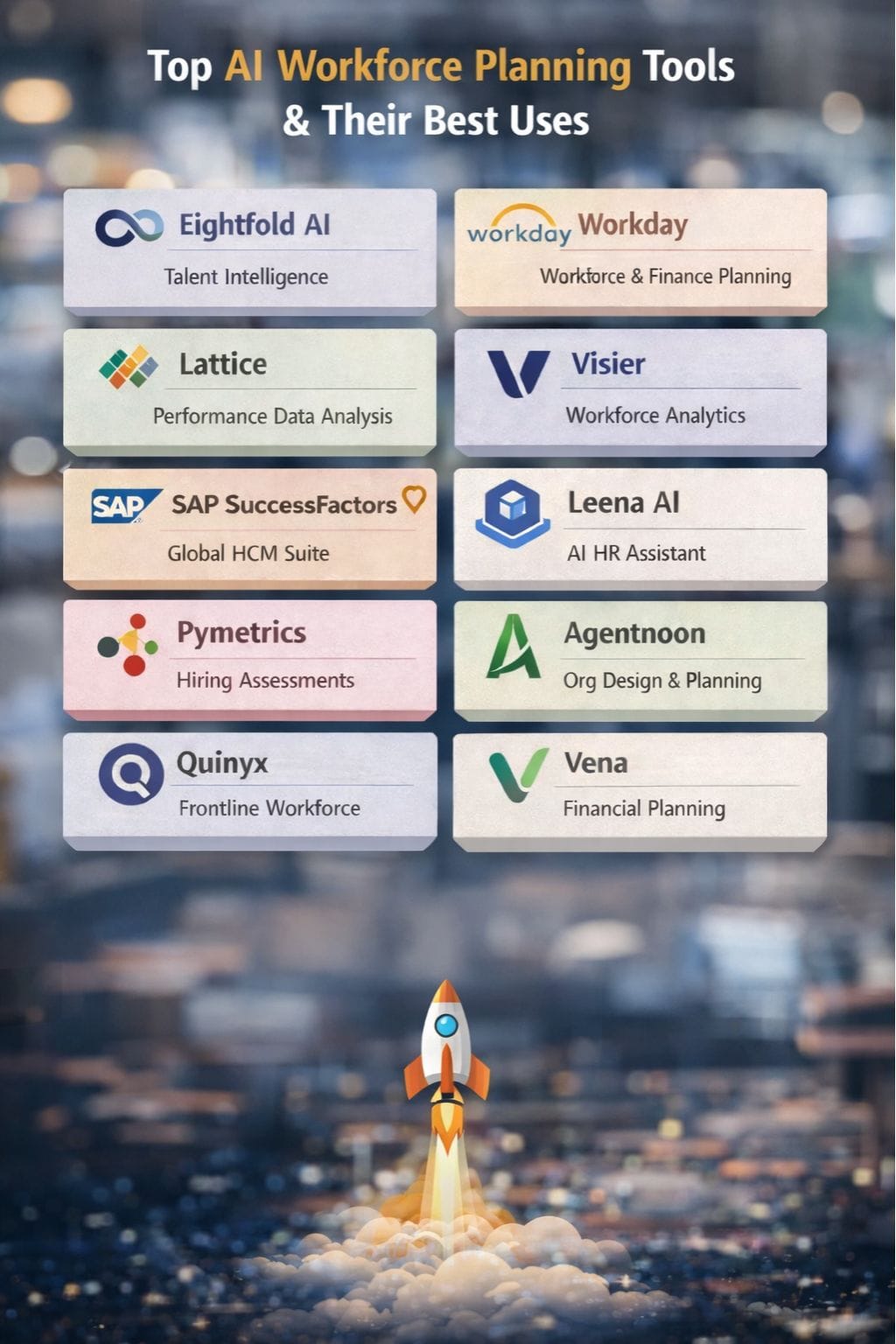
AI Workforce Planning Tools Comparison Table
| Tool | Best For | Key Features | Pricing Level | Drawbacks |
|---|---|---|---|---|
| Eightfold AI | Talent intelligence & skill gap analysis | AI matching, skill prediction, talent graph | High | Complex setup, expensive |
| Workday | Enterprise workforce & finance planning | Headcount forecasting, scenario modeling | High | Needs clean data, admin-heavy |
| Lattice | Performance & talent strategy | Attrition risk, feedback insights | Medium | Feature-heavy, costly modules |
| Visier | Advanced workforce analytics | Predictive modeling, dashboards | High | Technical setup |
| SAP SuccessFactors | Global workforce planning | AI forecasting, compliance tools | High | Complex UI |
| Leena AI | HR automation & support | AI chat, workflow automation | Medium | Setup time |
| Pymetrics | Hiring & talent matching | Gamified assessments, job fit AI | High | Low transparency |
| Agentnoon | Org design & planning | Org charts, scenario modeling | Medium | Setup effort |
| Quinyx | Frontline workforce management | Scheduling, forecasting | Medium | Learning curve |
| Vena | Financial workforce planning | Excel-based modeling, AI insights | High | Slow with large data |
Best AI Workforce Planning Tools Explained
Eightfold AI
Eightfold AI consists of a talent intelligence platform that enables human resources to build a workforce ready for the future. The skills-based data and predictive analytics enhance people's decision-making.
The Eightfold platform brings together HR data, labor market insights, and over a billion talent profiles. It identifies current skills and predicts skills that will be needed in the future and lays out clear pathways for internal moves, reskilling, or succession.
Key features include skill inference, AI-driven talent matching, workforce planning, and DEI-aware recommendations. It also automates hiring and talent management tasks.
Pros
- Well-supported skills-based workforce view and gap analysis
- Robust artificial intelligence matching for effecting internal mobility, reskilling
- Large, continuously updated global talent graph leads to ever-improving predictions
Cons
- Highly complex and time-consuming to implement for large organizations
- Pricing is prohibitive for smaller organizations
Pricing
| Plan | Pricing |
|---|---|
| RFP | Custom |
Workday
Built-in AI and machine learning help Workday to quicken and clarify workforce planning for leaders. It is capable of forecasting headcounts and modeling costs while linking people plans to finance in real-time.
Teams can test scenarios and identify skill gaps and staffing issues early on. It consolidates HR, time, and financial data in a single view. Predictions are straightforward, and simple queries even get support from digital assistants.
This helps HR and FP&A teams plan quickly, save on heavy spreadsheet work, and provide a much better visibility across teams.
Pros
- Strong integrated streams of HR, Payroll, and Finance for a single source of truth
- Advanced AI for scenario modeling, talent insights, and skills-based planning
- Governance, security, and audit trails are robust enough for large global organizations.
Cons
- Data quality must be very high, and dedicated admins are required
- Occasional bugs
Pricing
| Plan | Pricing |
|---|---|
| RFP | Custom |
Lattice
With the help of Lattice AI it is a platform designed to help human resource professionals intelligently strategize roles, skills, and headcounts.
It analyzes up-to-date evaluations and multiple sources, including feedback, 1:1s, goals, and surveys with data to recognize and follow risks and growth opportunities and inform decisions.
Lattice AI agents raise alerts for attrition risk, spot future leaders, and support succession planning. With real-time insights into compensation, performance, and talent health, leaders can make informed decisions.
Built-in analytics and integration with HRIS, payroll, and tools such as Workday reduce much manual work.
Pros
- A complete view across dimensions like performance, engagement, and compensation
- The AI agent presents risks, high performance, and succession paths
- Succession and Employee Health tools show the leadership pipeline and attrition risk
Cons
- A heavy feature set can sometimes feel cumbersome for smaller companies
- quite pricey once several modules (HRIS, Engagement, Compensation) are piled up.
Pricing
| Plan | Pricing |
|---|---|
| Foundations | $11/seat/month |
 Vivek Dev Jacob
Visier
Visier is an AI-powered workforce analytics and planning platform designed for large, data-driven organizations.
It helps leaders accurately forecast headcount, understand capacity requirements, and examine different workforce scenarios. The platform consolidates HR, finance, and business data in a single system, providing out-of-the-box metrics and dashboards. It uses predictive models to specify future requirements and associated skills gaps and turnover risks.
The teams will now be able to work closely on workforce plans, compare actual results with their forecasts, and reconfigure roles and budgets with all shifts in business conditions. This is one of the features that make Visier strong.
Pros
- World-class prebuilt performance evaluation tool sets, dashboards for HR
- Advanced predictive modeling on attrition, hiring needs, and scenario modeling
- Fully deep integrations into HRIS, payroll, and business systems
Cons
- Detailed configuration and extended features could be technical
- Compounding some user reports has a less friendly mobile experience
Pricing
| Plan | Pricing |
|---|---|
| RFP | Custom |
SAP SuccessFactors
SAP SuccessFactors is a fully integrated HCM suite that utilizes artificial intelligence to assist all organizations in resource planning and workforce management.
The suite applies predictive analytics and skills proficiency data to predict headcount, identify skill shortages, and perform very easy what-if scenarios. KPIs of real-time HR data can guide the leader in aligning talent needs with the business requirements.
Create a workforce strategy that connects to hiring, learning, performance, and pay. As a result, it becomes easy to simulate organizational changes and succession planning. Global teams are adequately supported with built-in automation, compliance, as well as people analytics.
Pros
- Advanced AI for skills inference, forecasting, talent matching, and scenario planning
- Strong global capabilities with multi-country compliance, localizations
- Fabulous people analytics and dashboards for trend analysis, risk identification
Cons
- Steep learning curve and some clunky inconsistencies on the user interface
- Integration with non-SAP tools and very specialized workflows can be tricky.
Pricing
| Plan | Pricing |
|---|---|
| RFP | Custom |
Leena AI
Leena AI is used by HR and operations to help in the planning and running of the workforce using AI "colleagues".
The AI handles all the routine tickets at the same time responds to policy and leave questions and also supports the onboarding process through simple chat use.
All these save time and avoid repeating work in most cases because these teams become self-service.
Built-in analytics transform employee feedback and activity into plain, actionable insights on workload, engagement, and risk of attrition. Tight interfaces with all HRIS, IT, and finance systems give leaders a complete view of headcount.
Pros
- Strong AI functionalities in HR, IT, and finance, which automate chat and workflows
- Very deep integration with HRIS, collaboration tools, and knowledge bases
- Engagement and action planning modules that convert feedback into improvement plans.
Cons
- Time-taking to initial configure and curate knowledge base and may require specialized support.
- Greatly customized or atypical HR processes may require additional configuration
Pricing
| Plan | Pricing |
|---|---|
| RFP | Custom |
StartupTalky Official
Pymetrics
Unlike many others, Pymetrics is an AI talent platform that makes people's decisions better in organizations.
It effects short, game-like assessments that measure how people think, feel, and behave at work. Insights from that then match it to top performers' data to predict job fit and future success.
It provides companies with a more precise method of hiring, promoting, and shifting people internally. It also helps in planning future skills, reskilling, and career paths. Shifting from instinct to data, Pymetrics proposes fair recruitment, improved retention, preparedness for an increasingly diverse workforce.
Pros
- Future-proofing the need for roles and 'internal' promotions for retention purposes.
- Most candidates seem to find gamified assessments more engaging and less like tests.
- Models that have a data-driven focus favor more objective and DEI-oriented decision-making.
Cons
- The low level of transparency on scoring and algorithms raises a trust issue.
- The setup favored enterprises, and the complex may not suit small HR teams.
Pricing
| Plan | Pricing |
|---|---|
| RFP | Custom |
Agentnoon
Exclusively AI trained, Agentnoon is a workforce planning and org design platform for modern leaders.
Headcount, expenses, and structure are planned in one clear visual space. Connect and automatically clean people data with the HR systems. Quickly simulate hiring, restructuring, or budget cuts.
Org charts are just a drag-and-drop exercise. Simple rules to identify risks can be shared in live views across teams and HR, finance, and business leaders.
Built-in insights reveal what cost drivers, control spans, and skills gaps are needed to plan for a future-ready workforce more quickly.
Pros
- Visualization of org charts is extremely intuitive, with drag-and-drop navigation
- Fast scenario modeling along with an AI-powered "what-if" plans
- Strong performance plus data integrity
Cons
- Although the price can seem high for quite small companies or startups
- Time may be lost during setup and integration
Pricing
| Plan | Pricing |
|---|---|
| RFP | Custom |
Quinyx
Quinyx is an AI-powered, workforce management platform developed for large frontline teams. It helps businesses to have well-planned staffing, well-scheduled labor, and well-forecasted conditions with the highest accuracy.
By machine learning, it predicts the number of workers required, thereby reducing overtime. It enables compliance with labor laws while effectively controlling costs.
Moreover, this system allows managers to plan shifts, track time and attendance, manage leave, and prepare payroll data. Employees can view schedules in it by using the mobile app, checking swap shifts, receiving their tasks, and staying updated. This creates a high value of engagement.
Pros
- Artificial intelligence-driven forecasting and scheduling automation
- Mobile-first app has the highest utilization in any enterprise-level rollout.
- Tangible ROI with proven savings and reduction in overtime.
Cons
- Learning curve
- Occasional bugs
Pricing
| Plan | Pricing |
|---|---|
| RFP | Custom |
Shubham Kumar
Vena
Vena is a workforce planning tool that consolidates human resources, payroll, and financial data into a single source. It helps teams plan labor costs, headcount, and scenarios concerning the future with the use of Excel.
Users can develop hiring plans, pay modifications, and benefits using easily structured models that have more drivers. Predictive forecasts indicate what might take place next.
With Vena Copilot, users can ask questions in plain language, thus receiving fast insight. Templates made for use incorporate headcount, pay, and benefits. Dashboards can capture gaps and changes. It allows the development of planning.
Pros
- Excellent scenario modeling for hiring freezes, rapid growth, and restructuring.
- Built-in logic for salaries, bonuses, and benefits, speeding up the processes
- It also features AI enhancements such as Copilot and planning agents
Cons
- The implementation is often long and tedious, especially when handling massive datasets.
- Performance can get slow while doing heavy calculations in a huge model.
Pricing
| Plan | Pricing |
|---|---|
| RFP | Custom |
Final Thoughts
AI tools for workforce planning are now changing the dynamics in teamwork and growth. They help leaders in trend spotting, talent balance, and intelligent planning.
This could bring quick insights into data-driven decisions by companies to reduce waste and increase productivity. The tool will bring into one view people, skills, and strategy, and let teams adjust quickly to new needs.
They would leave gray areas in nearly every move, even more precise-from identifying skill gaps to testing new plans for staff deployment. With changes in places of work and goals, the use in the planning of AI is a must.
FAQs
What are AI workforce planning tools?
AI workforce planning tools are software platforms that use artificial intelligence to help businesses plan hiring, manage teams, and predict future workforce needs. They analyze data like performance, attrition, and skills to improve decision-making.
How do AI tools improve workforce planning?
AI tools improve workforce planning by identifying skill gaps, forecasting hiring needs, and optimizing team structures. They provide real-time insights and allow companies to test different scenarios before making decisions.
Which is the best AI workforce planning tool?
The best tool depends on your needs. Eightfold AI is great for talent intelligence, Workday for enterprise planning, and Quinyx for frontline workforce management.
Are AI workforce planning tools useful for small businesses?
Yes, many AI workforce tools can be useful for small businesses as they help reduce manual work, improve hiring decisions, and provide insights that were earlier only available to large companies.