UPI Hits Record 23.2 Billion Transactions in May 2026, Transaction Value Nears ₹30 Lakh Crore
UPI recorded 23.20 billion transactions in May 2026, its highest-ever monthly volume since launch, with value nearing ₹30 lakh crore. Daily averages hit 748 million transactions, as India's digital payments network continues its record-breaking run.
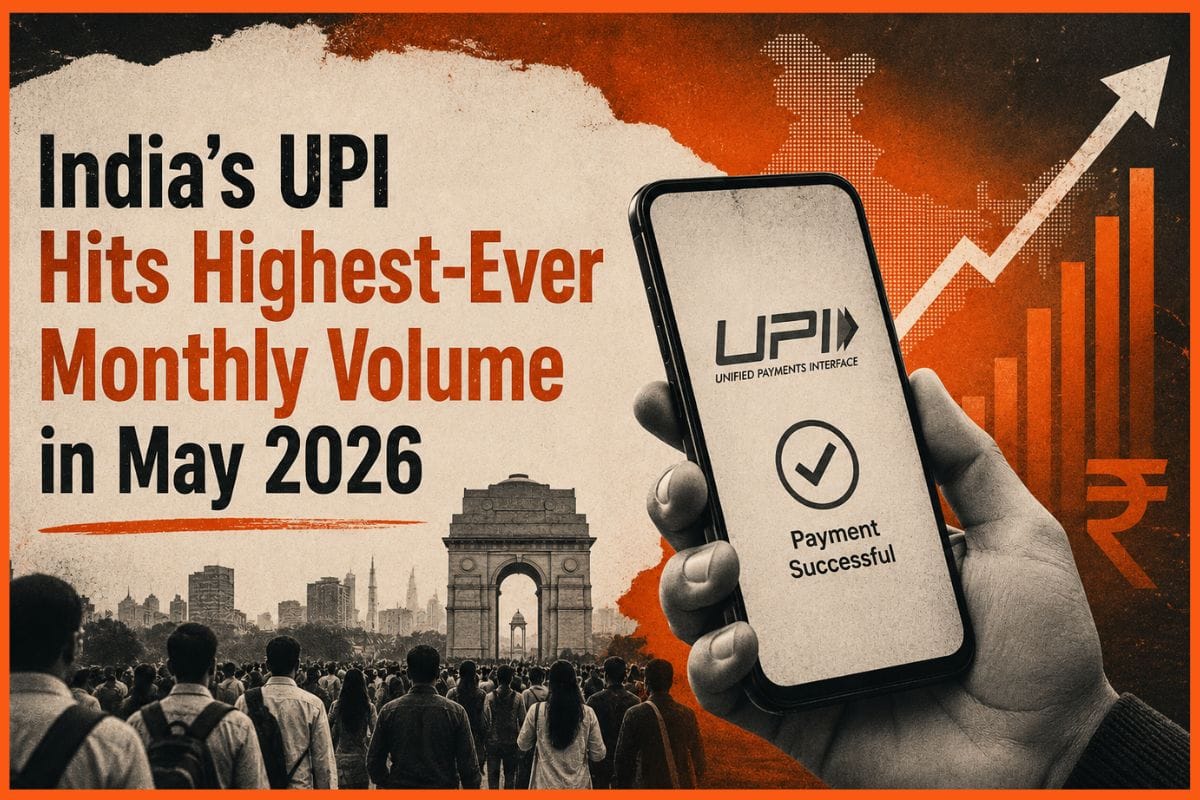
India's Unified Payments Interface (UPI) crossed 23 billion monthly transactions for the first time in May 2026, according to the latest NPCI UPI data. The digital payments platform processed a record 23.20 billion transactions worth ₹29.90 lakh crore during the month, marking a 24% year-on-year increase in transaction volume and a 19% rise in transaction value. The milestone highlights the continued growth of digital payments in India and further strengthens UPI's position as one of the world's largest real-time payment networks.
May 2026: A Historic Milestone for Digital Payments India
The May figures represent the highest monthly UPI transaction volume ever recorded since the platform was launched. The previous record stood at 22.64 billion transactions in March 2026. On average, UPI processed around 748 million transactions every day in May, while the daily transaction value reached nearly ₹96,465 crore, highlighting its growing role in India's day-to-day payments ecosystem.
Compared to April, transaction volume increased by 3.8% from 22.35 billion, while transaction value rose by nearly 3.4%. The growth follows a slight dip in April and suggests that UPI adoption continues to expand steadily, supported by strong consumer and merchant usage across the country.
UPI Monthly Transactions: March-May 2026
| Month | Transactions (Billion) | Transaction Value (₹ Lakh Crore) | MoM Growth (Volume) | YoY Growth (Volume) |
|---|---|---|---|---|
| March 2026 | 22.64 | 29.53 | +11.0% | +24% |
| April 2026 | 22.35 | 29.03 | −1.3% | +25% |
| May 2026 | 23.20 | 29.90 | +3.8% | +24% |
Source: National Payments Corporation of India (NPCI)
Key Trends Behind UPI's Growth
Several structural and cyclical forces converged to drive May's record tally.
- Small-ticket payments continue to anchor volume growth. The declining average ticket size, a figure that observers may initially read as a concern, is, in fact, a hallmark of mass adoption. As UPI penetrates vegetable markets, auto-rickshaw fares, and roadside eateries, the transaction base broadens even as individual amounts shrink. This democratisation of digital payments represents the platform's most significant long-term achievement.
- QR-code merchant adoption has accelerated substantially, particularly in Tier-II and Tier-III cities, where smartphone penetration and affordable data plans have lowered the barrier to entry for small merchants. Person-to-merchant (P2M) payments now constitute a growing proportion of total volumes, reflecting a qualitative shift from mere peer transfers to a full-fledged merchant ecosystem.
- Government-led digital payment push, through initiatives under the Digital India programme, has provided consistent tailwinds. Subsidies, awareness campaigns, and mandated acceptance at public utilities have kept onboarding momentum high even in semi-urban geographies.
- Credit-on-UPI represents perhaps the most consequential near-term opportunity. By enabling pre-sanctioned credit lines to be drawn via the UPI rail, NPCI and partner banks are positioning the platform to serve as a credit-delivery mechanism for underserved segments, a market with enormous latent demand.
- Cross-border expansion gathered further momentum in May. UPI is now live in eight countries: the UAE, Singapore, Bhutan, Nepal, Mauritius, Sri Lanka, France, and Qatar, enabling Indian travellers and the diaspora to transact in local economies without currency-conversion friction.
Who Is Processing UPI's Record Volumes?
Whilst NPCI is yet to release app-wise market share data for May 2026, April figures offer the clearest available picture of how volume is distributed across the ecosystem.
UPI App Market Share, April 2026
(Latest Available; May 2026 data pending NPCI release)
| App | Transactions | Volume Share | Transaction Value |
|---|---|---|---|
| PhonePe | 1,033 Cr | 47.07% | ₹14,31,000 Crore |
| Google Pay | 735.9 Cr | 32.9% | ₹9,72,000 Crore |
| Paytm | 177.8 Cr | 8.10% | ₹1,94,318 Crore |
| Navi | 80.1 Cr | 3.65% | ₹42,684 Crore |
| super.money | 36.9 Cr | 1.68% | ₹16,365 Crore |
| CRED | 15.7 Cr | ~0.70% | ₹56,569 Crore |
Seasonal Catalysts and Structural Drivers
Analysts attribute May's volume surge to a confluence of seasonal and behavioural factors. The Indian Premier League's peak schedule drove a measurable lift in micro-transactions, food delivery, entertainment subscriptions, and sports-related commerce. Simultaneously, the summer travel season elevated hotel, cab, and ticketing payments. Together, these cyclical drivers are layered atop the platform's compounding structural growth.
The increasing dominance of merchant payments is particularly noteworthy. As P2M transactions rise as a share of total volumes, UPI transitions from a convenience tool into a critical commercial infrastructure, a shift with significant implications for fintech lending, merchant analytics, and supply-chain financing.
A Decade of Transformation: UPI Growth Snapshot
The scale of UPI's journey from a regulatory experiment to national infrastructure is best illustrated by long-run data.
| Metric | FY2016–17 | FY2025–26 |
|---|---|---|
| Annual Transactions | 2 Crore | 24,162 Crore |
| Banks on UPI | 21 | 703 |
| Share of India's Digital Payments | Negligible | ~85% |
| Global Real-Time Payments Share | — | Nearly 49% |
Source: NPCI / Government of India
India now accounts for nearly half of all real-time payment transactions processed globally, a statistic that would have seemed implausible at UPI's launch a decade ago.
What Comes Next?
- Credit-on-UPI is the most anticipated near-term catalyst. Regulatory frameworks are being refined, and a successful rollout could meaningfully expand both the volume and the demographic reach of the platform, drawing in formal credit for the first time for millions of thin-file borrowers.
- International acceptance is set to deepen. NPCI International is in active discussions with additional market regulators, and the eventual addition of major corridors, including parts of Europe, Southeast Asia, and the Gulf, could create a de facto global Indian payments passport.
- Merchant ecosystem growth will be driven by value-added services layered atop the UPI rail, loyalty programmes, embedded insurance, and working-capital loans triggered by payment history. These services will make UPI stickier for merchants and raise switching costs across the ecosystem.
- NPCI's long-term ambitions extend to positioning UPI as infrastructure for everyday commerce rather than simply a payments conduit. The organisation has signalled aspirations around offline UPI, feature-phone compatibility, and deeper integration with India Stack, all of which, if executed, would extend the platform's addressable market well beyond its current base.
Conclusion
May 2026's record is more than a headline number. The combination of a 24 per cent year-on-year volume surge, near-₹30 lakh crore in monthly value, and daily averages approaching 750 million transactions reflects a payment system that has moved beyond adoption into ubiquity. The declining ticket size signals not saturation but deeper penetration into the informal economy. As credit-on-UPI matures and cross-border corridors expand, the platform's next inflection point may prove even more consequential than the one it has just crossed.