What HDFC Bank's Own Probe Found Behind Rs 45 Crore of "Marketing" Payments
An internal vigilance report at India's largest private bank, concluded that money paid to a Maharashtra state agency as "road safety" sponsorship was really interest the bank was not allowed to pay. HDFC Bank rejects any wrongdoing. The timing is what makes the story hard to put down.
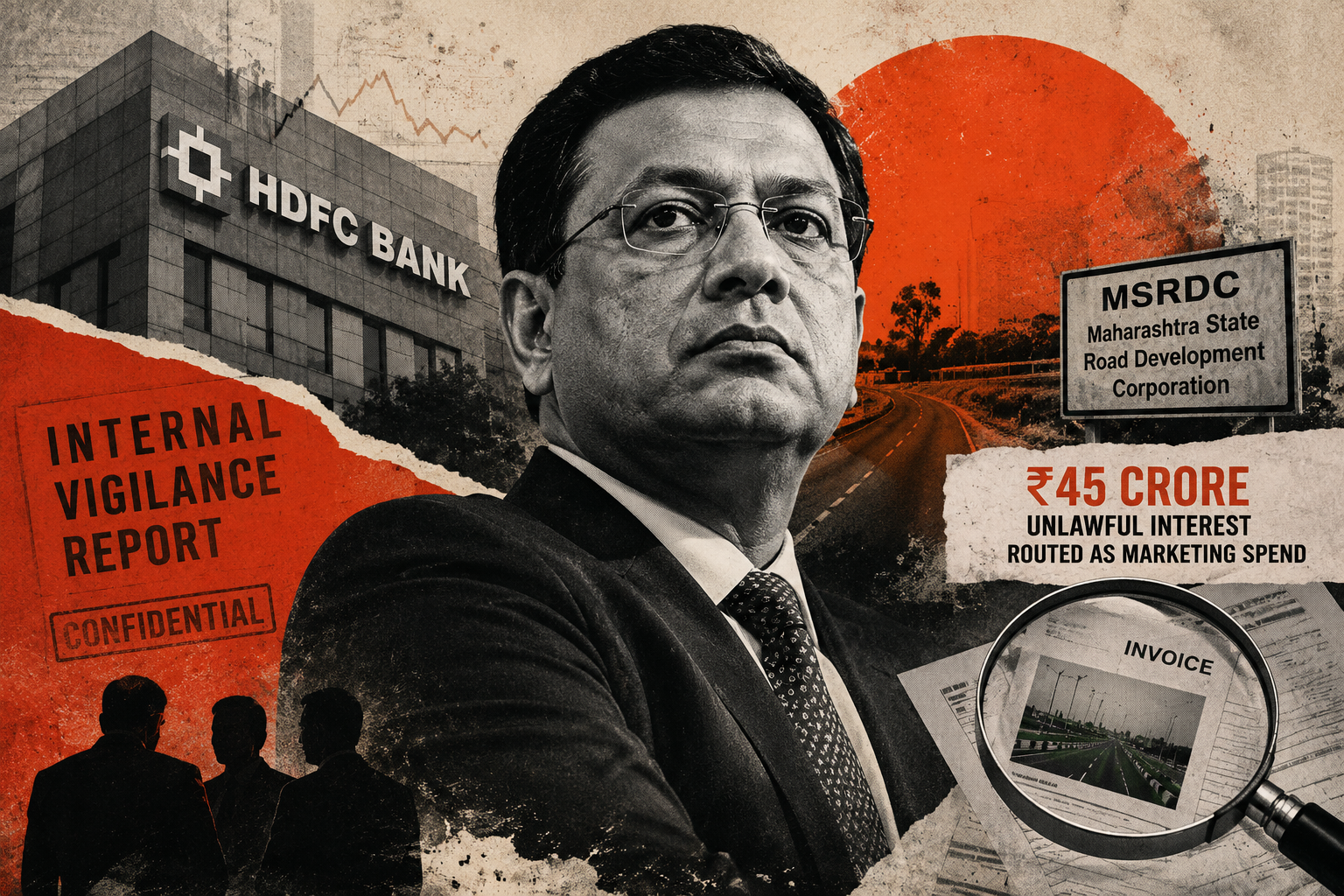
When Atanu Chakraborty resigned as chairman of HDFC Bank in March 2026, he gave a reason that was at once personal and vague. Certain "happenings and practices within the bank," he said, were "not in congruence with my personal values and ethics." He did not spell out which ones. Within days, the bank's new interim chairman and the Reserve Bank of India both stepped forward to say there was nothing wrong with HDFC Bank's governance.
Two months later, a fuller picture arrived. An investigation by The Indian Express, published on 27 May 2026, reported that the bank's own auditors had concluded it paid the Maharashtra State Road Development Corporation (MSRDC), a state government agency, around Rs 45 crore in interest it was not allowed to pay, and buried it inside its marketing budget as sponsorship of a road safety campaign.
One detail captures how thin the cover was. A single photograph, the auditors found, was attached to three separate invoices worth about Rs 9 crore, presented as proof of a campaign they could find almost no other sign had taken place. And the trail did not stop at a junior employee. The bank's internal vigilance report, the Express reported, pointed to the chief executive, the chief financial officer and the chief marketing officer, among more than ten senior names.
What happened, in simple terms
- 2021: HDFC Bank courts MSRDC's deposits. It offers 3.5% on savings; MSRDC signals rivals offer 6% or more and wants at least 6.01% to route deposits from a land-acquisition project it expected to reach about Rs 25,000 crore.
- Feb–Apr 2022: MSRDC starts placing funds, but the big money never arrives (deposits briefly cross Rs 3,000 crore in 2023). A special 4.5% large-deposit rate is shut after two months.
- 2023–2025: HDFC Bank pays MSRDC about Rs 45 crore in total, of which roughly Rs 39.7 crore flows through the marketing department as "road safety awareness" sponsorship via four vendors.
- 12 Mar 2026: The board's Audit Committee, chaired by M D Ranganath, orders an Internal Vigilance Investigation after an internal audit rates the marketing department "unsatisfactory."
- 17 Mar 2026: Chairman Atanu Chakraborty resigns, citing practices "not in congruence with my personal values and ethics."
- 19 Mar 2026: Keki Mistry is named interim chairman; he and the RBI both say there are no governance concerns.
- 10 Apr 2026: The vigilance report reaches the Audit Committee; it reportedly faults more than ten senior officials, including the MD & CEO, the CFO and the CMO.
- 27 May 2026: The Indian Express publishes; HDFC Bank "strongly rejects" wrongdoing; the stock falls about 2.7%.
The mechanism, in plain terms
"Differential interest" just means interest above the rate everyone else gets. RBI rules do not let a bank quietly hand one depositor a better savings rate than other customers.
Per the Express, the gap here was 2.51 percentage points: regular savers got 3.5%, while MSRDC had been promised 6.01%. The bank's Asset Liability Committee briefly approved a 4.5% rate for very large deposits, betting MSRDC would bring in over Rs 10,000 crore. Only around Rs 200 crore showed up at first, and that window was shut in April 2022.
So the promised gap still had to be paid somehow. The solution, the vigilance report says, was to route it through the marketing department as sponsorship of an MSRDC "road safety awareness campaign."
The internal audit's own description of the cover story is the damning part. The payments skipped the team that normally runs such campaigns. Auditors could not find any document explaining how the contribution amounts were arrived at. In one detail the Express highlights, a single photograph was attached across three invoices worth roughly Rs 9 crore, and payments went out without the event-confirmation certificates the bank's own rules required.
The marketing team's reply to auditors was unusually frank: the deal "was done by the business team (Retail Branch Banking) with MSRDC," it said, and "came to marketing for processing the payment," with extra budget handed over by finance for the purpose.
What the bank's own people reportedly said
This is the line that travelled. The Chief Marketing Officer, Ravi Santhanam, testified that the marketing department acted as a "facilitator to camouflage differential interest reimbursement as marketing spend," and that a "small portion" went on real marketing to make the invoices look legitimate. He called it a "one-off."
The findings reach higher. Per the Express, the report says MD & CEO Sashidhar Jagdishan took part in the senior call where the 6.01% structure was "verbally agreed upon" without written approval, and that CFO Srinivasan Vaidyanathan was "present at the inception of the arrangement and approved the reimbursement modality through marketing." In all, more than ten officials were found to bear responsibility.
The rules it allegedly broke
The vigilance report, the Express says, flags a breach of the RBI's Master Directions on deposit interest, the rule against negotiated rates for individual depositors. It also flags the bank's own anti-bribery policy, which bars payments that could be an "improper inducement," and a source frames it as a Banking Regulation Act issue too.
There is even a tax wrinkle. Because the money moved as vendor invoices rather than interest, the vendors would have claimed input tax credit, the bank's offset for tax paid on purchases, on what was really an interest payment.
The part that is hard to ignore: the timing
Read the dates back to back. The board ordered the probe on 12 March. Five days later the chairman resigned over unstated "ethics." Two days after that, the new interim chairman and the RBI both publicly reassured everyone that governance was fine. The MSRDC specifics did not become public for another ten weeks.
The Express's framing is that the reassurances of 19 March came six days after the board had quietly opened a vigilance investigation that the public knew nothing about. That recasts Chakraborty's ethics-citing exit as possibly less abstract than it first looked.
What HDFC Bank says
The bank is firm in denial. In a statement, HDFC Bank said it "strongly reject(s) any assumptions of wrongdoing or culpability based on selective material," and that issues are handled per established norms, with the full process followed before any final determination. At the time of publication, it had not answered the Express's detailed questions.
The RBI's reassurance also stands on the record, though it came in March: "there are no material concerns on record as regards its conduct or governance," the regulator said, describing HDFC Bank as a systemically important lender with a competent board.
What is not being asserted
The findings here are those of an internal vigilance report and an internal audit, as reported by a newspaper. They are not a regulator's finding, a court verdict, or a charge against any individual.
As far as public records show, no regulator has penalised HDFC Bank over the MSRDC payments, and the RBI's "no material concerns" statement predates the public disclosure of these specifics rather than addressing them. The named executives have not been accused of any crime; an internal report assigning "responsibility" is not proof of personal culpability. And nothing here suggests ordinary customers lost money or that MSRDC's deposits were themselves improper.
What comes next
The report now sits with the Audit Committee and the Nomination and Remuneration Committee. The checkable questions are narrow and real: does the RBI, having said "no material concerns" in March, revisit the matter now that the specifics are public? Do any of the named executives face consequences? Does the bank's "selective material" defence get borne out by the full record, or does its own report's characterisation stand?
Until late May, the public version was a chairman who left over unstated "ethics" and a regulator that saw nothing wrong. By the bank's own internal account, as reported, its auditors had already written down what those ethics were about. Which version the full record supports is now the only question that matters.
This article is journalism, not financial advice. The allegations described are the reported findings of an internal investigation, not proven facts; HDFC Bank denies wrongdoing, and no regulator or court has made any adverse finding against the bank or any named individual on this matter as of publication. If you have information related to this story, reach out through StartupTalky's tips line. Anonymity is the default.