Why Story-Driven Videos Are Winning More Attention Online
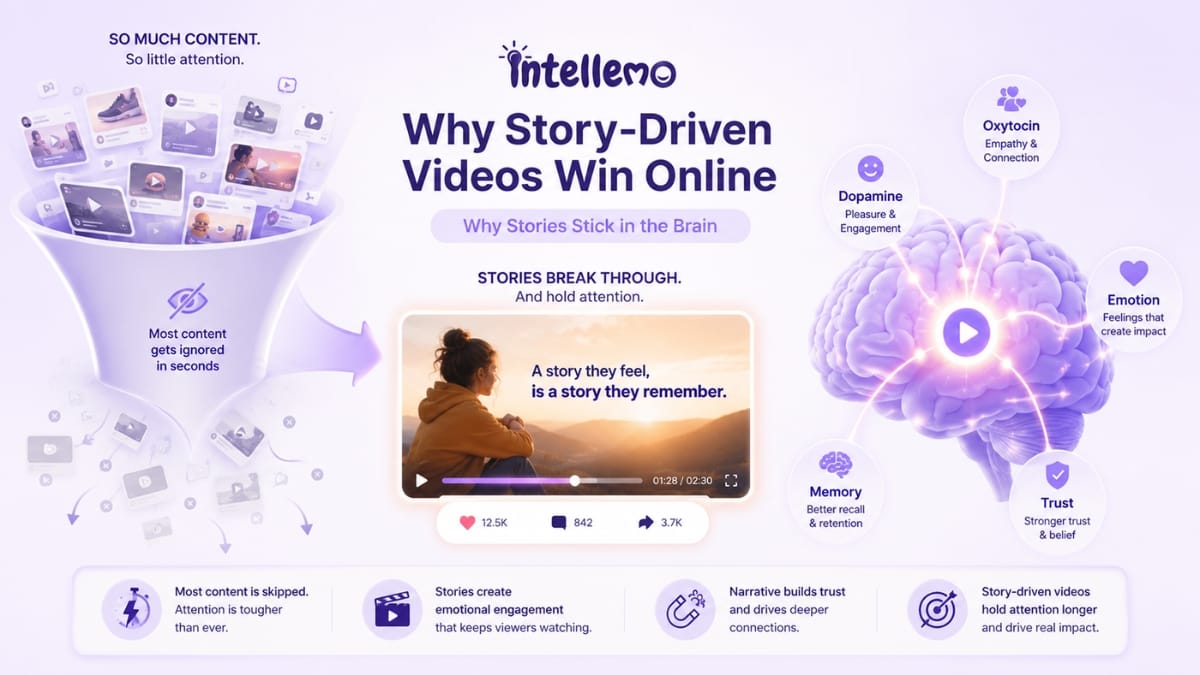
People do hundreds of scrolls on content each day without giving it a second glance. A majority of things they see are completely ignored, not because they are bad, but because they don't cause them to cease. All of these are run-by videos that take less than 2 seconds to watch and leave no real impression. However, occasionally a video pauses for someone in the middle, and they watch the entire video. They share it with someone, they think about it the next day, and the thing that made the difference was almost always a story.
Story-driven video marketing is nothing new, but it is the most effective method of capturing viewers on platforms where their attention is increasingly difficult to capture. Now, however, it is a question with practical application implications and not just a creative preference as to why this is the case and how brands can do this.
The Attention Problem Has Become Much Harder to Ignore
The amount of video available and consumed online is hard to imagine. The number of uploads on business hosting platforms rose by 15 percent between 2023 and 2024, as did the total watch time on those platforms by 44 percent. These are the two big things: more content is being produced, and more time is being devoted to consuming it.
In that context, most single videos are not designed to capture the interest of the viewers and consequently fail to keep them on the site for more than a few seconds, not because they are not interested, but because there is no compelling reason for them to remain. It's no longer a battle between brands to reach the same audience. It is between any given video and the dozens of other things competing for attention at the exact same moment on the exact same screen.
Story-driven video does this in a particular manner. Promotional content dictates what the viewer is going to learn about the brand. Story-driven content engages the viewer with a sense that the video is being made for him/her and the next moment has some meaning he/she wants to achieve.
The Science Behind Why Stories Hold Attention
If you think of video storytelling, there's more to it than just intuitive or creative sense. There is a measurable neurological explanation that content teams would benefit from understanding more concretely.
If it's a story that's unfolding and there's a real challenge or a conflict involving a character, then the brain releases oxytocin, a hormone that's linked with empathy and trust. It's not an abstract effect. It has a direct impact on the receptivity of the audience towards the message and the chances of the audience taking the action they took based on the message. There are also studies that reveal that stories cause the release of the chemicals oxytocin, cortisol, and dopamine, which help to facilitate memory retention and also to feel a true emotional bond to what is being observed.
The implications of this are important ones. Only 5-10% of what people are presented with as pure data or a list of facts is retained. These figures rise to 65-70% if the same information is presented in narrative format. That's not a small tweak in the effectiveness of the message. It is a totally different approach to whether the material "sticks" or not.
The visual element adds to this. Story-driven video integrates motion, sound, and narrative, triggering multiple brain regions at once, leading to increased engagement, longer viewing times, and significantly improved recall over any one-channel communication alone.
Why the Format Works Across Almost Any Goal or Context
Perhaps one of the most useful aspects of video for storytelling is its versatility in accomplishing various goals and reaching various audiences, regardless of the organization's mission or its target audience. A story that reflects on the true meaning of something to the people who created it, the people it impacts, and the moment it saw a real problem finally solved will resonate far more than visual branding elements and organized information. A character navigating a familiar situation with a familiar move and reaching a resolution provides the context for the viewer to understand something new and, more significantly, provides some kind of anchor to hang a narrative on, rather than some content to process and throw out.
Story-driven content also has a factor of trust and reach that other types of content don't. Research also shows that 81 percent of consumers trust an organization more after viewing a video produced by that organization, so specific and honest stories about real-life experiences help build an audience. Beyond trust, stories travel in ways that informational content almost never does, because what people choose to share with others is almost always something that made them feel something rather than something that simply informed them of a fact, and that distinction has a direct and measurable effect on how far a piece of content can actually reach.
Production Has Become Far More Accessible
Story-driven video has been a budget-intensive and time-consuming process for a long time. A scripted narrative with true production value entailed camera crews, on-screen talent, post-production editing, and a weeks-long development process. That reality made the format unaffordable for most smaller brands and content teams, meaning that they either had to drastically simplify and streamline or opt out of the format completely.
That barrier is meaningful change. High-quality narrative video, once a luxury reserved for only a few big organizations, is now possible at a little fraction of the cost, as evidence shows that some teams are able to produce a video for as little as a few hundred dollars. This transformation is being widely adopted in the industry, as AI video is expected to grow to more than $42 billion by 2033, from $3.86 billion in 2024. Platforms like Intellemo AI are already making this shift possible through AI storytelling video tools that turn text prompts into cinematic content, without the camera crew or the budget that used to come with it.
This is particularly true of story-driven content, where the creative investment, narrative development, scriptwriting with a true emotional journey, and character development or scenario building can now be matched by production tools that deliver the visual content rapidly and reliably. The current problem isn't execution anymore; it's the quality of the story itself, which is the problem now and which has likely been the problem throughout its entire existence.
What Makes Some Story Videos Work and Others Fall Flat
Not every video that has a character and a beginning-to-end structure qualifies as effective storytelling. There are specific qualities that separate narrative content that actually performs from content that follows the format on the surface without delivering the underlying effect.
- A genuine problem or tension: Viewers need a reason to stay engaged from one moment to the next. If everything in the video is going fine from the start, there is no narrative pull keeping anyone watching. The conflict does not need to be dramatic or high-stakes, but it needs to be real and recognizable to the person watching.
- A character the audience can see themselves in: Even in short-form content, the viewer needs to find something of themselves in the situation being shown. Specificity in the scenario is what creates this connection, not broad generalities about the kind of customer the brand serves.
- Emotional honesty over production polish: Research on viewer retention consistently shows that perceived authenticity reduces skepticism and increases watch time. A video that feels honest and real will hold attention more reliably than a highly polished production that feels manufactured or detached from genuine experience.
- A clear arc that arrives at resolution: The brain seeks closure in narratives. Videos that establish a problem, move through some kind of journey, and deliver a genuine resolution create a complete experience that viewers are far more likely to finish and remember.
Frequently Asked Questions
How long should a story-driven video be to hold attention effectively?
The video should be just as long as the story is and no longer. The best measure to follow is not a specific time limit; it is a completion rate.
Does the production quality of a video affect how well the story lands with an audience?
People consistently perceive authenticity as superior to high production polish when being studied by viewer research. A video with its authenticity and specificity will capture people's attention more than a video that looks costly but is lacking in a human element.
What signals actually tell you whether a story-driven video is connecting with its audience?
The most obvious indicators are watch time and completion rate. More than that, shares and comments can tell you whether your story has triggered any emotional reactions and whether or not it has accomplished its purpose.
Conclusion
Story-driven video is performing better than almost any other content format online because it works with the way human attention and memory genuinely function, not against them. The neurological case for narrative is well-documented, the platform dynamics actively reward it, and the production barriers that previously limited access to quality story-driven content have been substantially reduced. For brands that are thinking seriously about where to invest their video production effort, the practical question is no longer whether storytelling belongs in the strategy. It is how to build the capability to tell stories consistently, at a quality that earns and holds the attention those stories are competing for.