

Why Uber Paid $3.1 Billion for Careem, and Then Sold the Super App
In 2019, Uber made the largest startup-exit deal the Middle East had ever seen. How it was structured, and what Uber did with the pieces four years later, says more about what Uber actually wanted than the headline number ever did.
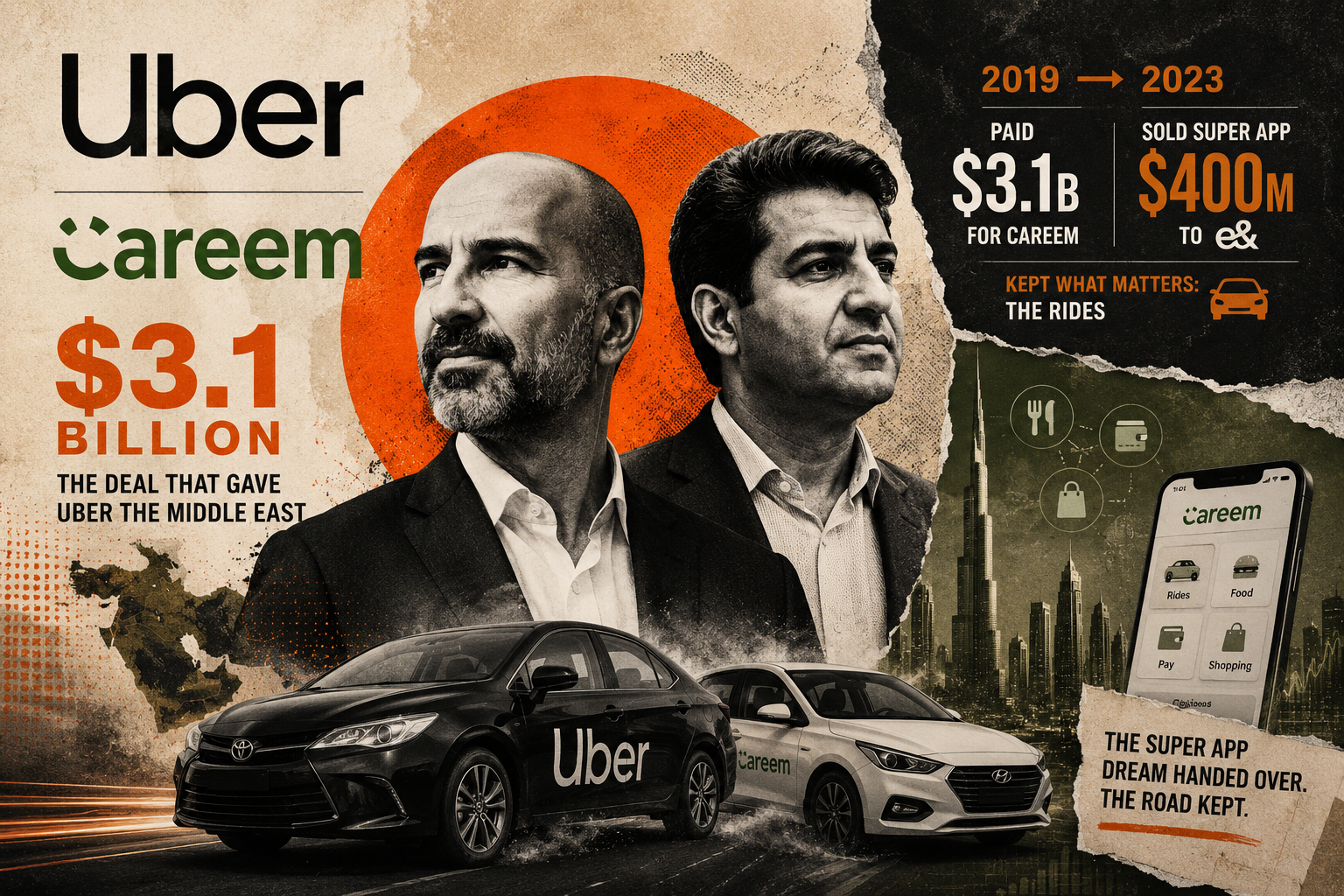
Key facts
- Total price: $3.1 billion (announced 26 March 2019, closed 2 January 2020)
- How it was paid: $1.4 billion in cash + approximately $1.7 billion in convertible notes (no interest; converted to Uber Class A stock at $55/share)
- Escrow holdback: 25% of the total price held back against post-deal surprises
- What the accounts showed: Approximately $2.5 billion of the ~$3.0 billion in net assets acquired was booked as goodwill; only $540 million was identifiable assets
- Careem at the time of the deal: 33 million users, 1 million drivers, 120 cities, 15 countries. The largest startup exit in Middle East history to that point
- 2023 unwind: Uber sold 50.03% of Careem Technologies (the super app: food, payments, shopping) to UAE telecom group e& for $400 million; deal completed 8 December 2023
- What Uber kept: The ride-hailing business outright. Careem Rides remains fully owned by Uber
Uber bought its biggest regional rival, paid for most of it with paper instead of cash, kept the boring part that fed its core business, and four years later sold the flashy growth story to a phone company. That is the Uber–Careem deal in one line.
Here is why it is worth your time. This is the single move that handed Uber the entire Middle East, and the 2023 unwind shows exactly what a ride-hailing company keeps once the "super app" dream starts getting expensive.
What happened, in simple terms
- 2012: Careem is founded in Dubai by Mudassir Sheikha and Magnus Olsson, two former McKinsey consultants. Abdulla Elyas joins as a co-founder in 2015.
- 26 Mar 2019: Uber agrees to buy Careem for $3.1 billion, made up of $1.4 billion in cash and about $1.7 billion in convertible notes.
- 2 Jan 2020: The deal closes in the big markets: Egypt, Jordan, Saudi Arabia and the UAE. Pakistan, Qatar and Morocco still need their regulators to sign off.
- 10 Apr 2023: Uber agrees to sell most of Careem's "super app" (everything except rides) to UAE telecom group e&.
- 8 Dec 2023: That sale completes. e& takes 50.03% of the super app for $400 million. Uber keeps Careem's ride-hailing business outright.
The price, and how it was paid
The headline was $3.1 billion. The structure was the interesting part.
Only $1.4 billion of it was cash. The other ~$1.7 billion came as convertible notes, a kind of IOU that turns into Uber shares later instead of being paid out in money up front. Uber's own annual filing spells out the terms: the notes paid no interest, matured 90 days after issue, and converted into Uber stock at $55 a share. Uber also held back a quarter of the price, 25% of the total, as cover against post-deal surprises.
For that price Uber got a company running 33 million users, a million drivers, 120 cities and 15 countries. Careem had raised around $800 million over its life and was last valued near $2 billion. So $3.1 billion was a real premium, and at the time it was the biggest exit a technology startup in the Middle East had ever produced.
Why pay mostly in IOUs
Two reasons, and both tell you something.
First, timing. Uber was weeks from its May 2019 stock-market debut. Paying in notes that convert into Uber shares preserved cash and tied Careem's payout to Uber's own listing instead of draining the bank before the IPO.
Second, this was not really a growth purchase. It was a ceasefire. Uber and Careem had burned money against each other across the region for years. Buying Careem ended that war in one stroke. Dara Khosrowshahi called Careem "one of the most successful startups in the region"; the cleaner read is that it was cheaper to own the competition than to keep fighting it.
What $3.1 billion actually bought
This is the part I keep coming back to, and it only shows up if you read Uber's accounts. After the deal closed, Uber booked about $2.5 billion of the price as goodwill, out of roughly $3.0 billion in net assets acquired. Goodwill is the premium a buyer pays over the identifiable, countable value of what it gets. Uber's filing attributes it to "the assembled workforce of Careem and anticipated operational synergies."
Only $540 million was identifiable assets: $270 million for Careem's rider relationships, $120 million for the Careem brand name, $110 million for its technology, and $40 million for its driver network.
Read that the plain way. Roughly five-sixths of the price was not for technology or contracts. It was for the team, the market position, and the rival no longer being a rival.
A close that arrived in pieces
Big cross-border deals need antitrust clearance, where regulators check that the combined company will not unfairly dominate a market. Careem's footprint made that slow.
When the deal formally closed on 2 January 2020, it closed in four markets only: Egypt, Jordan, Saudi Arabia and the UAE. The rest were carved out and handled separately. Pakistan cleared the following month, in February 2020. Qatar and Morocco were the holdouts, and Qatar was the hardest of all: Uber's filing notes that Qatar's competition authority had blocked the deal outright in August 2019, a decision Uber was appealing, though Qatar was only about 1.8% of Careem's business.
Careem kept its brand, app and CEO. Sheikha stayed on, reporting to a board of three Uber representatives and two from Careem. The two apps even kept competing in the same cities: Uber owned Careem, and Careem kept taking riders from Uber.
The 2023 unwind, which is the real tell
Here is the part most people missed.
Careem's pitch was never just rides. Sheikha wanted a super app: one application for moving, eating, paying and shopping. He told the market the goal was to "build a more holistic view of the consumer," and Careem had already poured around $150 million into its delivery arm.
In 2023, Uber stopped funding that dream itself. Careem was split in two: Careem Rides (ride-hailing) and Careem Technologies (the super app). UAE telecom group e& bought 50.03% of the super app for $400 million. Uber kept the ride-hailing business in full.
Sit with those numbers. Uber paid $3.1 billion in 2019. Four years on, the whole super-app business, the part Careem always sold as its future, was valued at well under a billion dollars when the majority stake changed hands. Uber chose to keep the rides.
What this signals
Uber did not buy Careem to build a super app. The accounts say it plainly: it paid for a workforce, a market position, and the end of a price war. The super app was the seller's dream, and the moment it needed real, sustained capital, Uber handed it to a local telecom and kept the cash-generating rides for itself. The thing everyone wrote about in 2019 turned out to be the part Uber was happiest to let go of.
If I'm honest, it's the 2023 sale that convinced me of this, more than anything in the original 2019 press release. A company tells you what it actually values by what it refuses to keep paying for.
What comes next
Two things worth watching.
Careem Pay and the rest of the super app now sit under a phone company. A telecom running fintech and delivery across the region is a different animal than a startup, and it holds the customer relationship Uber once paid billions to reach. Meanwhile the rides are split from the app that was meant to make them sticky. Uber's bet is that Gulf ride-hailing stays dominant on its own, without the super-app glue Careem spent a decade building.
The headline said $3.1 billion. The structure said Uber wanted the road, not the everything-store built on top of it. The next time a global platform "buys a super app" in an emerging market, watch what it keeps when the bill comes due. That is the part it actually wanted.
If you have information related to this story, reach out through StartupTalky's tips line. Anonymity is the default.
Frequently asked questions
How much did Uber pay to acquire Careem?
Uber agreed to pay $3.1 billion, structured as $1.4 billion in cash and approximately $1.7 billion in convertible notes that would convert into Uber shares at $55 per share.
When did the Uber–Careem acquisition close?
The deal closed on 2 January 2020 in four initial markets: Egypt, Jordan, Saudi Arabia, and the UAE. Pakistan received regulatory approval in February 2020; Qatar and Morocco required separate clearance.
Did Uber keep the Careem brand and app after the acquisition?
Yes. Careem kept its own brand, app, and CEO Mudassir Sheikha. The two apps continued operating in the same cities, with Careem still competing against Uber even under Uber's ownership.
How much of the $3.1 billion Careem price was goodwill?
Approximately $2.5 billion of the roughly $3.0 billion in net assets acquired was booked as goodwill, per Uber's FY2020 10-K filing with the SEC. Only $540 million was identifiable assets: $270 million for rider relationships, $120 million for the brand name, $110 million for technology, and $40 million for the driver network.
What did Uber sell to e& in 2023 and for how much?
Uber sold a 50.03% stake in Careem Technologies (the super app covering food delivery, payments, and shopping) to UAE telecom group e& for $400 million. The deal was announced on 10 April 2023 and completed on 8 December 2023. Uber kept Careem's ride-hailing business in full.


