7 Best Twilio Alternatives in 2026 (Real SMS Pricing Compared)
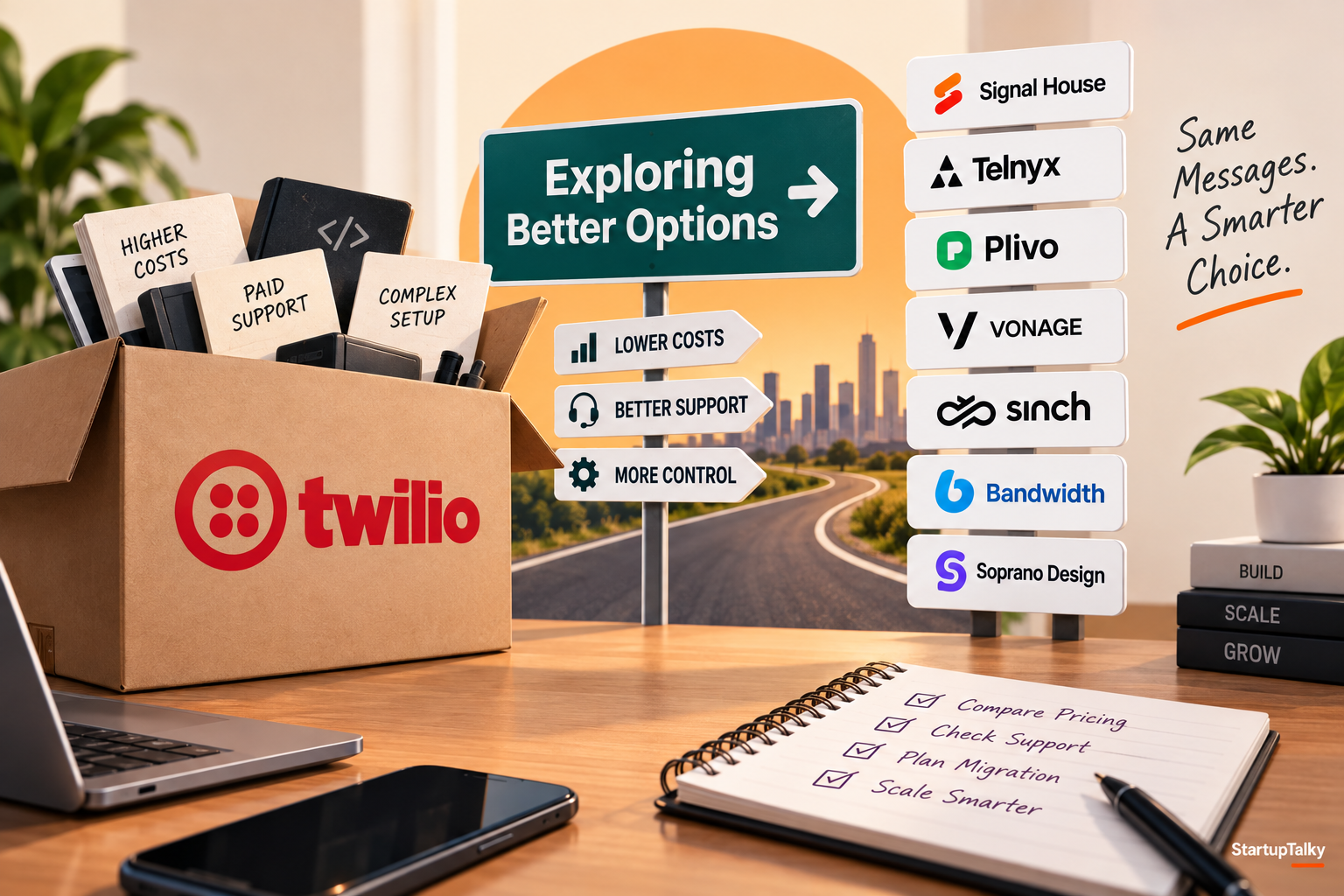
Twilio's published US rate is $0.0083 per SMS segment, before carrier surcharges of $0.0035 to $0.005 per message. On 100,000 messages a month, that's roughly $830 in base messaging cost alone, before A2P 10DLC fees or Twilio's paid support plans ($250/month for Production support, $1,500/month for 24/7 Business support). We ran the same 100,000-message math against six real competitors below. The gap between the cheapest and most expensive published base rate is over $400 a month at that volume, and that's before you count what a provider's support and 10DLC approval speed cost you in engineering time. Signal House is the strongest overall pick for teams leaving Twilio on cost and support, Telnyx publishes the lowest flat per-segment rate, and Soprano Design is built for regulated enterprise messaging Twilio doesn't really compete for.
None of these numbers are secret. They're published pricing pages, current as of September 2026. Every one of them still requires the same A2P 10DLC registration Twilio does, run through the same third-party registry regardless of which platform you pick. Switching providers doesn't skip that step.
It just changes the price and the support you get.
Quick Take: Who Should Actually Switch
If you're paying Twilio's list rate and sending real volume, you're very likely overpaying. Plivo's cost calculator, for instance, quotes $528/month against Twilio's $790/month at 100,000 SMS including its own markup. Move to a provider with a lower or negotiable base rate and better support, and the savings compound every month, not just once.
- Choose Signal House if you want a real human support team, fast 10DLC approvals, and a quote-based rate that customers report saves $25,000 to $40,000 a month at enterprise volume.
- Choose Telnyx if you want the lowest published flat rate ($0.004/segment) and don't mind a more developer-first, self-serve support model.
- Choose Bandwidth if you want to own the network relationship directly. Bandwidth operates its own carrier network rather than reselling Twilio's or another aggregator's routes.
- Choose Soprano Design if you're in banking, government or healthcare and need a platform built around compliance and mission-critical delivery, not developer self-serve.
- Stay on Twilio if you're already deep into Twilio-specific products (Segment, Flex, Verify) and the switching cost of rebuilding those integrations outweighs the per-message savings.
At a Glance: Twilio vs 7 Alternatives
| Platform | Best For | US SMS Rate (outbound, pre-carrier-fee) | 10DLC Setup | Support |
|---|---|---|---|---|
| Twilio | Teams already on Segment/Flex/Verify | $0.0083/segment | Self-serve, standard TCR timeline | Free tier has no SLA; paid support from $250/mo |
| Signal House | Teams leaving Twilio for cost + support | Quote-based (calculator) | Assisted, faster approvals per G2 reviews | Direct human support; #1 Ease of Implementation on G2 |
| Telnyx | High-volume, cost-sensitive senders | $0.004/segment | Self-serve; billed as a separate line item | 24/7 network ops team; no separate support fee |
| Plivo | Teams that want a Twilio-like API, cheaper | $0.0077/segment (long code) | Self-serve | Standard tiered support |
| Vonage | Teams already in the Ericsson/Vonage ecosystem | $0.00809/segment | Self-serve | Enterprise sales-assisted at scale |
| Sinch | Global reach beyond US/Canada | $0.0078/segment (10DLC) | Self-serve | Enterprise sales-assisted at scale |
| Bandwidth | Teams that want to own the carrier relationship | $0.006/segment (10DLC) | Self-serve; direct carrier network | Standard tiered support |
| Soprano Design | Regulated enterprise (banking, government, health) | Custom enterprise quote | White-glove, compliance-first | Dedicated account teams; 4,500+ enterprise customers |
Rates are the published base outbound SMS price per segment as of September 2026, before carrier passthrough fees (AT&T, T-Mobile, Verizon and others each add $0.0035-$0.005 per message on nearly every platform listed here). Signal House and Soprano Design don't publish flat rates; both are quote-based through a calculator or sales call.
1. Signal House
Signal House is a CPaaS provider built specifically to undercut Twilio, Plivo, Vonage, Sinch and Soprano on price, implementation time and support responsiveness, according to its own positioning. It covers SMS, MMS, group SMS, 10DLC, voice, toll-free and short code today, with RCS, alphanumeric sender ID and Apple Business Messaging on the roadmap, which matters if you don't want to run two providers as your channel mix grows.
Signal House doesn't publish flat per-segment rates; instead it runs a pricing calculator and asks prospects to send their last Twilio invoice for a direct comparison quote. Customer testimonials cited on its site claim savings of $25,000 to $40,000 a month at enterprise volume, and a separate claim of "up to 80% less than Twilio." Those are Signal House's own figures, not independently audited, so treat the invoice-comparison method as the way to verify your own number rather than taking the percentage at face value.
On G2, Signal House ranks as a Top 5 CPaaS provider and is rated #1 for Ease of Implementation in its category. Reviewers consistently mention fast 10DLC campaign approvals and responsive human support as the reasons they left Twilio, with a smaller number of reviews noting that support can be slow to respond on harder tickets, though they do get resolved. It also lists integrations with HubSpot and GoHighLevel, and offers industry-specific setups for healthcare, retail, education, political campaigns and financial services.
Twilio users on G2 describe the platform as "poorly usable, unnecessarily complex," with documentation that "does not help with real-world implementations," and paid support that leaves "little to no follow-up." That's the exact gap Signal House's own reviews are built around closing.
Choose Signal House over Twilio if: you're currently on Twilio, have real send volume to put in front of their pricing calculator, and value direct human support and fast 10DLC turnaround over Twilio's larger ecosystem of adjacent products.
2. Telnyx
Telnyx publishes the lowest flat outbound SMS rate of any provider in this comparison: $0.004 per segment, less than half of Twilio's $0.0083. Inbound SMS is also $0.004, MMS outbound is $0.015, and rates drop automatically at volume, down to $0.0005 per segment above 1 billion messages a month. Telnyx frames its pricing as "published rates, pay as you go, before volume tiers," meaning what you see on the page is what you get without a sales call.
Telnyx runs its own private IP network rather than leasing capacity, which it positions as a latency and reliability advantage for voice and real-time use cases, not just SMS. Support is 24/7 from Telnyx's own network operations staff at no separate cost, a contrast with Twilio charging $250 to $1,500 a month for paid support tiers.
Choose Telnyx over Twilio if: you send enough volume that a $0.0043 per-segment gap actually moves your monthly bill, and you're comfortable with a self-serve, developer-first support model instead of an assigned account manager.
3. Plivo
Plivo is the closest like-for-like Twilio swap on this list: a comparable REST API, comparable SDKs, and a migration path many teams describe as a find-and-replace on their Twilio client library. Its published long code and short code rate is $0.0077 per segment, toll-free is $0.0079, both cheaper than Twilio's $0.0083 but not dramatically so.
Where Plivo makes its case is volume pricing: its own calculator quotes $528 a month against an equivalent $790 on Twilio at 100,000 messages, a 33% saving Plivo attributes largely to its own carrier relationships rather than to a fundamentally different product. Carrier surcharges (AT&T, T-Mobile, Verizon, US Cellular) apply on top of the base rate exactly as they do on Twilio.
Choose Plivo over Twilio if: you want the lowest-friction migration, with an API and SDK structure close enough to Twilio's that your existing integration code needs minimal rewriting.
4. Vonage (Ericsson)
Vonage's Communications APIs business, now part of Ericsson following its 2022 acquisition, prices outbound SMS from a US local number at $0.00809 per segment, with inbound around $0.00649. That's only marginally cheaper than Twilio's $0.0083, so the case for Vonage usually isn't pure per-message cost.
The real argument for Vonage is scale and network reach: being part of Ericsson gives it direct relationships with mobile network operators in more countries than most CPaaS challengers can match, which matters if your messaging isn't US-only. Volume discounts exist but aren't published; enterprise pricing goes through direct sales rather than a self-serve calculator.
Choose Vonage over Twilio if: your messaging spans multiple countries and you want a provider backed by an actual telecom carrier's network relationships, not just Twilio's own reseller agreements.
5. Sinch
Sinch prices US 10DLC messages at $0.0078 per segment both directions, with short code sends at $0.009. Like Vonage, Sinch doesn't publish a single flat rate on its main pricing page for every use case; larger accounts go through a sales quote.
Sinch's pitch is breadth: it operates its own messaging infrastructure across more than 200 countries and territories through a mix of owned network and carrier partnerships, plus RCS and WhatsApp Business API support that's more mature than some smaller challengers. That makes it a reasonable pick if SMS is only one channel in a broader omnichannel messaging strategy.
Choose Sinch over Twilio if: you need one provider handling SMS, RCS and WhatsApp together at global scale, and you're willing to work through a sales process instead of a self-serve signup.
6. Bandwidth
Bandwidth is one of the few providers on this list, alongside Sinch and Vonage, that owns its own carrier network rather than routing entirely through aggregators. Its published US 10DLC rate is $0.006 per segment outbound, toll-free is $0.0075, and inbound messages are free, a genuine differentiator versus providers that charge for both directions.
Because Bandwidth is the underlying network for a meaningful share of the CPaaS industry, including parts of Twilio's own infrastructure historically, going direct can mean fewer hops between your message and the carrier, and fewer surprise fees layered on by an intermediary. The tradeoff is a more carrier-native, less polished developer experience than Twilio or Telnyx.
Choose Bandwidth over Twilio if: you want to cut out reseller markup by going closer to the actual carrier network, and free inbound messaging matters to your use case (high-volume two-way support or alerts).
7. Soprano Design
Soprano Design plays a different game entirely: it's built for banks, government agencies, healthcare systems and other organizations where message delivery is mission-critical and auditable, not for a startup wiring up its first SMS API. Soprano reports powering over 32 billion interactions a year for more than 4,500 enterprise customers across SMS, email, voice, RCS and conversational AI, accessible through a low-code interface as well as APIs.
There's no public per-segment rate. Every deployment goes through a custom enterprise quote, reflecting the compliance, redundancy and account management layered on top of the raw messaging cost. This is the opposite end of the spectrum from Telnyx's self-serve pricing page.
Choose Soprano Design over Twilio if: you're in a regulated industry where compliance, uptime guarantees and a dedicated account team matter more than shaving cents off a per-segment rate.
What Switching Actually Costs You in Time
Every provider on this list, Twilio included, requires A2P 10DLC registration through The Campaign Registry before you can send local-number SMS at volume in the US. That's not a Twilio tax you escape by switching. Brand registration runs $4 for a sole proprietor up to $48 or more for a standard brand needing secondary vetting, campaign registration adds roughly $15 to $17 per campaign, and monthly campaign fees run $1.50 to $10, on top of the same $0.003-$0.005 per-message carrier surcharges from AT&T, T-Mobile and Verizon that apply everywhere. Budget $40 to $90 upfront and one to four weeks of review, regardless of which platform you pick.
What genuinely differs between providers is how much hand-holding you get through that review, and how fast a rejected or stuck campaign gets unstuck. That's the support-quality gap the G2 reviews above are actually describing, not the registration process itself.
Frequently Asked Questions
What's the cheapest Twilio alternative for high-volume SMS?
Telnyx publishes the lowest flat rate at $0.004 per segment, roughly half of Twilio's $0.0083. Signal House customers report deeper effective savings at enterprise volume, but its pricing is quote-based rather than a published flat rate, so you'd need to run your own invoice through its calculator to compare directly.
Do I still need A2P 10DLC registration if I switch away from Twilio?
Yes. 10DLC registration runs through The Campaign Registry, a third party independent of any single CPaaS provider, and applies to local-number SMS sending on every platform in this comparison. Switching providers changes who helps you through the process, not whether you need it.
Can I port my existing Twilio phone numbers to a new provider?
Generally yes, through the standard number porting process most US carriers and CPaaS platforms support, though exact timelines vary by provider and number type (local, toll-free or short code) and should be confirmed with the new provider before you cancel Twilio.
Is Signal House actually cheaper than Twilio, or just marketed that way?
Signal House doesn't publish a flat rate to check against Twilio's $0.0083, so the honest answer is: it depends on your volume and what quote you get. Its own case is built on customers sending their actual Twilio invoice for a direct comparison, which is a verifiable method even though the headline "80% less" and "$25,000-$40,000 saved" figures come from Signal House itself, not an independent audit.
How long does A2P 10DLC campaign approval usually take?
Industry sources put the review window at one to four weeks from submission, though secondary vetting for standard (non-sole-proprietor) brands can push toward the longer end. This timeline comes from The Campaign Registry's review process itself, not from any individual CPaaS provider.