Building High-Trust Workplaces in the AI Era: Insights from Akshat Shah of Great Place To Work India
Akshat Shah shares insights on workplace trust, AI-driven culture shifts, employee engagement, and how Indian organisations can build high-performance, future-ready workplaces.
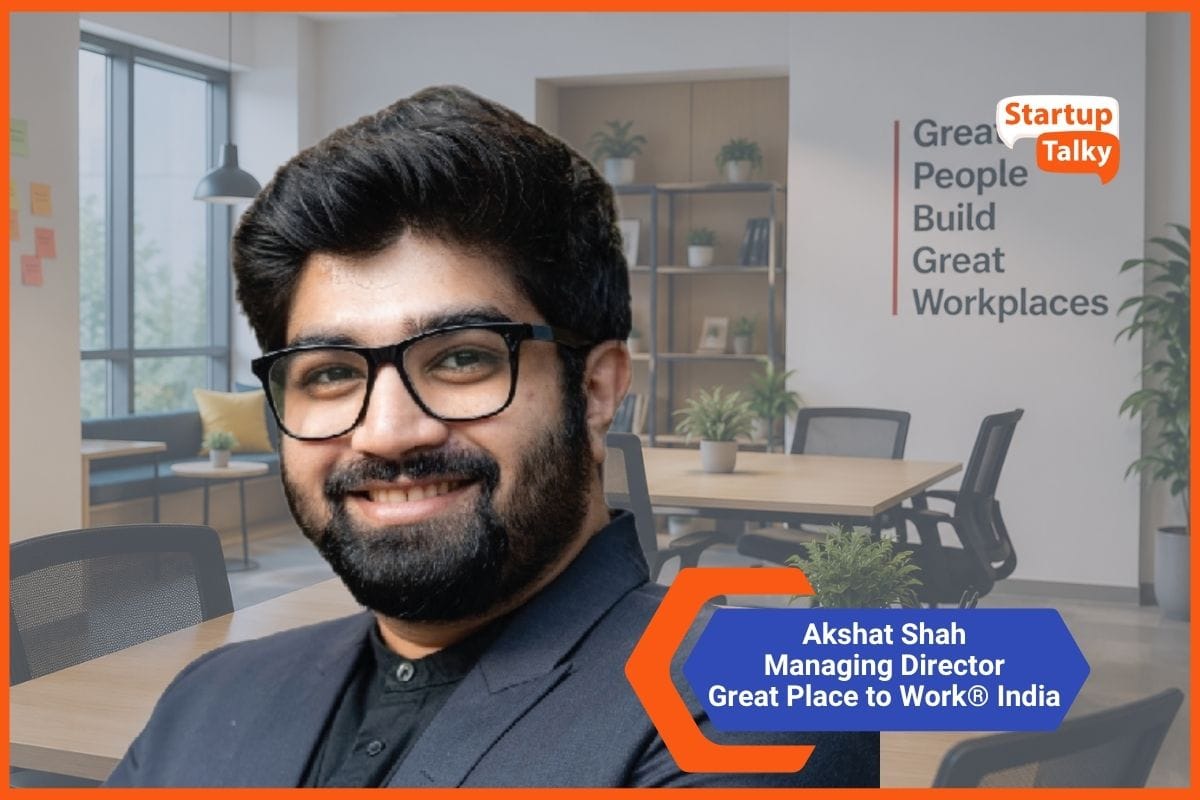
As hybrid work, AI adoption, and changing employee expectations reshape workplaces across India, organisations are being forced to rethink how they build trust, engagement, and performance. According to Great Place To Work studies, employees in Certified workplaces report 20% stronger leadership support and greater preparedness for AI adoption. Additionally, 8 in 10 employees say they are more likely to work for a Great Place To Work Certified™ company, highlighting the growing importance of workplace culture in talent attraction and retention.
In this interview with StartupTalky, Akshat Shah, Managing Director at Great Place To Work, shares how the definition of high-trust culture has evolved in India, why transparency and listening matter more than perks, and how organisations can build resilient, future-ready workplaces in the age of AI.
The Evolution of High-Trust, High-Performance Culture in India
StartupTalky: Considering the fast-changing nature of work models and the rise of AI, how has the definition of a "high-trust, high-performance culture" changed within the Indian context over the past three years?
Akshat Shah: In India, the definition has matured from engagement in the traditional sense to adaptability and resilience at speed. The change in work models and the rise of AI have forced leaders to change their management style to a more “outcome-based approach” as opposed to a “presence-based” system.
In sectors where AI is reshaping roles and fuelling anxiety, a new question of trust has been introduced. Therefore, in times like these, a high-trust, high-performance culture is one in which employees feel informed, treated fairly, developed continuously, and safe to speak up, especially during uncertain times. In Certified Workplaces, 20% more employees report stronger leadership support, a positive outlook on AI, and greater preparedness for AI adoption. When people are underprepared and anxious, there is a visible adverse impact on performance, not because of the lack of talent, but on account of the lack of trust.
The Overlooked Drivers of Employee Trust and Pride
StartupTalky: Beyond traditional benefits, what are the most impactful, yet often overlooked, elements that help build genuine employee trust and pride in today’s diverse Indian workplaces?
Akshat Shah: Trust in India is less about policies and more about day-to-day experiences and interactions. Every interaction with an employee, colleague, or team member is an opportunity to build trust. Think about how a manager responds to bad news, whether promotions feel earned, whether feedback is heard, and whether people can log off without guilt.
Three overlooked levers that I like to talk about with leaders:
- Purpose: Employees are constantly seeking meaning, community, and visible impact.
- Fairness that you can explain: It’s important to be fair and also be seen as being fair. Employees are reasonable when they’re given clarity and reasons that make sense.
- Listening and co-creation: Extremely underrated in my view, this is the most important leadership behaviour in building trust.
Measuring Trust Across India’s Multi-Generational Workforce
StartupTalky: How do you ensure Great Place to Work's proprietary metrics, such as the Trust Index™ and Culture Audit™, effectively capture the unique expectations of India's multi-generational workforce, especially Gen Z and Millennials?
Akshat Shah: Our Trust Index™ is a structured employee experience survey that measures trust through the five dimensions of credibility, respect, fairness, pride, and camaraderie, and it combines scaled responses with open-ended voice and demographic cuts.
This enables us to understand both the core human experience of trust and the consistency of that experience across groups. We believe in the Great Place To Work For All philosophy, and we treat multi-generational expectations like a feature, not a complication.
Our Trust Index survey has repeatedly showcased how Gen Z and Millennials don’t necessarily want more perks, but instead, they are looking for transparency, growth velocity, and above all, purpose. The Culture Audit™, on the other hand, looks at whether the organization’s people practices can actually deliver on these promises, especially for different demographic groups.
This dual-lens approach enables us to guide organizations in translating leadership intent into what employees actually live day-to-day.
How Culture Assessments Drive Business Outcomes
StartupTalky: Can you share a specific example where a data-driven approach to workplace assessment, supported through certification, led to clear business outcomes or improved organisational resilience for an Indian company?
Akshat Shah: Among others, a strong example is IHG Hotels & Resorts in India, where culture assessment helped move from intent to measurable outcomes. The organization used the Trust Index™ and Culture Audit™ to identify gaps in recognition, fairness, inclusion, and leadership perception across locations and roles, then acted with targeted interventions like strengthened recognition, improved work design, inclusive hiring, and stronger development mechanisms.
What’s powerful is that the shifts weren’t just “culture wins.” They translated into business-relevant outcomes: 35% growth in internal promotions, 12% lower absenteeism, and 15% higher referrals/engagement outcomes that matter even more in high-attrition, high-service environments.
We have numerous case studies like this that reaffirm that a data-driven approach is key, and that measurement helps build culture intentionally, not accidentally.
The Competitive Advantage of Workplace Certification
StartupTalky: In a time where employer branding is crucial, how does Great Place To Work Certification translate into a real competitive advantage for attracting and retaining talent, especially for organisations dealing with growth or market changes?
Akshat Shah: An organization is Great Place To Work Certified™ only when the employees say so. The fact that it’s rooted in employee experience and backed by a consistent methodology makes it valuable.
For organizations experiencing change/growth, the advantage is two-fold:
1) Attraction: It creates credibility with talent who are increasingly skeptical of glossy employer marketing. 90% Employees cite work culture as a crucial consideration when selecting a potential employer.
2) Retention: It gives leaders a clear diagnosis of what to protect while scaling, and what to fix before it becomes attrition.
8 in 10 employees say that knowing a workplace has been Certified makes them more likely to want to work there. In a market where AI and automation are reshaping roles and even triggering workforce anxiety, organizations that pair change with transparency and development will win.
Addressing Scepticism Around Workplace Certifications
StarupTalky: How does Great Place To Work address and reduce scepticism around workplace certifications, ensuring the process remains a true and reliable reflection of an organisation’s culture rather than just a marketing tool?
Akshat Shah: Scepticism to a degree is understandable in my view, and perhaps it helps keep the standard honest.
For us, it has always been about making the process employee voice-led and practice-backed. The Trust Index™ captures employees’ lived experience through a structured survey across multiple dimensions and open-ended input. The Culture Audit™ checks whether the organization’s people practices can sustain that experience. This approach, over the past 3 decades, has aided us in representing millions of employee voices across 180 countries, adding tremendous pride and validation for partner organizations.
Our assessment process is rigorous and offers data-backed insights for leaders across genders, teams, and other demographics. There are numerous reported cases of improved business performance through our partnership, resulting in a stronger, engaged workplace culture. Certification, thereby, is a byproduct. It is a win for organisations that truly invest in creating a high-trust environment, and the experience is validated by their employees. The true essence lies in listening, learning, and improving.
The Different Cultural Challenges Faced by Startups and Enterprises
StartupTalky: Based on your experience across sectors, what key HR priorities and cultural challenges differ between agile Indian startups and established large enterprises when building high-trust, high-performance environments?
Akshat Shah: This is a very interesting question, as both of these organizations are seeking high trust but are essentially trying to solve different challenges.
Startups in India are looking for indiscriminate speed while avoiding chaos. Their priorities tend to be around: speedy manager capability building, decision and directional clarity, and avoiding burnout among key people. The risk is that execution becomes paramount and psychological safety takes a back seat at the altar of urgency.
For large enterprises, it’s all about managing consistency at scale. Communication and last-mile connectivity become key to avoiding cultural fragmentation across managers or teams. Fairness across the board and limited growth or internal mobility have also come up as concerns during our studies. The risk they run is usually erosion of trust and people feeling like a number because of a one-size-fits-all approach.
The Future of Workplace Culture by 2030
StartupTalky: With the growing use of hybrid work and digital tools, what trends do you expect will shape the future of workplace culture measurement and define “best workplaces” by 2030?
Akshat Shah: Best Workplaces in 2030 will be defined less by what they offer and more by how they lead in times of change. Three trends that I expect:
The role of Trust will be more significant than ever. It will be the true indicator of adaptability and organizational resilience.
“For All” will be the differentiator. The Best Workplaces will be the ones with the highest consistency across all cohorts of their people.
The ability to learn, unlearn, and re-learn at scale will be a crucial currency.
Akshat Shah’s Advice for Building Future-Ready Organisations
StartupTalky: For HR leaders aiming to create truly employee-first cultures that are adaptable and future-ready, what is your most important strategic advice to build and maintain high levels of trust and performance?
Akshat Shah: A personal belief that I carry as a leader is that Trust is not built by being perfect. It’s built by being consistent and authentic. Authentic leadership starts with listening; it’s the most underrated yet most powerful of the 9 key leadership behaviors.
From a strategy standpoint, high trust and performance are increasingly about flow and not force. Organizations that will win in the remainder of this decade will not be the busiest, but those with the least friction, i.e., more agile and more aerodynamic. Thus, focus on the free flow of information to aid faster decision-making, and eliminating any operational drag will be paramount. In other words, a “Zero Drag” culture is the key to building and maintaining high levels of trust and performance, especially during uncertain times.
 Sanvi Barjatya