Mohit Gupta of EquiRize on India's Retail Bond Market, SEBI's OBPP Framework & the Future of Fixed Income Investing
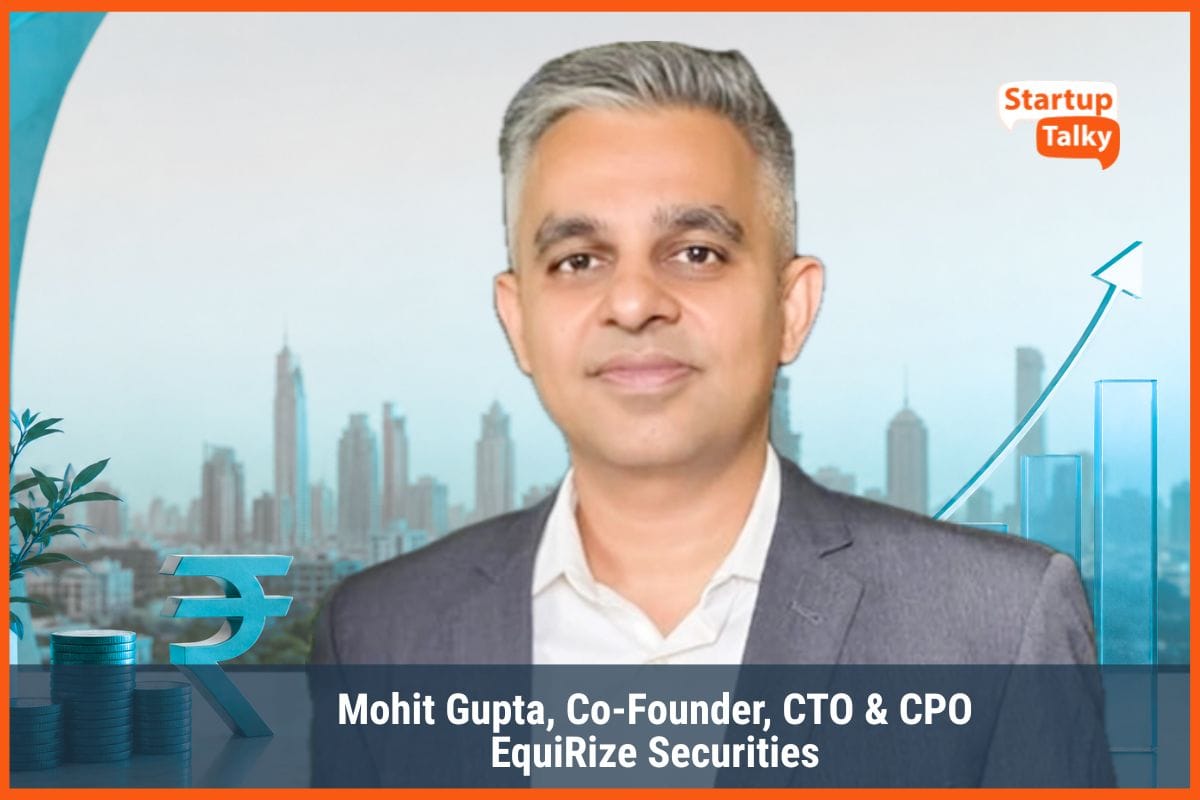
India's fixed income market is growing as SEBI reforms and digital platforms improve retail access. In this StartupTalky interview, Mohit Gupta, Co-Founder, CTO & CPO of EquiRize Securities, discusses bond investing, regulations, technology, investor education, and the future of fixed income.
India's fixed income market is entering a new growth phase as retail investors increasingly diversify beyond equities and mutual funds. According to industry estimates, India's bond market is expected to grow at a CAGR of around 8–10% through 2030, supported by regulatory reforms, rising retail participation, digital investment platforms, and increasing corporate debt issuances. The Securities and Exchange Board of India (SEBI) has also accelerated this transformation through the Online Bond Platform Provider (OBPP) framework, making listed corporate bonds more accessible to retail investors.
As India's financial ecosystem matures, experts believe fixed-income investing will become an essential part of diversified investment portfolios. Technology, investor education, and transparent regulations are expected to play a major role in driving the next phase of growth.
To understand how this transformation is unfolding, StartupTalky spoke with Mohit Gupta, Co-Founder, CTO & CPO of EquiRize Securities, a SEBI-registered Online Bond Platform Provider (OBPP). In this exclusive interview, Mohit shares insights on India's evolving bond market, retail participation, regulatory developments, technology, investor education, and EquiRize's vision for making fixed-income investing more accessible.
Interview Highlights
- EquiRize became a SEBI-registered Online Bond Platform Provider (OBPP) in 2026.
- Retail investors can access listed corporate bonds with investments starting from ₹10,000 in many cases.
- Technology and AI are simplifying bond discovery and investor education.
- SEBI's regulatory framework is improving transparency and investor confidence.
- Secondary bond market liquidity is expected to improve over the coming years.
- EquiRize aims to expand access across multiple fixed-income investment products.
Why EquiRize Entered India's Retail Bond Market at the Right Time
StartupTalky: EquiRize launched as a SEBI-registered Online Bond Platform Provider in 2026. What gap in India's fixed income market made this the right moment to build?
Mohit Gupta: For most of the past two decades, an Indian retail investor who wanted to buy a listed corporate bond had three options: go through a private banker whose relationship matched the size of their portfolio, accept a debt mutual fund as the intermediary, or wait. Before the OBPP framework, the minimum investment in most listed bonds was ₹1 lakh, which effectively meant HNIs and family offices were the buyers. The bond itself worked the same way for a ₹10,000 investor and a ₹10 crore investor. What was scarce was access, the listings, the documents, the settlement, the information an institutional investor took for granted.
The SEBI Online Bond Platform Provider framework, introduced in 2022 and tightened through 2023, gave that access a defined regulatory perimeter for the first time. Listed-only inventory, bonds held in the investor's own demat, settlement through the same exchange rails equity investors use, and registration as permission to operate, never endorsement of any particular security. The minimum for many listed bonds dropped to ₹10,000, in some cases even lower. That single change transformed the buyer profile of the category.
By 2024, two things had come together. The framework was no longer experimental; there was a stable set of rules to build inside. And Indian retail behaviour was visibly shifting. Across the post-Covid bull run, the rate cycle that followed, and the tightening around adjacent debt-like products, the investor's first question was slowly moving from "how much can I earn" toward "what can go wrong". Fixed income, more than most retail categories, rewards the second question.
That was the moment. Not because retail demand had peaked, but because the infrastructure to serve it responsibly finally existed inside a defined regulatory shape.
Opening India's Fixed Income Market to Retail Investors Through Technology and Compliance
StartupTalky: Fixed income has traditionally been the domain of institutional investors and HNIs. What does it actually take, from a product and compliance standpoint, to open that up to retail investors meaningfully?
Mohit Gupta: On the product side, the meaningful access is not the user interface, it is the plumbing underneath. A retail investor subscribing to a listed corporate bond needs the same demat account that holds their equities, the same exchange-settlement infrastructure that clears them, and the same offer document an institutional investor reads. The platform's job is to make those things reachable cleanly, not to invent parallel infrastructure that competes with them. The bond sits in the investor's own demat from day one; the platform never appears as a counterparty.
On the compliance side, the work is structural rather than procedural. The OBPP framework draws a perimeter, listed-only, credit-rated by SEBI-registered rating agencies, with public offer documents and the discipline is keeping every part of the platform inside that perimeter even when commercial logic suggests otherwise. We do not surface unlisted paper. We do not surface unrated paper. The platform is a facilitator, not an advisor, not a counterparty.
The harder part is the cognitive layer. A retail investor coming from a fixed deposit has a specific mental model, defined coupon, defined tenure, capital back at maturity. A listed corporate bond carries the same contractual shape, but with issuer credit risk replacing bank credit risk (or DICGC coverage where applicable, for bank deposits up to ₹5 lakh per depositor per bank). The work is not selling the product. It is making sure the investor understands what changed in the risk frame, before they subscribe.
Opening fixed income to retail meaningfully means accepting that the analytical demand of the category does not disappear when the minimum drops to ₹10,000. The minimum changes; the work the investor has to do does not.
Leveraging Global Fintech Experience to Build EquiRize's Digital Infrastructure
StartupTalky: You have built platforms that have processed over $30 billion in transactions globally. How much of that infrastructure thinking has carried into EquiRize, and what had to be rebuilt from scratch for India's regulatory context?
Mohit Gupta: Earlier in my career I built CRM and research tools for financial advisors across Australia, systems that processed transactions worth billions of dollars. The architecture and the operating discipline behind them were designed for that scale, and for the possibility of 5x growth on top.
A lot of that thinking carries cleanly. The sequencing does not depend on the market: identify the underlying problem first, build the reusable capability second, apply it across products third. Segregated custody so the investor's holding is independent of the platform's solvency. Audit trails that meet a regulator's lookback. Identity-and-permissions architecture that scales across products without being rebuilt each time. Whether the framework you sit inside is the RBI's NBFC-P2P regime, which is IndiaP2P's world, or SEBI's OBPP regime, which is EquiRize's, those disciplines are the same. That is the practical benefit of running both a P2P platform and an OBPP: the same reusable capabilities serve both perimeters. CKYC, IAM, audit logging, onboarding workflow. Built once, applied twice.
What had to be rebuilt for India is the regulatory plumbing, and there's more of it than international markets typically demand. Identity verification through DigiLocker, KRA registration, PAN-linked demat verification, the CKYC framework, the Securities Contracts (Regulation) Act framing around what can and cannot be offered to retail, plus each regime's Master Directions and circulars stacked on top. Every piece of that is highly specific to the Indian retail-finance perimeter, and every piece has tightened over the last few years.
The honest version is: the infrastructure thinking compounds, the compliance plumbing is local. Anyone building retail financial infrastructure in India who imports a foreign architecture wholesale, without anchoring it back to the SEBI and RBI frameworks tends to discover the gap the hard way.
Making Bond Investing Simpler Through Investor Education and Risk Awareness
StartupTalky: Bonds and debentures carry credit risk that most retail investors are not trained to evaluate. How does EquiRize approach investor education alongside product access?
Mohit Gupta: Distribution is not the same as education. Marketing content supports business goals; educational content should stay useful to the reader even if they decide not to invest. We try to keep those two streams cleanly separate.
On the credit-risk question specifically, a retail investor who has only held bank FDs has a workable mental model, but it has been compressed by DICGC into something that feels binary. Either insured up to ₹5 lakh, or not. Corporate credit risk is more continuous. The credit rating from CRISIL, ICRA, CARE, or India Ratings is a quantitative call on the probability of default, on a scale that runs from AAA to D, with a published methodology anyone can read. Most retail investors have not been shown how to read one.
Our platform compresses the complex documents into what we design as a two-minute read. Net worth, PAT, capital adequacy, another ten or so parameters, financial trends, strengths and weaknesses, the credit rating rationale, and taxation notes, all visible at a glance, so the investor can make an informed decision without piecing it together from a two-hundred-page offer document.
Alongside the surfacing, we try to name the four risks that define any listed corporate bond: credit risk, interest-rate risk, liquidity risk, and process risk. Most retail explainers cover the first three. The fourth, process risk, meaning the platform-level failure mode that sits structurally separate from the issuer-level credit risk, is often where the avoidable losses happened in earlier waves of Indian retail debt, outside the regulated perimeter. And credit risk is not theoretical. During Covid, defaults across the women microfinance industry spiked. Any retail investor considering the category should understand that macro shocks translate into real portfolio impact, even inside the regulated perimeter, and diversification is what limits how much of that impact reaches them.
A reader who understands these layers can decide whether a specific bond is worth their money. That decision stays with them. The offer document remains the source of truth.
How SEBI's Evolving OBPP Framework Is Shaping EquiRize's Growth Strategy
StartupTalky: SEBI has been tightening the OBPP framework since 2023. How has regulatory evolution shaped EquiRize's product decisions, and where do you see further regulatory change coming?
Mohit Gupta: The way I've come to think about this is that clarity from the regulator helps the industry, it is not a restriction. When a regulator defines the rules for a category, it signals that the category is being taken seriously, and it gives platforms operating in good faith a stable set of expectations to build against. The OBPP tightening since 2023, the disclosure norms, the segregated-account requirements, the eligibility criteria around what counts as a listed debt security available to retail, has made the platforms operating inside the framework more durable, not less. Every clarification removes a category of ambiguity that would otherwise become an investor-loss vector later.
The decisions it shaped on our side are largely operational. We chose an architecture that assumes future regulatory specificity rather than one that works around today's ambiguity. Our KYC integration and audit trails were built to accommodate requirements we expect, not just the ones already in the rulebook. Issuer-side screening was set up with the expectation that offer-document standards will get more granular over time, not less.
On future regulatory direction, I would avoid a specific prediction, forecasting regulator decisions is exactly the kind of forecasting that ages badly. What I would point at instead are the structural questions where clarity has not fully landed yet. The treatment of green and sustainability-linked debt under the OBPP framework as Indian issuers begin to issue more of it. The standardisation of secondary-market disclosure for listed corporate bonds. The eventual interaction between the OBPP perimeter and the RBI Retail Direct platform for sovereign debt. Retail investors would benefit from clearer rules in these areas. Platforms operating in good faith would benefit from less ambiguity.
Using Technology and AI to Simplify Bond Discovery for Retail Investors
StartupTalky: What role does technology play in making fixed income instruments discoverable and understandable for a first-time bond investor in India?
Mohit Gupta: The discoverability work is mostly about meeting the investor where their mental model already sits. A first-time bond investor is not searching for a CRISIL AA+, 9.2 percent, three-year, semi-annual coupon. They are searching for something that fits their cash-flow need or their tenure tolerance. The platform has to translate that intent into the bond-level specifics they will eventually have to evaluate.
Technology helps in three concrete ways:
The first is structuring the search itself, by rating band, by tenure, by cash-flow shape, so a saver comparing multiple instruments can do it on the dimensions that matter to them, not just on the headline yield.
The second is surfacing the offer-document inputs cleanly: the coupon, the rating, the rating-agency rationale, the use-of-proceeds section, the maturity schedule, the issuer's recent disclosures. These are the actual inputs to a bond evaluation. A well-built platform makes each one accessible without asking the investor to open a PDF and read it cold.
The third is the post-purchase experience, which I think is under-discussed in fintech generally. The discoverability problem is partly solved by showing investors what holding a bond actually looks like, coupons arriving in the bank on schedule, maturity dates on the dashboard, the bond present in the investor's own demat as their own holding. Once someone has held one bond through its first few coupon cycles, the category becomes familiar in a way no amount of pre-purchase content can simulate.
A note on how we build this. A meaningful part of our engineering work uses AI-accelerated tooling under senior-developer review, but the point isn't the volume of code AI writes. The point is the frameworks and guardrails we developed during our P2P years and the early EquiRize years. Even when AI is developing something, it is developing it inside pre-defined rules that have to be followed to build a system in a regulated financial context. In our category, guardrails matter more than acceleration.
Technology is most useful when it removes the repetitive effort that does not require human judgment, and leaves the judgment, “Is this credit risk worth this coupon for me?”, with the investor.
The Road Ahead for India's Fixed Income Market and Retail Investor Participation
StartupTalky: India's mutual fund and equity markets have captured most of the retail investor attention over the last five years. What will it take for fixed income to earn a comparable level of engagement?
Mohit Gupta: Mutual funds and equity have had a fifteen-year head start on retail attention, and they have used it well. The category is also genuinely simpler at the surface, start an SIP, watch the NAV, even when the underlying products are more complex than the surface suggests. Fixed income's surface is different. The contract is the bond's offer document, the variable is the issuer's credit, and the investor's job is more analytical than choosing between a large-cap fund and a flexi-cap fund.
That's not a problem to be solved by copying the mutual-fund playbook. It's the actual shape of the category. What I would point at instead are three structural conditions that would change the engagement curve.
First, investor education that respects the analytical demand of the category. Not "fixed income is safe", that framing has caused more harm than good in earlier waves of Indian retail debt. Closer to "here is what the credit rating tells you, and here is what it does not".
Second, simpler product discovery, multiple platforms operating inside the OBPP perimeter, surfacing bond inventory the way mutual fund aggregators surfaced MF inventory a decade ago, with comparable transparency on terms.
Third, secondary-market liquidity across a wider set of securities. A bond an investor can exit cleanly before maturity is a different proposition from one they cannot.
There is a live example on the RBI side of the ledger that shows this maturation pattern in real time. In August 2024 the RBI significantly refined the NBFC-P2P Master Directions, moving the industry onto T+1 settlement and trust-operated escrow accounts, among other changes. The industry-wide AUM compressed materially during the transition period as platforms adapted. But what came out the other side is a P2P segment that is cleaner, more auditable, and better positioned for retail investor confidence than the pre-2024 version. Regulatory clarity produced short-term compression, then durable structure. That is the arc worth watching in fixed income more broadly.
The regulator is already moving on the education question too. SEBI's "Bonds - Ek Sashakt Bandhan" campaign is one of the cleaner signals I've seen that the awareness question is being taken seriously at the framework level. When investor education gets pushed alongside product infrastructure, the engagement curve tends to follow, even if slowly.
When all three of these conditions move together, fixed income will earn its curve. It will look different from the equity curve. That's appropriate. The category is different.
EquiRize's Growth Roadmap: Expanding Access to Fixed Income Over the Next 18 Months
StartupTalky: What does the next 18 months look like for EquiRize in terms of product expansion or market depth?
Mohit Gupta: I would answer that in two parts, because the two are sometimes confused.
On market depth: the retail listed-corporate-bond market in India is still in the early innings of becoming a category. Most of the visible activity is in primary subscription. The secondary market exists but is uneven across issuers and tenures. What I would expect over the next eighteen months across the OBPP industry, not specifically EquiRize- is more participation, more frequency of secondary trading, and gradually more pricing visibility on bonds that are currently held passively to maturity. That is a maturation story, not a product story.
On product expansion: the principle we work from is that the investor's need spans a fixed-income spectrum, not a single product type. Listed corporate bonds. Fixed deposits. Sovereign debt via the existing Retail Direct rails. ESG-labelled debt where it sits cleanly inside the SEBI green debt securities framework. The work is not shipping new products; it is deepening the access to the products that already exist inside the regulatory perimeter, and the educational layer around them.
The thing I would resist promising is a specific feature timeline. The category rewards systems built carefully more than it rewards feature velocity. The eighteen-month outlook that holds up is: more access, more education, more secondary-market depth with the regulatory perimeter doing the screening on what does and does not belong inside a retail-bond platform.
 Muskaan Kapoor