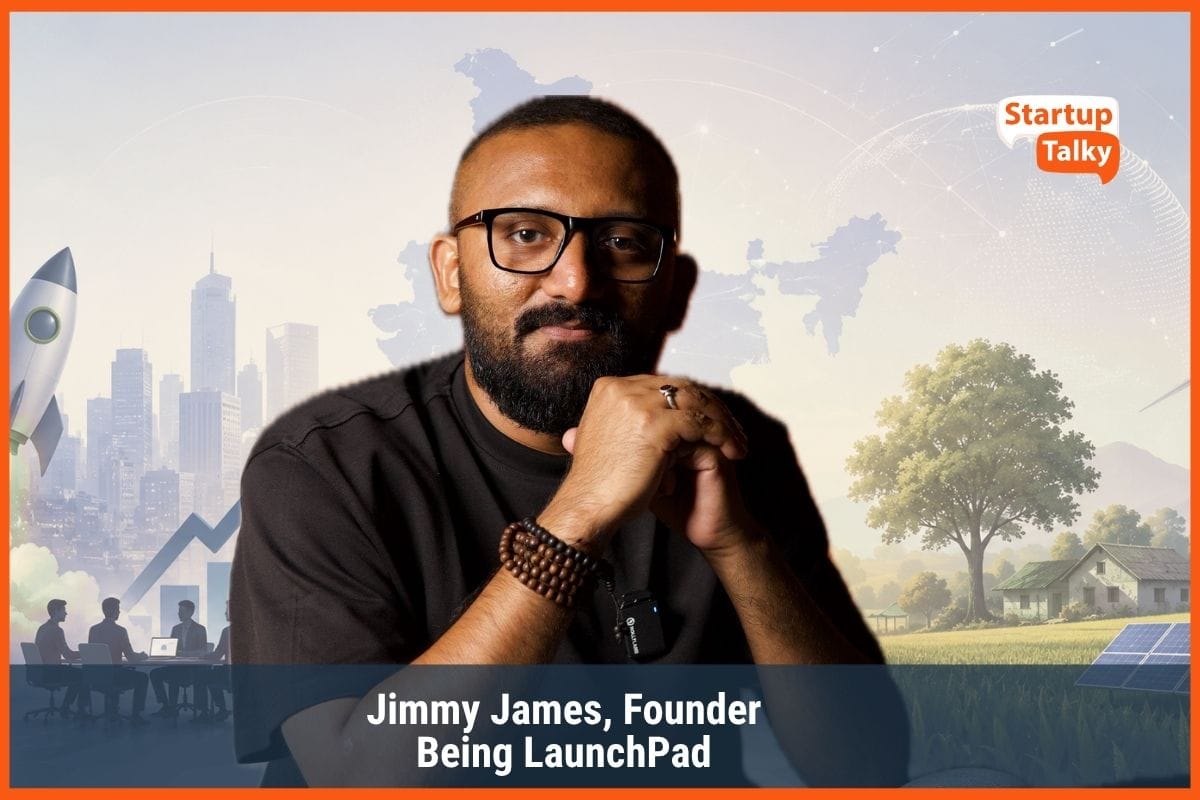
“Don’t Study Startups, Build One”: Jimmy James on Building the Next Generation of Founders
What does it really take to become a successful founder? Jimmy James shares lessons from building PlantShop.ae and explains why young entrepreneurs need less theory and more action, customer feedback, and real-world execution.
India’s startup ecosystem has grown rapidly over the past decade, expanding from around 500 DPIIT-recognised startups in 2016 to more than 2.3 lakh by June 2026. This represents roughly 86% CAGR in the number of recognised startups over the period. India is now the world’s third-largest startup ecosystem, with more than 120 unicorns and nearly half of recognised startups emerging from Tier-II and Tier-III cities.
In this interview, Mr. Jimmy James, entrepreneur and founder of Founder-Being LaunchPad, shares his journey from building PlantShop.ae to helping young entrepreneurs develop practical founder skills. He discusses why entrepreneurship education needs to move beyond theory, how AI is changing the role of founders, what customer evidence really matters, and why the next generation of entrepreneurs must focus on building rather than simply studying startups.
Jimmy James’ Journey From Entrepreneur to Founder Coach
StartupTalky: Jimmy, could you take us through your journey as an entrepreneur and the experiences that eventually led you to start Founder-Being LaunchPad?
Mr. Jimmy James: Founder-Being LaunchPad is basically the program I wish existed when I started. I began my entrepreneurial journey at 23 and later co-founded PlantShop.ae in Dubai in 2015. That year, I was shortlisted as one of the Top 5 Young Entrepreneurs in the UAE. In 2018, Plantshop entered 500 Startups (now 500 Global) through its MENA Dojo II accelerator, and we raised USD 150,000 in seed capital. I also received honorary recognition from KAUST in Saudi Arabia for contributions to the Middle East startup ecosystem.
Today, we value Plantshop.me at approximately USD 30 million. But that's not the interesting part. The interesting part is everything that happened between those milestones, wrong decisions. Money lost. Customers who didn't care. Products that didn't work the way we expected. Capital raised. Plans changed. Markets tested. Things rebuilt.
That is where entrepreneurship actually happens. I learned very early that entrepreneurship is not a subject. It is what happens when you have incomplete information, limited time, real money on the line, and nobody sitting beside you with the correct answer. That is why I say: I am not coaching entrepreneurship because I studied it. I am coaching it because I lived through it.
Founder-Being LaunchPad starts from that position. Don't study startups. Build one. Put something into the world. Let customers judge it. Fix it. Sell it. Break it. Build again. Because behind every successful startup is a founder, and behind every founder is a human being. We aren't here to manufacture pitch decks. We are here to build founders.
The Need for More Experiential Entrepreneurship Education
StartupTalky: You believe entrepreneurship education needs to become more experiential, with customer conversations, validation, and real execution. What do you think conventional approaches to teaching entrepreneurship are missing today?
Mr. Jimmy James: The world does not need another startup lecture. We already have more startup information than any previous generation. The problem isn't information. The problem is execution. Anyone can explain MVP. Now remove nine features from your brilliant idea and put the ugly tenth one in front of a customer. That is entrepreneurship. Anyone can learn sales theory. Now ask somebody to pay. Anyone can learn customer discovery. Now speak to twenty strangers who have no reason to be polite to you. That is where the learning starts. And there is another problem. A lot of founder education was designed before AI changed what one person can actually do. Today, a single founder with the right tools can research, design, prototype, write, analyze, and build at a speed that would have sounded ridiculous a few years ago. If founders are getting faster, founder mentoring cannot stay slow.
Founder-Being LaunchPad isn't trying to replace accelerators or incubators. We need to upgrade the way founders are coached for the world we are entering. Stop asking only: “Did you finish the module?” Start asking: What did you build? Who saw
it? What happened? What number came back? What changed your mind? What are you doing tomorrow? That is why one of our rules is "Evidence before appearance." A beautiful logo is not evidence. A polished deck is not evidence. A projected ₹100 crore revenue slide is definitely not evidence. A customer changing behavior because your product matters? Now we have something to talk about. Our operating loop is simple: Question Test Evidence Improve. And then do it again. Build every week.
Today's education often rewards "playing startup", writing 50-page business plans for a market that doesn't exist yet. We want founders to fail fast and cheap so they can succeed faster.
Turning Entrepreneurship Knowledge Into Real-World Execution
StartupTalky: Young people now have access to startup courses, incubators, founder communities, and vast amounts of information online. Where do you see the biggest gap between learning about entrepreneurship and actually being prepared to build a business?
Mr. Jimmy James: An idea without execution has zero value. Today, information is cheap. AI can give you a hundred ideas before breakfast. It can analyze competitors, suggest features, generate market reports, and write a business plan.
Great. Now tell me: Which one are you going to build? That is judgment. Startup ecosystems generate a lot of noise. Funding announcements. Valuations. Followers. Awards. Pitch competitions. People telling you your idea is incredible.
Signal is much less glamorous. A customer has a problem. They use what you made. They come back. They pay. They recommend it. That is signal. If 10,000 people like your launch post but nobody uses the product, congratulations, you have engagement. You don't necessarily have a business. If three customers repeatedly use an ugly prototype and ask when they can pay, I am far more interested.
This is why I say: The founder is the MVP, the Most Valuable Person. The startup world spent years talking about Minimum Viable Product. Fair enough. But now, with vibe coding, AI agents, and no-code tools, ideas can turn into prototypes incredibly quickly. So the bottleneck changes. It becomes: Can the founder identify what deserves to be built? Can they recognize signal? Can they ask the right question? Can they kill a bad idea even if they love it? Can they decide when to proceed, modify, or stop? AI is making products cheaper to build. It is making great founder judgment more valuable. So before we obsess over the Minimum Viable Product, I want to develop the Most Valuable Person.
When founders focus on judgment over information, they stop asking "What can I do?" and start asking "What matters?"
Lessons From Building, Fundraising, and Failing
StartupTalky: Your journey includes building Plantshop.ae and being part of the 500 Startups ecosystem. Which lessons from building, raising capital, making mistakes, and adapting the business have most influenced how you think entrepreneurship should be taught?
Mr. Jimmy James: Money is recoverable. Time is not. I've lost money. You can make money again. Waste twelve months building the wrong thing, and nobody is refunding you a year of your life. So I became biased toward testing. Put something imperfect in the market. Let reality embarrass you early. It is cheaper. I also learned the importance of co-founders. I don't want a co-founder who is another version of me. I want somebody who sees what I don't see. Great founding teams aren't built on identical strengths. They are built on complementary ones. 500 Startups also reinforced another belief: Founders need other founders.
Sometimes the fastest way out of a problem isn't another framework. It is sitting opposite somebody who says: “I went through exactly this. Here is what happened.” Someone who has raised money, lost money, hired badly, lost customers, made payroll, changed products, and survived has pattern recognition you cannot manufacture from theory. India needs more of those people inside the startup support system. Not just coming in for a one-hour motivational mentor session. I help design accelerator programs, evaluate founders, monitor outcomes, and improve the delivery of support. Sometimes a founder does not need another brainstorming session. They need: “I've seen this before. Test these three things tomorrow.” That is useful. And my experience at Plantshop coached me on something else. Stop obsessing over: “How do I impress investors?” Start obsessing over: “How do I become impossible for customers to ignore?” If you can do the second one well enough, the first conversation becomes much easier.
I also learned that "standard" advice doesn't always apply to your specific context. You have to develop the intuition to know which rules to break.
Another major lesson was the difference between investor attention and customer evidence. Founders should spend less time asking "How do I convince an investor?" and much more time asking "How do I become impossible for my customer to ignore?" Customers before investors. Evidence before fundraising.
 Preeti Karna
Using Customer Behavior to Validate Business Ideas
StartupTalky: Customer validation is widely discussed, but positive feedback does not necessarily translate into demand. What evidence should a first-time founder look for before deciding that a problem is worth building a business around?
Mr. Jimmy James: First rule: Stop asking people if your idea is good. People are polite. “Nice idea.” “Sounds amazing.” “I would definitely use this.” Great. Now let's see what they actually do. Who actually needs your idea? Are they already spending money or wasting time trying to solve the problem? Will they test your product? Will they come back? Will they introduce someone? Will they pay? Behavior beats compliments every time. And today, founders have no excuse to spend six months debating an idea internally. The cost of testing has collapsed.
Wireframe it. Prototype it. Use AI to create the PRD. Build the first workflow. Put it in front of someone. Then: Make Validate Proceed. Not: Think think think think launch six months later. Fast building does not mean random building.
The sequence is: Understand the problem Make Validate Proceed. If customers don't care, modify or stop. If something interesting happens, push
further. That connects directly to my 1% Push Theory. Founder-Being LaunchPad is not designed to take somebody with zero founder intent and somehow turn them into Steve Jobs in sixteen weeks. That's nonsense. I want founders who are already
99% ready. Maybe they have an idea. Maybe they built something. Maybe they already pitched it. Maybe they spoke to customers. But something is stopping them. For one founder, the missing 1% is validation. For another, pricing. For another, launching; and for another, making the first sale. For another, the missing 1% is somebody looking them in the eye and saying: “Enough planning. Ship it.” The founder brings the 99%. Our job is to find the missing 1%.
If you can't get someone to give you their time or attention for free, they likely won't give you their money later. Friction is your best teacher.
The Changing Role of Founders in the Age of AI
StartupTalky: AI and no-code tools have made it much easier to research markets, develop prototypes, and launch products. As the barriers to building fall, which skills do you think will distinguish strong founders from those who can simply build quickly?
Mr. Jimmy James: AI is going to create a lot more builders. It is not automatically going to create a lot more great founders. Today, a PRD, TRD, wireframe, backend schema, and first implementation can move from thought to something tangible incredibly quickly. That changes the MVP conversation. Minimum Viable Product still matters when you're testing an assumption. But once you know what the customer values, I want founders to think beyond the minimum. I call it the Maximum Value Product. Not maximum features. That would be stupid. I mean: What is the maximum useful value I can deliver to this customer with the resources and evidence I have today? If AI makes development cheaper, don't waste the savings by generating twenty pointless features.
Use it to improve the customer experience. The old founder problem was overbuilding. The new founder problem may be emerging too quickly, without careful thought. That is why I separate planning mode from build mode. An idea comes at 9:00 a.m. The amateur starts vibe coding at 9:05. I want the founder to ask first: Who is the user? What exactly are we solving? What is the flow? What are the edge cases? What data are we storing? Who can see it? What happens if an API fails? Where are the secrets stored? Can we accidentally expose an API key? What needs authentication? What should the database schema support? What belongs in the PRD? What belongs in the TRD? Then build. You don't have to become the world's best engineer. But you need to understand enough engineering to direct AI intelligently. You don't need to become the world's best designer. But learn how an excellent designer frames a user problem. You don't need to become a CFO. But learn what questions a CFO would ask.
The founder of the future isn't necessarily the person who can write the fastest prompt. It is the person who knows what should be prompted before anyone starts building. So: AI is leverage, not judgment. Generating code does not mean you know how to build a company.
The future of entrepreneurship belongs to the "Curators of Problems." Those who can identify a deep human need and use technology to bridge it, rather than those who just know how to prompt an LLM.
Building Founder Judgment Alongside Technical Skills
StartupTalky: Founder-Being LaunchPad is designed for people aged 15 to 25. How do you teach entrepreneurship across such a broad age group while ensuring younger participants develop a realistic understanding of the risks and demands of building a company?
Mr. Jimmy James: I don't think 25 is a magical age when someone suddenly becomes capable of being an entrepreneur. I believe: Founders are neither created nor destroyed. They move from one idea to another. A 16-year-old can build the wrong thing, fail, learn, and become dramatically more capable as a result. A 24-year-old can have an MBA-style business plan and still have no idea what their customer actually wants. So I care less about age and more about founder readiness.
Our Initial Founder Assessment is intentionally selective. I want people who are already close. That 99%. Then we find the missing 1%. I also think India is massively underestimating this age group. Silicon Valley has already shown that people under 25 can build extraordinary companies. Why shouldn't India produce ten times more? This generation is growing up inside AI. They are adaptive. They are ambitious. They are learning tools faster than previous generations can create rules around them. The raw material is already there. Look at school and college pitch competitions across India. Students are already coming up with ideas. Some of those ideas could genuinely have enormous potential.
Then the competition ends. They get a certificate. Everybody claps. Monday comes. Now what? Who converts the deck into a wireframe? Who turns that into a product? Who gets them in front of customers? Who makes them launch? Who coaches them to sell? That is the gap. I want more young Indians to stop seeing themselves only as technology users. I want them thinking: Creator. Builder. Founder. Entrepreneur. But I am not romanticizing it. They should also learn rejection. Pressure.
Responsibility. Failure. Uncertainty. And they need to learn to manage themselves because, behind every founder, there is still a human being.
We teach them that risk is not about gambling; it's about managed experimentation. We want them to be adventurous, not reckless.
Preparing Young Entrepreneurs for Real-World Challenges
StartupTalky: The first cohort will have 20 participants and run for 16 weeks. Beyond an MVP or a Demo Day pitch, how will you determine whether participants have actually developed better founder judgment and decision-making skills?
Mr. Jimmy James: I don't care if somebody can memorize Module 8. I care what changed in their company because of Module 8. The sixteen modules are part of one founder's journey.
Founder-Being LaunchPad Journey
Phase Focus
- Discover Founder Mindset, Customer Discovery, Value Proposition
- Design & Build Market Research, Wireframing, MVP, AI for Founders
- Find the Market Branding, Marketing, Sales, CRM
Founder-Being LaunchPad Journey
Venture Ready Finance, IP, Fundraising, Pitch & Demo Day
If the module is about solution design, wireframe it. If it is MVP, build it. If you built it, show someone. If you showed someone, measure what happened. Make Validate Proceed. Technology can generate the artifact. The founder has to prove the artifact matters. That is also why I wrote Don't Study Startups. Build One. It is not a graduation souvenir. It is closer to a founder's lab notebook. Interview notes. Customer quotes. Tests. Pricing. GO / MODIFY / PIVOT decisions. Pipeline. Runway.
Focus on 'next steps.' Don't just tell me, 'We're iterating.' Prove it. Show me exactly what changed and why. I’m not here to critique 'startup theatre', where MVPs and Demo Days are just performances to look busy. A great pitch is empty without substance. Stop guessing what customers want and start tracking reality. I want to hear, 'We talked to 17 customers, four tested, two paid, here’s what happened, and here’s the plan.' That’s progress. Anyone can build an MVP or deliver a polished pitch; those are just skills. Building a trail of evidence, though? That’s how you prove you can think.
The program may provide the 1% push, but the handbook is what stops that push from evaporating when the founder goes home. I call it the Monday Test. Demo Day has lights; Monday morning doesn't. What does the founder do when the applause is gone? That is why the handbook ends with a 90-day plan, the program may finish, but the habit of making decisions from evidence cannot.
Measuring Founder Growth Beyond MVPs and Demo Days
StartupTalky: Fundraising and valuations often receive more attention than customers, margins, retention, and cash flow. Based on your own experience, what business fundamentals should aspiring founders understand before they begin thinking about raising external capital?
Mr. Jimmy James: First: Don't build for investors. Build for customers. The VC doesn't have the problem. Your customer does. Make something useful. Find one customer. Make them happy. Find another. Make them return. Understand whether serving them actually makes financial sense. That is a business. But I am also not going to pretend fundraising ambition is bad. Getting funded is one of the most effective motivational systems in the startup ecosystem. It makes aspiring founders build decks. Apply.
Prototype. Register companies. Pitch. Get rejected. Try again. Then an investor tells them: “Come back when you have customers.” Fantastic. Now get customers. And this is where something beautiful happens. The founder who initially wanted to make money by raising money discovers: “Wait. I can make money by making customers happy.” Then everything changes. They become obsessed with the product. Users. Features. Retention. Sales.
The next improvement. The investor stops being the center of the universe. The customer becomes the center. That is what I want. I won't tell an ambitious 19-year-old founder: “Stop dreaming about raising millions.” Dream big. Use the ambition. Then learn something even more powerful: Build great. Prove greatness. Do that long enough and investors, customers, and opportunities can start chasing you. Fundraising is a tool. It is not the company. Build a great product before trying to build a great valuation.
Putting Customers Before Fundraising and Valuations
StartupTalky: As Cohort 1 begins in Kochi this September, what are you looking to learn from these first 20 participants, and what would need to work before you consider taking the model to more young founders or other cities?
Mr. Jimmy James: First, you have to get in. Founder-Being LaunchPad isn't designed for everyone who likes startups. Our Initial Founder Assessment is deliberately tough. I want to find people who are already approximately 99% ready. Then identify the missing 1%. Where are you stuck? Customer? Product? Pricing? Confidence? Technical execution? Sales? Decision-making? Are you coachable? Can you hear evidence you don't like and still act on it? Can you execute? That matters more to me than whether you can explain startup terminology. And the twenty founders won't all have the same finish line. My target is approximately 3x stage-adjusted progress. If you enter with an idea, maybe you leave with customer evidence and a working prototype. If you enter with an MVP, maybe you leave with repeat users.
If you're already selling, you can improve conversion, retention, revenue, or economics. The important question is: How far did you move from the place where you were actually stuck? I don't need twenty funded companies after sixteen weeks. I'd rather have: Twenty founders who are harder to fool, including by themselves. Can you separate what you hoped would happen from what actually happened? Can you sell? Can you build? Can you understand money? Can you change your mind? Can you walk into a customer or investor meeting without waiting for your mentor to rescue you? That is founder readiness.
Founder-Being LaunchPad isn't here to fill sixteen Sundays with startup content. Find the founders. Find the missing 1%. Push. Then get out of the way and let them prove themselves. Through products. Customers. Revenue. Decisions. Evidence. Not merely building startups and building founders.
Program Snapshot: Cohort 1
- Duration: 16 Weeks
- Location: CUSAT Technology Business Incubator (TBI), Cochin University of Science and Technology, South Kalamassery, Kochi, Kerala, India
- Begins: October 4, 2026
- Fee: ₹30,000 + ₹3,000 per additional founder or team member
- Contact: hello@founderbeinglaunchpad.com
Muskaan Kapoor