Shoury Gupta on Building Patang and Bringing India's Authentic Regional Flavors to Every Home
India's regional snacks market is growing as consumers seek authentic and clean-label foods. In this StartupTalky interview, Shoury Gupta, Founder & CEO of Patang, shares how the brand is preserving traditional recipes, supporting local makers, and building a premium regional food brand.
India's packaged snacks industry is evolving rapidly as consumers increasingly seek authentic, clean-label, and regionally inspired food products. According to industry estimates, the Indian savory snacks market is expected to grow at a CAGR of around 8–10% through 2030, driven by premiumization, quick commerce, rising disposable incomes, and growing demand for traditional flavors. As consumers become more conscious of ingredient quality and regional authenticity, brands that preserve India's culinary heritage while leveraging modern distribution channels are well-positioned for long-term growth.
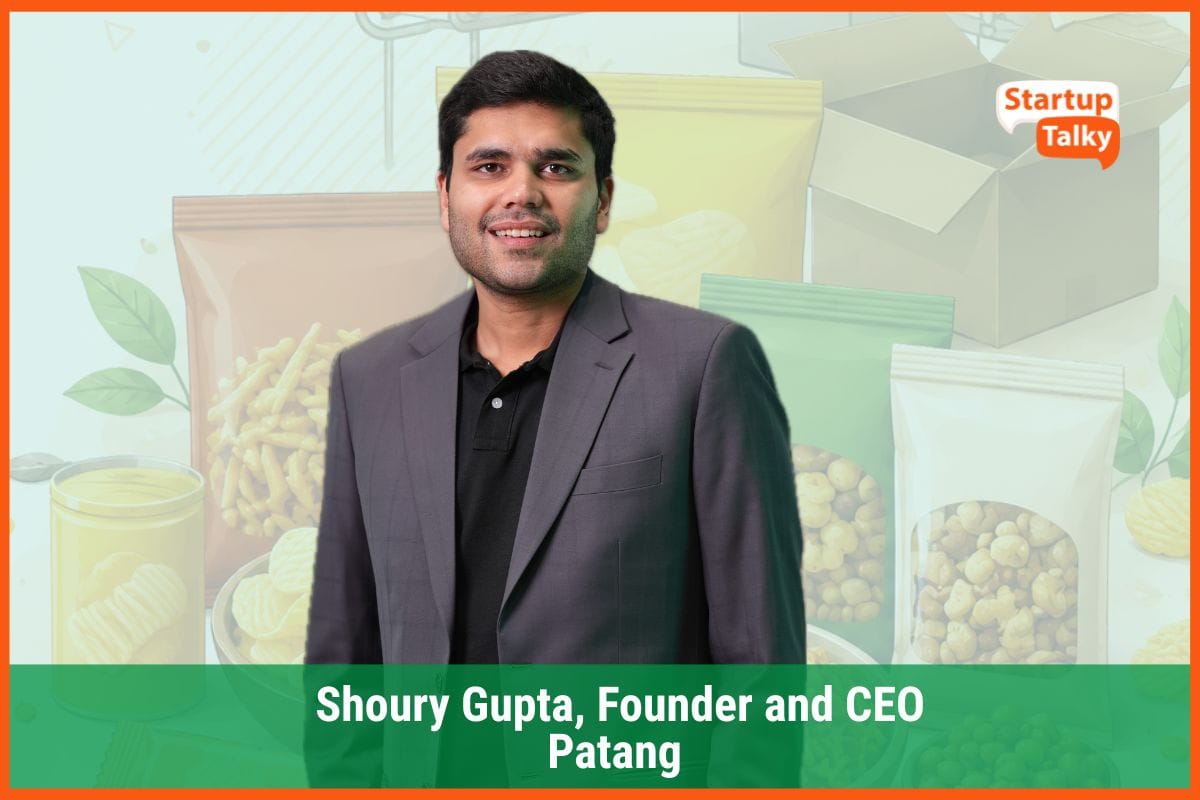
Against this backdrop, StartupTalky spoke with Shoury Gupta, Founder and CEO of Patang, a premium regional snack brand committed to bringing authentic Indian flavors to consumers by sourcing recipes from their place of origin. In this exclusive interview, he shares Patang's philosophy of preserving traditional recipes, scaling through quick commerce, supporting local makers, and building a national food brand rooted in authenticity.
Interview Highlights
- Patang preserves authentic regional recipes instead of creating fusion snacks.
- Every product is made in its region of origin using traditional methods.
- Quick commerce has accelerated product discovery and nationwide distribution.
- The brand works with traditional makers through fair pricing and guaranteed volumes.
- Patang maintains quality through small-batch production and rigorous testing.
- Regional storytelling and authenticity drive customer engagement and repeat purchases.
- The company plans to raise capital to expand distribution and discover more regional flavors.
- Patang aims to grow beyond snacks into pickles, chutneys, staples, and other traditional foods.
Preserving India's Regional Food Heritage Through Authentic Recipes
StartupTalky: Patang is built around regional authenticity rather than new-age fusion snacks. In a market where most brands chase innovation, why did you choose preservation as the business opportunity, and what convinced you there was genuine commercial demand for it?
Shoury Gupta: I grew up in a neighbourhood where everyone's kitchen was open to everyone's kids. My neighbours were from different cities, so I ate food from all over India without ever leaving my street. Somewhere along the way, that food just vanished. What replaced it was either western flavours, experimental fusion, or the old snacks made badly. Shortcut recipes, bad oil, no soul.
That's really the whole insight behind Patang. The market didn't need another innovation. It needed someone to do the originals right. Naani and daadi's food was always clean. That's the thing people forget. Innovation usually means shortcuts. Preservation means old methods and simple ingredients. So we picked preservation, not as a romantic idea but as a gap nobody was filling seriously.
As for demand, the sell-outs told us. We didn't need a consultant's report. We put products out, they sold out, we made more, they sold out again. When a Jaipuri Hing Chana or a Calcutta Chanachur flies off a quick commerce shelf in a city where nobody grew up eating it, you know the demand was always there. It was just waiting for someone to take it seriously.
Building a Regional Snack Brand That Competitors Can't Easily Replicate
StartupTalky: India's healthy snacking market is getting crowded, with many brands now promoting clean labels and natural ingredients. What makes Patang's approach genuinely difficult for a competitor to copy?
Shoury Gupta: I'll give you an answer you probably don't hear often: I don't think about this much, and I'm okay being copied.
It's very easy to find our kitchens. We're not hiding anything. If someone copies us and more people end up eating good, honest food, that's a win for the country. Good food finding more homes is the whole point.
That said, if you ask what's hard to replicate, it's the work nobody wants to do. I travelled to each city our recipes come from. I did local surveys after the online research, sat with people, collected samples, ran sample reviews, and only then chose who we'd work with. Ratlami Sev is made in Ratlam. Sattur's Seeval is made the Sattur way, at Sattur. Kolhapuri Bhadang comes from Kolhapur. You can't shortcut that from one factory outside Delhi with a "regional inspired" label. The taste gives you away immediately.
And there's the relationship side. We don't negotiate our makers down; we pay what's fair and guarantee weekly volumes. That trust took time to build, and trust doesn't copy-paste. So yes, copy the idea. The hard part is copying the patience.
Scaling an At-Source Manufacturing Model Without Compromising Quality
StartupTalky: Your products are made at source, in the region each recipe comes from, often in small batches through partner kitchens rather than large factories. What operational challenges does this create for quality control and consistency as you expand across India, and how far can this model scale before it strains?
Shoury Gupta: The honest answer: logistics is the hard part, quality is the solved part.
On quality, every recipe is written down precisely, and every batch goes through strict QA before it ships. We also send multiple batches to labs for testing on a regular basis, so it's not just our own palate deciding whether something passes. Small batches actually help here rather than hurt. When a batch is small, a problem is small, and you catch it before it reaches ten thousand homes.
The real strain is coordination. When your Chanachur is made in Calcutta, your Bhakarwadi in Pune, your Pepper Cashews in Thoothukudi, and your makhana in Darbhanga, you're essentially running a dozen small supply chains instead of one big one. Coordinating with transporters, timing pickups, keeping shelf life intact across distances. That's a daily grind. We manage it with manpower and attention, not some magic software. It's unglamorous work.
Can it strain? Of course. Any model strains if you grow carelessly. But I'd rather solve a logistics problem than a taste problem. Logistics improves with scale and systems. Authenticity, once you compromise it for convenience, doesn't come back. So we'll take the harder operational road and keep the recipe where it belongs: at home.
How Quick Commerce Is Transforming Regional Snack Discovery
StartupTalky: Quick commerce platforms are changing how people discover and buy food. How has the rise of Blinkit, Swiggy Instamart and Amazon Now shaped Patang's distribution strategy and the way you plan to acquire new customers?
Shoury Gupta: Quick commerce hits our margins. I won't pretend otherwise. But it gives us two things worth paying for: discovery and distribution.
Today we're available pan-India across Blinkit, Swiggy Instamart, Amazon Now, BigBasket, and FirstClub, alongside modern trade stores like Nature's Basket, Le Marche, and The Roots, plus our own website. For a brand our age, that footprint would have taken years the traditional way. Quick commerce collapsed that timeline.
The bigger shift is behavioural. People don't want to wait any longer for flavours like ours. If someone remembers the taste of Bhakarwadi from a Pune trip at 10 pm, they want it in ten minutes, not in four days by courier. Quick commerce turned a craving into an order, and cravings are exactly what our category runs on. Nostalgia is impulsive. It doesn't survive a five-day delivery window.
It's also become a genuine discovery engine. Someone searching for "chana" stumbles onto Jaipuri Hing Chana and takes a chance because it's ₹150 and arrives before their chai is ready. That first low-risk trial is how we acquire customers, and our repeat rate of around 64% does the rest of the work. Get the first pack into their hands; the snack takes it from there.
Expanding Patang's Portfolio with India's Next Iconic Regional Flavors
StartupTalky: After Gujarat, which region or recipe are you most keen to bring into the Patang portfolio next, and what would tip that decision: consumer demand, cultural weight, or how ready the sourcing is?
Shoury Gupta: The kite flies across the whole country. That's the brand.
The two I'm most excited about right now are Bihar's makhana and Ratlam's sev. Makhana has a huge audience already. It's probably India's most loved "healthy" snack, but most of what's sold is small-grade and dressed up with additives. We're sourcing the big ones from Darbhanga, Bihar's makhana heartland, lightly roasted, nothing added that doesn't belong. And Ratlami Sev, largely because of its sheer richness. The clove, the pepper, the way Ratlam makes it. It's famous for a reason.
On what tips the decision, it's never just one factor. It's the combination. Demand tells you people will buy it. Cultural weight tells you it deserves to be preserved. Sourcing readiness tells you it can be done right. If any one of the three is missing, we wait. There are enough flavours this country misses that we never need to force one before its time.
Turning Regional Stories and Nostalgia into a Powerful Brand Strategy
StartupTalky: Food with a story seems to matter more to consumers now. Have you noticed regional identity and nostalgia becoming a stronger reason to buy, particularly among younger urban buyers who may not have grown up eating these snacks, and how does that shape the way you market each new flavour, from the language you use to the platforms you choose?
Shoury Gupta: Yes, and it's broader than we expected. We assumed nostalgia would be our engine, people buying the taste of their hometown. That happens. But we're seeing buyers across age groups, including young people picking up a Kolhapuri Bhadang who've never been within 500 kilometres of Kolhapur. For them it's not memory, it's curiosity. The story is the reason to try.
The most surprising signal: a steady stream of orders from Shillong and Nagaland with zero marketing spent there. Nobody targeted the Northeast. The products just travelled. That taught us that a real story markets itself further than any campaign.
So our marketing leads with place, always. Every pack is a postcard from a place, a person, a time. The city is in the product's name, the city is on the pack. We stay mostly on Instagram and WhatsApp, plus ads on the quick commerce platforms where the purchase actually happens.
And sometimes we take the name literally. On 15th August 2025, we flew 500 kites across Delhi with a message on them. Anyone who caught a cut kite got a free Patang snack. Patang means kite. If your brand is named after something the whole country plays with, you'd be foolish not to put it in the sky.
Supporting Traditional Food Makers While Growing Sustainably
StartupTalky: Working with traditional makers helps keep recipes authentic, but these are often small operations with limited capacity. How is Patang supporting these partners while still growing the business at a sustainable pace?
Shoury Gupta: Our policy is simple and a little unusual: we don't negotiate with our makers.
Most brands treat sourcing as a squeeze. Get the price down, push the risk out. We do the opposite. These are people who've kept recipes alive for generations, often through periods when nobody valued that work. We feel they deserve the fair price, so we pay it without haggling. It costs us margin. We consider it the cost of the product being real.
The second thing we give them is predictability, with guaranteed volumes every week. For a small kitchen, the difference between a good year and a bad one usually isn't price, it's uncertainty. When a maker knows exactly what's leaving their kitchen every week, they can hire, plan, buy ingredients in advance, and say no to work that undercuts them. That steadiness is worth more than any one-time premium.
Growing sustainably with partners like this means growing at the pace they can hold quality, not the pace a spreadsheet demands. If a kitchen can't stretch further without cutting corners, we don't stretch it. We'd rather a flavour be occasionally out of stock than permanently compromised. Sell-outs we can apologise for. Bad batches, we can't.
Patang's Growth Strategy and Plans for Future Fundraising
StartupTalky: Many early-stage Indian food brands raise capital to help them move from a loyal online following into mass retail. Is that the plan for Patang too, and are you looking to raise further funding to support the next stage of growth?
Shoury Gupta: Yes. No coyness on this one. We will raise money.
The good news is we're not raising to find the model; we're raising to feed it. We're already pan-India across quick commerce, modern trade, and our own website, and our repeat rate sits around 64%. So the question isn't "does this work," it's "how many more people can we reach with it."
The round goes to three things. First, reaching more consumers. More people should simply know Patang exists; the products convert once they're tried, so awareness is the bottleneck. Second, being more available. Deeper in the cities we're in, present in the ones we're not, better fill rates on the platforms where demand already outruns supply. And third, my favourite line item: finding more flavours the country misses. Every new recipe means research trips, local surveys, sample rounds, lab testing, and setting up a new maker partnership at source. That discovery engine is the actual company, and capital lets it run faster.
What we won't do is raise money to shortcut the model, to centralise production or chase volume at the cost of the kitchens. The money serves the method, not the other way around.
Lessons from Building a Premium Regional Snack Brand in India
StartupTalky: Since launching in 2025, what has been the biggest lesson in building a premium regional snack brand in India? Has anything about customer behaviour or market acceptance surprised you?
Shoury Gupta: Biggest lesson, two words: don't assume.
We assumed some products would be niche. We thought Calcutta Chanachur and Jaipuri Hing Chana might not find an audience outside their home regions. Too specific, too rooted, maybe too unfamiliar for a national shelf. They're now in our top three across platforms. The products we quietly worried about became the ones carrying the portfolio. That humbled us early, and it changed how we make portfolio decisions. We let the country vote instead of predicting on its behalf.
The second surprise was geography. Orders from Shillong and Nagaland, consistently, without a rupee of marketing spent there. We had no plan for the Northeast; the Northeast had a plan for us. It's a good reminder that in food, distribution follows taste, not the other way around.
And our repeat rates taught us where our real marketing budget lives. It's inside the pack. Every batch that tastes exactly like the last one is an ad we don't have to pay for. In this category, the second purchase is the business; the first one is just an introduction. So the discipline is less about campaigns and more about never letting batch forty taste different from batch four.
Patang's Vision to Become India's Leading Regional Food Brand
StartupTalky: Looking ahead, do you see Patang growing into a broader regional food company beyond snacks, or is the priority to first become India's leading brand for authentic regional snacks before moving into new categories?
Shoury Gupta: Broader regional food company, and we're not waiting for permission to start.
We're already working on pickles, staples, chutneys, and more. Because here's the thing: the problem we solve isn't a snacking problem. It's a disappearing-food problem. The same story playing out with namkeens, where original recipes got replaced by shortcuts, bad oil, and factory approximations, has happened to India's pickles, its chutneys, its everyday staples. A grandmother's aam ka achaar deserves the same rescue as her chiwda. The method transfers exactly: find the place, find the maker, pay fairly, make it at source, test every batch, tell the story on the pack.
On sequencing, there's no grand sequence, and I mean that. Whatever comes first, comes first. If a chutney is ready before the next namkeen, meaning the maker is right, the sourcing is right, and the recipe survives the lab and the shelf, it ships. We're not going to hold back a great product to satisfy a strategy slide about "category focus."
The name was chosen for this. A patang isn't meant to hover over one spot. You let out the string and it goes where the wind is. Snacks were our first flight, not our boundary. Fly with Patang across the country. That's the promise, and the country has a lot more flavours than namkeen.
 Apoorva Bajj