10 Best AI Tools for Writing Ad Descriptions in 2026
Struggling to write ad copy that grabs attention? Discover 10 AI tools that turn simple product details into catchy headlines, persuasive descriptions, and powerful CTAs in seconds.

AI tools for writing ad descriptions turn basic product details into clear, persuasive copy in seconds. They help marketers create headlines, value statements, calls to action, and short-form ads for many channels.
By adjusting tone, audience, and goals, teams can produce messages that feel relevant and on-brand. These tools also speed up testing by offering fresh angles and variations for the same offer. The result is faster campaign creation, more consistent messaging, and less time spent staring at a blank page.
Used well, they support human ideas rather than replace them, helping every ad make a stronger first impression.
Best AI Tools for Writing Ad Descriptions
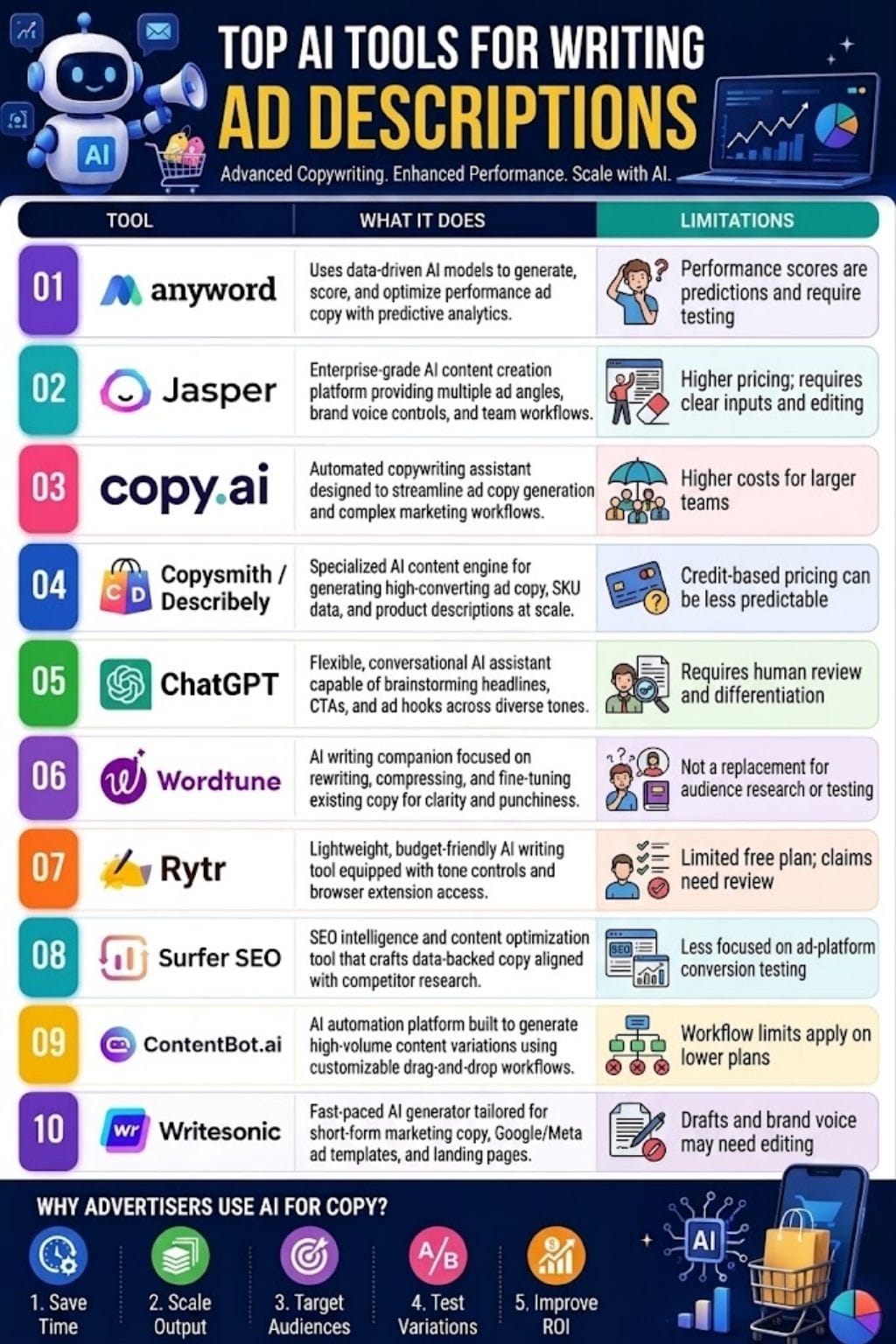
| Tool | Best For | Strengths | Limitations |
|---|---|---|---|
| Anyword | Performance-focused ad copy | Brand Voice, predictive performance scoring, marketing templates | Performance scores are predictions and require testing |
| Jasper | Marketing teams | Brand Voice, Knowledge tools, multiple ad angles, collaboration | Higher pricing; requires clear inputs and editing |
| Copy.ai | Ad copy and content workflows | Brand Voice, AI Chat, multiple AI models, projects and workflows | Higher costs for larger teams |
| Copysmith | Ecommerce and bulk content | Bulk product descriptions, ad templates, integrations and API | Credit-based pricing can be less predictable |
| ChatGPT | Flexible ad copy creation | Multiple angles, tones, formats, headlines and CTAs | Requires human review and differentiation |
| Wordtune | Rewriting and refining copy | Multiple rewrite options, tone adjustment, concise copy | Not a replacement for audience research or testing |
| Rytr | Solo marketers and small teams | Simple workflow, tone controls, Chrome extension | Limited free plan; claims need review |
| Surfer SEO | SEO-focused product and landing-page content | Keyword research, competitor analysis, AI writing | Less focused on ad-platform conversion testing |
| ContentBot.ai | Bulk content production | Bulk inputs, AI Workflows, unlimited seats | Workflow limits apply on lower plans |
| Writesonic | Short-form marketing copy | Ad templates, variations, brand voice, bulk generation | Drafts and brand voice may need editing |
Anyword
Anyword is an AI writing tool built for marketers who need ad descriptions that fit a brand and aim to convert. It generates variants for channels such as Google, Meta, LinkedIn, and product pages.
Its key edge is predictive performance scoring, which helps users compare drafts before publishing. You can set a brand voice, use marketing templates, improve existing copy, and analyze past campaign data on higher plans.
It suits teams that test ads often and want more than a basic text generator. Review each draft for facts, tone, and policy fit before launch.
Pros
- Brand Voice tools support more consistent messaging
- More than 100 marketing templates and prompts speed up drafting
- Higher plans can use campaign data and custom AI models
Cons
- Performance scores are predictions, not proof of ad results
- Strong output still needs human review and testing
Pricing
| Plan | Pricing |
|---|---|
| Starter | $49/month |
| Data Driven | $99/month |
| Business | Custom Pricing |
| Enterprise | Custom Pricing |
Jasper
Jasper is an AI writing platform made for marketing teams that need quick, on-brand copy. It can turn a simple product brief into ad copy for Google, Meta, social media, and product pages.
Its Brand Voice and Knowledge tools help keep the tone consistent and use key product and audience details. Jasper also offers templates, chat, and campaign tools for creating ideas, rewriting copy, and building related content from one brief.
Teams can work together through collaboration features, a browser extension, and advanced controls on higher plans. For better results review the final copy before publishing.
Pros
- Built around marketing work, rather than general-purpose chat alone
- Produces several ad angles quickly, making A/B-test planning easier
- Brand Voice can reduce tone drift across writers and campaigns
Cons
- Strong results require clear inputs and careful editing
- Pricing is high for casual or occasional use
Pricing
| Plan | Pricing |
|---|---|
| Creator | $29/month |
| Pro | $49/month |
| Business | $149/month |
| Enterprise | Contact Sales |
Copy.ai
Copy.ai is an AI writing platform that helps marketers create ad descriptions quickly. You can enter details such as your product, target audience, offer, and tone to get several copy options.
Its AI Chat lets you create and edit content through simple prompts. Copy.ai also offers templates for ads, product descriptions, social posts, and emails. Brand Voice helps keep the writing style consistent across campaigns.
It supports models from OpenAI, Anthropic, and Gemini. Projects and workflows can help teams manage repeated tasks and create content at scale. It is useful for testing different ad messages.
Pros
- Brand Voice can reduce the need to restate style rules
- Chat projects help organize work by campaign or client
- Broad model access gives teams more writing option
Cons
- Ad-platform rules, factual accuracy, and legal claims remain your job
- Workflow-focused plans rise sharply in price for larger teams
Pricing
| Plan | Pricing |
|---|---|
| Chat | $29/month |
| Enterprise | Contact Sales |
 Vivek Dev Jacob
Copysmith
Copysmith is an AI writing tool built for marketers who need to create content quickly. It can generate ad copy, product descriptions, headlines, taglines, and social media posts based on product details, audience, and tone.
It offers templates for platforms such as Google, Facebook, Instagram, and LinkedIn. Teams can also create product descriptions in bulk using CSV files, which is useful for large catalogs.
Other features include multiple copy options for testing, multilingual writing, a Chrome extension, plagiarism checks, and team workspaces. Copysmith works best for first drafts, but users should always review facts, brand tone.
Pros
- Fast variant generation makes it useful for A/B-test ideas and campaign brainstorming.
- Shared libraries and multi-user editing support agency and team workflows
- Integrations and API access can fit larger content-production system
Cons
- Generated ad claims still need legal, brand, and platform-policy review before use
- Credit-based plans can make costs less predictable when output volume rises
Pricing
| Plan | Pricing |
|---|---|
| Request for Pricing (RFP) | Custom Pricing |
ChatGPT
ChatGPT can help marketers write clear and engaging ad copy in less time. Give it basic details about the product, target buyer, channel, main benefit, and tone, and it can turn them into useful drafts.
It can create headlines, body copy, CTAs, and different versions for A/B testing. It can also simplify technical features, shorten long copy, and adapt content for search ads, social media, emails, and product pages.
You can improve the results by giving feedback, such as making the copy warmer or cutting it to a set length.
Pros
- Produces many usable angles in minutes, which can reduce blank-page time
- Can write in distinct voices, from direct-response sales copy to premium brand language
- Makes it easy to test different hooks, CTAs, value points, and audience messages
Cons
- It does not replace legal, compliance, brand, or human review
- Similar prompts can lead to similar wording, so differentiation still needs a marketer’s judgment
Pricing
| Plan | Pricing |
|---|---|
| ChatGPT Plus | $20/month |
| ChatGPT Business Standard Seat | $25/month |
| ChatGPT Business Premium Seat | $125/month |
Wordtune
Wordtune is an AI writing assistant that helps marketers turn rough ideas into clear and engaging ad copy. It can rewrite sentences, improve grammar, change the tone, and make text shorter or longer to fit different ad formats.
It also suggests new ways to present a product, making it useful for stronger headlines, product descriptions, and calls to action.
Its Spices and AI tools can add examples, explanations, and fresh angles when your copy feels weak or incomplete. Wordtune can also summarize long content and turn key points into useful copy.
Pros
- Gives several rewrite options, rather than one fixed rewrite
- Makes short ad copy easier to refine without starting over
- Helps preserve your original idea while improving flow and tone
Cons
- It does not replace audience research, brand strategy, or campaign testing
- Important claims, prices, and product details still need human fact-checking
Pricing
| Plan | Pricing |
|---|---|
| Advanced | $6.99/month |
| Unlimited | $9.99/month |
Vivek Dev Jacob
Rytr
Rytr is an AI writing tool that helps marketers create clear and engaging ad copy in less time. You can choose a writing use case, add your product details, pick a tone, and get several copy options within seconds.
It offers more than 40 writing use cases and over 20 tones for different audiences and needs. Rytr also has a Chrome extension that lets you write directly in your browser.
Paid plans include features such as tone-of-voice matching and plagiarism checks. It supports product ads, social media posts, Google Ads, and email snippets.
Pros
- Its simple workflow suits solo sellers and small teams
- Tone controls make it easier to test different ad style
- The Chrome extension can speed up work across ad platforms
Cons
- It can make weak or false claims, so human review is vital
- The free plan has a 10,000-character monthly limit
Pricing
| Plan | Pricing |
|---|---|
| Unlimited | $9/month |
| Premium | $29/month |
Surfer SEO
Surfer SEO is an AI-powered SEO writing platform that helps you create better, search-friendly content. Its Content Editor reviews top-ranking pages and suggests useful keywords, content length, structure, and questions to cover.
Surfy, its AI assistant, can also draft content, rewrite weak sentences, and change the tone. For ads, you can use it to create keyword-focused product descriptions, then adjust them to match your brand voice and platform rules.
It works best for ecommerce pages, category pages, and detailed landing pages where SEO traffic matters. However, it may not add much value to short, emotion-driven social ads.
Pros
- Gives live feedback while you write, which can speed up SEO revisions
- Competitor-page analysis can reveal missing buyer terms and common content themes
- Surfy can turn a brief into a usable first draft, outline, or rewrite
Cons
- It is built mainly for SEO content, not for ad-platform conversion testing
- Keyword suggestions can make brief ad copy sound stiff if used too often
Pricing
| Plan | Pricing |
|---|---|
| Standard | $119/month |
| Pro | $219/month |
| Peace of Mind | $359/month |
ContentBot.ai
ContentBot.ai is an AI writing platform built for marketers who need good copy without spending hours on every draft. It can create ad copy, product descriptions, slogans, and campaign ideas from a short product brief.
Users can choose a tone, rewrite weak lines, and generate many versions for testing. Its AI Workflows help automate repeat content tasks, while bulk imports make it easier to create copy at scale.
The platform also includes AI Chat and AI Blog Writer v4 for broader content needs. Listed plans offer unlimited seats, making it useful for teams.
Pros
- Bulk inputs help teams scale production
- Low entry price for monthly use
- Unlimited seats support team access
Cons
- Workflow limits apply on lower plans
- It does not replace ad strategy or legal checks
Pricing
| Plan | Pricing |
|---|---|
| Prepaid | $0.5/1,000 words |
| Starter | $9/month |
| Premium | $29/month |
| Premium+ | $49/month |
Vivek Dev Jacob
Writesonic
Writesonic is an AI writing tool built for marketers who need ad copy fast. You enter details such as your product, target audience, main benefit, and tone, and it creates drafts for Google Ads, social media ads, product descriptions, headlines, and calls to action.
It offers ready-made templates, brand voice settings, multilingual support, and bulk generation for large product catalogs. You can also use it for SEO content, emails, and social posts.
Its chat tools and integrations may vary by plan. Writesonic can save time, but every draft should be reviewed.
Pros
- Many variations make A/B testing easier
- Useful for short-form copy such as headlines and CTAs
- Bulk tools can help stores with many products
Cons
- It can make weak or unsupported claims, so human review is vital
- Brand voice may need editing before use
Pricing
| Plan | Pricing |
|---|---|
| Starter | $99/month |
| Basic | $249/month |
| Growth | $499/month |
| Enterprise | Contact Pricing |
How to Choose the Best AI Tool for Writing Ad Descriptions
The best AI ad copywriting tool depends on your campaign goals, team size, content volume, and the channels you use.
For performance-focused ad copy
Anyword is useful for marketers who want predictive performance scoring alongside AI-generated ad variations.
For marketing teams
Jasper is designed around marketing workflows and offers Brand Voice, Knowledge tools, collaboration, and multiple content formats.
For flexible AI writing
ChatGPT is useful when you need different ad angles, tones, formats, headlines, CTAs, and quick rewrites from the same product brief.
For ecommerce and bulk content
Copysmith and Writesonic can be useful when marketers need to generate multiple product descriptions or ad variations.
For SEO-focused content
Surfer SEO is more suitable when ad copy connects closely with product pages, landing pages, category pages, and search-focused content.
For simple and affordable workflows
Rytr and Wordtune can be useful for individuals and small teams that primarily need rewriting, refinement, and quick copy variations.
Tips for Writing Better Ad Descriptions With AI
AI tools can create ad copy quickly, but the quality of the output depends heavily on the information you provide. For better results:
- Clearly describe the product and its main benefit.
- Define your target audience.
- Mention the advertising platform and format.
- Give the desired tone, such as professional, friendly, premium, or conversational.
- Include important product differentiators.
- Provide character or word limits when required.
- Ask for multiple headlines, descriptions, hooks, and CTAs.
- Test different messaging angles rather than publishing the first version.
- Check facts, prices, offers, and claims before publishing.
- Make sure the final copy follows the advertising platform's policies.
Final Thoughts
AI tools for writing ad descriptions help teams create clear, lively copy in less time. They turn rough ideas into strong messages that fit the product, audience, and campaign goal.
Used with human judgment, they can improve speed, test fresh angles, and keep brand voice steady across channels. The best results come from simple inputs, careful review, and a focus on real customer needs.
These tools do not replace good marketing sense. Instead, they give writers more room to shape ideas, refine details, and create ads that feel useful, honest, and ready to inspire action.
FAQs
What are AI tools for writing ad descriptions?
AI ad writing tools create headlines, descriptions, CTAs, and ad copy from basic product and audience details.
Which is the best AI tool for writing ad descriptions?
The best tool depends on your needs. ChatGPT, Anyword, Jasper, Copy.ai, and Writesonic are useful options.
Can AI write Google Ads descriptions?
Yes. Many AI writing tools can create Google Ads headlines and descriptions based on your product, audience, and campaign goals.
Can AI tools create multiple ad variations?
Yes. Most tools can generate different headlines, hooks, value statements, and CTAs for testing.
Should AI-generated ad copy be reviewed?
Yes. Always review AI-generated copy for accuracy, brand voice, legal claims, and advertising platform policies.