“Your Geography Should Never Define the Size of Your Ambition”: Dr. Preet Sandhu on Deeptech, Rural Innovation, and Startup Stairs
In this exclusive interview, Dr. Preet Sandhu shares insights on deeptech startups, rural entrepreneurship, women founders, Startup League 2026, and building an inclusive innovation ecosystem in India.
India’s startup ecosystem is growing rapidly, with over 1 lakh DPIIT-recognized startups and more than 110 unicorns across sectors like deeptech, agritech, AI, fintech, and drone technology.
Government initiatives such as Startup India and Atal Innovation Mission are also expanding opportunities beyond metro cities. However, many founders from Tier 2, Tier 3, and rural India still face challenges in accessing funding, mentorship, and innovation infrastructure.
Organizations like Startup Stairs are working to bridge this gap by supporting both deeptech startups and grassroots entrepreneurs.
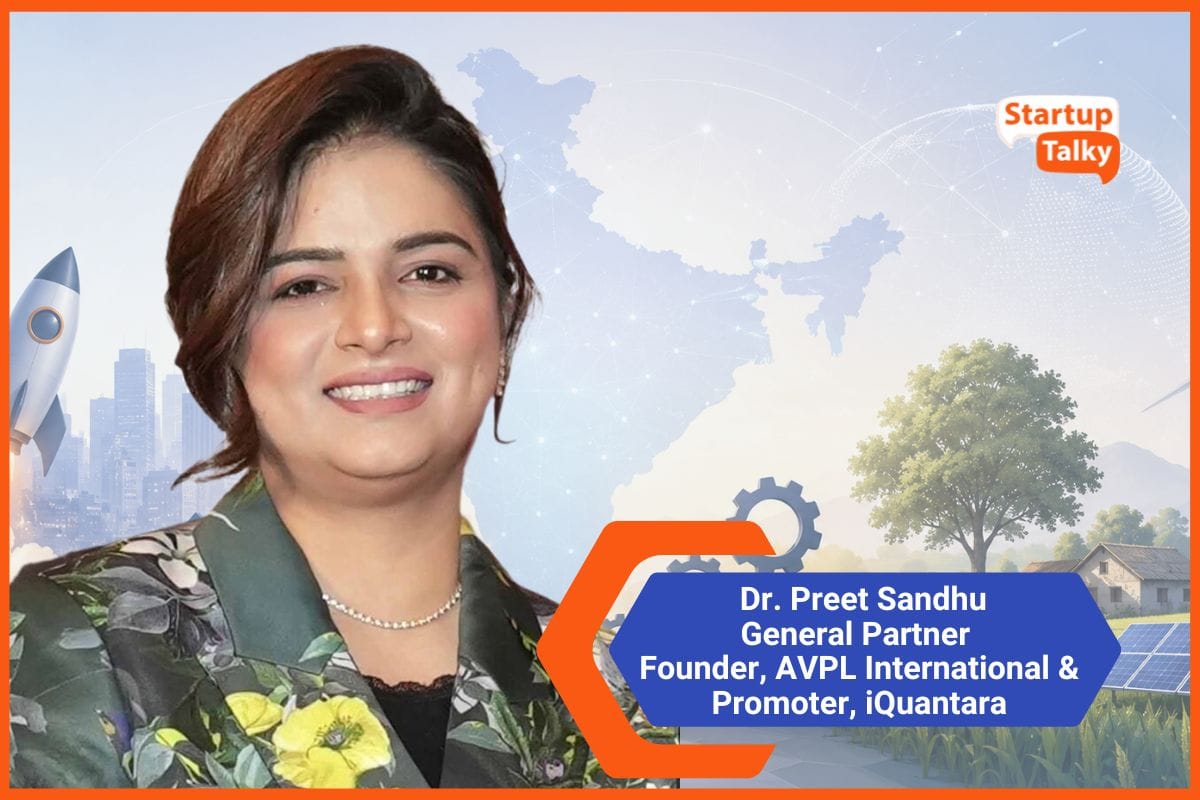
In this exclusive interaction with Dr. Preet Sandhu, Founder of AVPL International and Promoter of iQuantara, we discuss Startup League 2026, India’s deeptech ecosystem, rural entrepreneurship, women founders, incubation challenges, and the future of inclusive innovation in India.
Startup League 2026 and Breaking Network Biases
StartupTalky: Startup Stairs recently launched Startup League 2026, offering up to INR 4 Cr in funding for deeptech founders. You have noted that access to opportunities in deep tech remains structurally limited for founders outside elite institutions. What design choices in Startup League specifically address that gap, and how are you preventing it from replicating the same network biases?
Dr. Preet Sandhu: At Startup Stairs, we consciously designed Startup League 2026 to break the traditional “closed-circle” model of innovation access. In India, startup founders often emerge from Tier 2, Tier 3, and rural ecosystems, but the problem is not their talent, it is visibility, mentorship, and access to capital that they lack.
So instead of selecting founders based only on pedigree, we focus heavily on their problem-solving skills, execution intent, and grassroots relevance. We created a lot of options to assist them, like an open-access application framework, regional outreach programs, multilingual founder engagement, and partnerships with incubators, ITIs, engineering colleges, and local innovation ecosystems, not just IITs or elite campuses.
Another important design choice is decentralised evaluation. We do not rely on a single investor lens. Applications are reviewed through a mix of industry experts, operators, technologists, and ecosystem builders. This reduces the bias that often comes from “warm introductions” or urban networks.
Most importantly, we are building this for long-term mentorship enablement, not just funding announcements. Access to labs, innovation opportunities, mentorship, industry connections, and government alignment are equally important. Deeptech cannot grow through capital alone, it requires a whole ecosystem infrastructure.
Lessons from Building AVPL International
StartupTalky: You co-lead both AVPL International, India's top drone technology company, and Startup Stairs. How does your experience as a drone technology entrepreneur directly inform how you evaluate and support early-stage startups in drones, agritech, and robotics?
Dr. Preet Sandhu: Building AVPL International gave me firsthand exposure to the realities of scaling deeptech businesses in India, from regulatory hurdles, hardware supply chains, technology adoption, skilling gaps, to the existing market education.
Because of that experience, I evaluate startups beyond pitch decks. I look at whether the founder truly understands the operational realities of the sector they are entering or not. In drones, agritech, and robotics - execution matters far more than storytelling.
For example, I assess:
- Whether the startup solves a real industry pain point.
- Whether the technology can survive field conditions, not just lab testing.
- Whether the founder understands compliance and ecosystem integration.
- Whether they have thought about scalability, affordability, and adoption.
At Startup Stairs, we support founders with practical market access like pilot deployments, enterprise introductions, government ecosystem navigation, and skilling partnerships. My entrepreneurial journey has taught me that early-stage founders do not fail because of lack of ideas; they often fail because they lack ecosystem bridges.
Balancing Government Partnerships with Startup Agility
StartupTalky: Startup Stairs works with government bodies including Startup Haryana, UP CM Yuva Udyami Yojana, and the Atal Innovation Mission. Government-linked incubation often struggles with speed and founder experience quality. How do you navigate those institutional constraints while delivering real outcomes for startups?
Dr. Preet Sandhu: The key is to act as a bridge between institutional frameworks and entrepreneurial success.
Government ecosystems have enormous reach and intent, but startups require speed, responsiveness, and execution-oriented support. At Startup Stairs, we maintain a founder-first approach while aligning with government policies and its objectives.
We also strongly focus on NEEDS, identifying the real needs of founders, industries, and regions before designing support systems. Many incubation models fail because they are program-driven rather than need-driven. We constantly ask: What does the founder genuinely require at this stage to survive and scale? Sometimes it is funding, but often it is market access, regulatory guidance, technical mentorship, infrastructure, or simply faster decision-making.
At the grassroots level, we also believe in the philosophy of “1 Panchayat, 1 Entrepreneur, 1 Sector.” The idea is to empower every panchayat with at least one strong local entrepreneur who can create economic activity around the sector most relevant to that region - whether it is drones in agriculture, food processing, rural manufacturing, renewable energy, handicrafts, or digital services. India’s innovation story cannot be limited to metros alone; it must become hyperlocal, sector-driven, and community-led.
We do this through four things:
1. Simplifying access - helping founders navigate documentation, schemes, and approvals without overwhelming bureaucracy.
2. Creating execution pipelines - connecting startups directly with industry, investors, pilot projects, and mentors.
3. Building need-based interventions - designing programs around actual founder and market requirements rather than generic incubation formats.
4. Maintaining accountability through measurable outcomes - not just events and announcements.
I strongly believe that public-private collaboration is essential for India’s innovation future. But collaboration works only when implementation becomes founder-centric, need-centric, and locally relevant rather than process-centric.
Supporting Both Unicorns and Rural Entrepreneurs
StartupTalky: You have spoken about democratising entrepreneurship, not just for venture-scale startups but for rural entrepreneurs and local innovators. How do you balance supporting high-growth ambitions alongside village entrepreneur pathways within a single organisational mission?
Dr. Preet Sandhu: For me, entrepreneurship is not just limited to venture capital decisions. Entrepreneurship is fundamentally about problem-solving and economic empowerment. India needs unicorns, but India also needs thousands of sustainable local enterprises that create jobs and solve regional problems. At Startup Stairs and AVPL, we see both equally important as parts of nation-building.
The balance comes from understanding that innovation has multiple scales:
- One founder may build a global deeptech company
- Another may build a highly impactful local enterprise in agriculture, manufacturing, skilling, or drone services
Both contribute to economic transformation.
Our mission is to create the pathways - whether that means helping a deeptech startup raise institutional capital or, helping a rural entrepreneur formalise and scale their livelihood into a sustainable business model.
True democratisation happens when opportunity is not restricted by geography, language, or socio-economic background.
Women Founders and Real Ecosystem Inclusion
StartupTalky: Women founders in deeptech and agritech continue to face systemic barriers to capital and network access. As a woman founder and ecosystem builder yourself, what ecosystem-level interventions have actually moved the needle versus those that remain performative?
Dr. Preet Sandhu: What genuinely moves the needle is accessibility - real access to capital, to decision-making networks, to industry opportunities, and to leadership visibility.
Mentorship panels and symbolic representation are important, but they are not enough. Women founders need:-
- Access to institutional funding conversations.
- Inclusion in industry networks.
- Procurement and pilot opportunities.
- Technical leadership visibility.
- Long-term ecosystem sponsorship, not one-time recognition.
I have personally seen the strongest impact when women founders/leaders are integrated into execution ecosystems rather than isolated into special categories. When women are present in decision-making spaces, ecosystems naturally become more inclusive.
The performative layer is when diversity is discussed publicly but capital allocation patterns remain unchanged.
Startup Funding and Post-Incubation Challenges
StartupTalky: Startup Stairs has facilitated INR 20 Cr in seed funding across 50+ startups. What does the post-incubation journey typically look like, how many convert to institutional funding, and what are the most common reasons the others stall?
Dr. Preet Sandhu: Post-incubation outcomes vary significantly based on founder maturity, market timing, and execution capability.
A strong percentage of startups successfully move toward institutional conversations, strategic partnerships, or revenue-backed scaling. However, incubation is only the beginning — not the destination.
The most common reasons startups stall are:
- Lack of sustained execution discipline
- Weak market validation
- Founder misalignment within teams
- Scaling too early without product-market fit
- Inability to adapt based on customer feedback
In deeptech specifically, founders often underestimate commercialization timelines and capital requirements.
That is why we focus increasingly on founder preparedness, governance mindset, industry immersion, and resilience-building, not just pitch readiness.
Purpose-Driven Entrepreneurship and Founder Resilience
StartupTalky: How does a founder's personal philosophy, their relationship with purpose beyond profit, shape the way you evaluate their resilience and long-term commitment as an investable founder?
Dr. Preet Sandhu: A founder’s philosophy matters deeply, because startups go through a lot of uncertainty, failure, rejection, and long execution cycles.
When a founder is driven only by valuation or trends, resilience weakens during such difficult phases. But founders who are deeply and personally connected to the problem they are solving tend to stay committed even when outcomes are uncertain and not in their favor.
I look for clarity of purpose, emotional endurance, and long-term thinking. Purpose-driven founders often build stronger cultures, attract better teams, and make more responsible decisions.
Profit is important, sustainability also matters. But the most transformative companies are usually built by founders who are personally involved and genuinely believe they are solving something meaningful.
Advice for Young Entrepreneurs from Small Towns
StartupTalky: For a young entrepreneur from a small town or rural background with a genuinely innovative idea but no institutional pedigree, what is the single most actionable first step they can take to enter India's formal startup ecosystem?
Dr. Preet Sandhu: The first step to enter India's startup ecosystem when you are from a small town, is to just trust yourself, start building and do not wait for perfect conditions, or outside validations.
Create a prototype, test your idea locally, document your work, and start participating in startup ecosystems like startup incubators, hackathons, innovation missions, government programs, or digital founder communities.
Access is expanding rapidly through government and private initiatives, technology and overall policy support. What matters most for small startups is trust your work, be consistent and believe in proof of execution. Afterall, your geography should never define the size of your ambition.
 Apoorva Bajj