Building India's Solar Manufacturing Future: Gautam Mohanka on TOPCon Technology, Backward Integration, and Global Expansion
Gautam Mohanka discusses India's solar manufacturing growth, TOPCon technology, backward integration, AI-driven quality control, ALMM reforms, and how domestic manufacturers are preparing to compete on the global stage.
India's solar manufacturing sector is entering a high-growth phase, driven by the country's target of achieving 500 GW of non-fossil fuel capacity by 2030 and a strong push for domestic manufacturing. The Indian solar module market is expected to grow at a CAGR of 15-20% over the next decade, supported by rising utility-scale installations, industrial decarbonization, and government initiatives such as the Approved List of Models and Manufacturers (ALMM) and Production Linked Incentive (PLI) schemes.
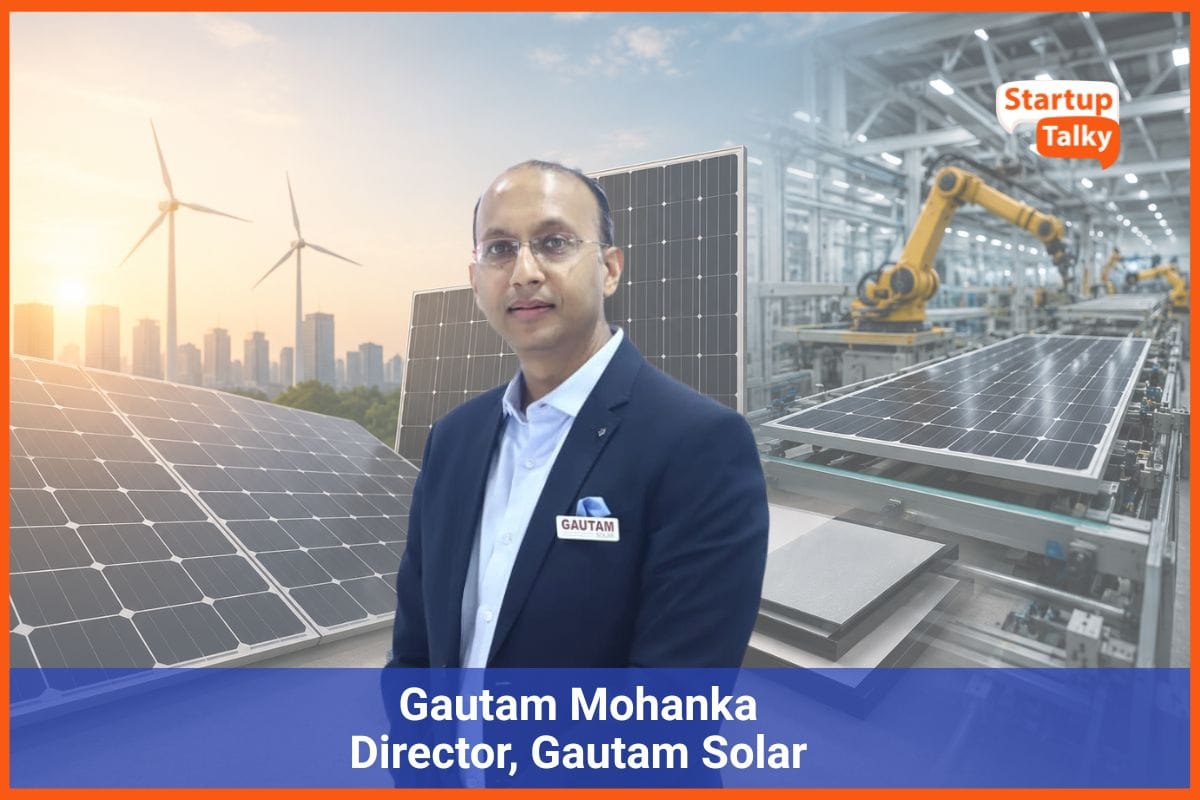
As the industry moves toward greater self-reliance through backward integration and advanced technologies like TOPCon, manufacturers are investing heavily in cells, automation, quality control, and global competitiveness. In this interview, Gautam Mohanka, Director at Gautam Solar, discusses the company's rapid growth, strategic investments in cell manufacturing, solar technology advancements, quality assurance, policy changes, and India's emergence as a global solar manufacturing hub.
Driving 200% Revenue Growth Through Manufacturing Excellence
StartupTalky: Gautam Solar achieved a 200 percent revenue rise over three years and recently received a CRISIL A-/Stable rating. From a manufacturing business perspective, what were the most consequential operational decisions that drove that growth, and what had to be sacrificed or deferred to get there?
Gautam Mohanka: What helped Gautam Solar achieve 200% revenue growth over three years was disciplined manufacturing expansion, operational efficiency, and a strong focus on growth led by quality. Increasing production capacity helped, while investing in automation, process optimisation, and high-efficiency technologies like TOPCon helped. The company focused on building long-term credibility with utility-scale developers and institutional buyers rather than competing only based on prices. Other major factors that aided in scaling sustainably were supply chain strengthening and faster execution.
However, growth at this pace requires difficult decisions. We consciously deferred certain diversification plans and prioritised investments directly linked to manufacturing scale and quality enhancement. In the short term, this meant tighter capital allocation and sacrificing some margin flexibility to strengthen our operational foundation. We also invested heavily in technology, testing, and workforce capabilities before seeing immediate returns. For us, sustainable manufacturing growth comes from long-term capability building rather than chasing short-term market opportunities or aggressive volume without operational discipline.
The Strategic Case for Backward Integration and Cell Manufacturing
StartupTalky: Your 5 GW TOPCon cell manufacturing facility in Madhya Pradesh represents a significant bet on backward integration at a time when cell imports from China still influence much of India's market. What is the financial and strategic logic behind investing in cell manufacturing rather than continuing to source cells and focusing on module assembly?
Gautam Mohanka: Our decision to invest in a 5 GW TOPCon cell manufacturing facility is based on both strategic necessity and long-term financial logic. India’s solar industry cannot become truly self-reliant if manufacturers remain dependent on imported cells. While module assembly is important, the real technological and value advantage increasingly lies upstream in cell manufacturing. The company focuses on backward integration, which leads to gaining better control over quality, efficiency, supply chain stability, and even cost optimisation.
From a financial perspective, vertical integration improves resilience against global supply disruptions and pricing volatility. It also positions us more strongly as India’s policy framework evolves, particularly with the expansion of ALMM and the government’s push for domestic manufacturing.
Strategically, owning cell manufacturing capability allows us to innovate faster, improve product differentiation, and strengthen bankability with large domestic and international buyers who increasingly prefer integrated manufacturers with tighter quality control and stronger manufacturing ecosystems.
How High-Efficiency TOPCon Modules Are Reshaping Solar Project Economics
StartupTalky: The 630 Wp R-Series TOPCon modules Gautam Solar launched offer up to 23.32 percent efficiency. For utility-scale developers and EPC companies evaluating module selection, how significant is the efficiency delta between generations of technology in terms of actual land use, output, and project economics?
Gautam Mohanka: The efficiency difference between module generations has a major impact on utility-scale project economics. Developers can generate more power from the same land area with the help of our 630 Wp R-Series TOPCon modules delivering up to 23.32% efficiency. As land availability and optimisation are some of the most important factors in large-scale solar projects, higher efficiency will directly improve project viability.
For EPC companies, higher wattage modules reduce the total number of modules that are required to achieve a target capacity. This outcome leads to fewer complications in the installation process, cabling requirements, structure costs, logistics expenses, and labour timelines. When it’s a matter of deploying across hundreds of megawatts, even a small improvement in efficiency can bring significant savings.
In addition, advanced TOPCon technology also improves long-term energy yield and performance consistency, especially from an operational perspective. It could strengthen project returns over the lifecycle. When the solar market is this competitive, efficiency has to be prioritised instead of being sidelined. It has become essential for project economics and investment decisions.
Using AI-Powered Quality Control to Improve Long-Term Module Performance
StartupTalky: India's solar sector has faced a persistent quality problem, with a number of modules in the field underperforming their rated output within a few years of installation. How does Gautam Solar's AI-based defect detection system address the quality-at-source problem, and what does your field performance data show compared to industry norms?
Gautam Mohanka: Quality inconsistency has been one of the biggest concerns in the solar industry, especially when manufacturers prioritise low pricing over manufacturing discipline. This issue is addressed by our AI-based defect detection system directly at the production stage rather than after deployment in the field. What such systems do is continuously monitor manufacturing parameters and identify micro-defects (cracks, soldering inconsistencies, etc.) better than traditional inspection methods with more precision and speed. Such defects could include cracks, soldering inconsistencies, alignment issues, and visual anomalies
This technology reduces the possibility of defective modules that reach within the market. It helps maintain consistency across large-scale production volumes. It also enables predictive quality control by identifying process deviations. If it identifies them earlier, it will be able to correct them before they affect output.
Our field performance data has shown stronger output stability and lower degradation trends compared to broader industry benchmarks. For developers and institutional buyers, long-term performance reliability is increasingly more important than only upfront pricing, making quality-at-source a critical differentiator in today’s solar market.
Rising Energy Security Concerns and the Growing Demand for Solar Power
StartupTalky: With global oil prices surging due to the Iran war and India under pressure to accelerate its energy transition, is there a shift in the urgency or scale of demand from government and institutional buyers for solar modules? What kinds of projects are now moving faster than before?
Gautam Mohanka: With the current geopolitical complications rising day by day, there is an increased urgency around renewable energy adoption in India. But even before that, the nation has been aiming for clean energy adoption at a global level. There is a strong momentum from government agencies, public-sector undertakings, and institutional investors who deem solar energy as both an economic and strategic move. Energy security is now as important as sustainability, especially in policy and procurement decisions.
The current industry is filled with projects related to utility-scale power generation, industrial decarbonization, captive solar, and hybrid renewable infrastructure more than ever before. There are organisations, especially in sectors with high energy dependence, that want to reduce exposure to volatile fossil fuel prices and are increasingly looking for clean energy options.
Another noteworthy thing is how the speedy decision-making timelines have become for government-backed infrastructure projects and large institutional procurements. At this point, solar is not just viewed as a climate-focused investment but rather being prioritised for India’s long-term energy dependence strategy. This mindset is contributing to the increasing demand across multiple sectors of the renewable energy ecosystem.
The Impact of ALMM Expansion on India's Solar Manufacturing Ecosystem
StartupTalky: India's ALMM framework is expanding to include cells, not just modules. How does this policy shift affect manufacturers at different stages of integration, and what does full ALMM compliance for an integrated manufacturer actually require in terms of capital and process?
Gautam Mohanka: The expansion of India’s ALMM framework to include cells is a transformative shift for the domestic solar manufacturing ecosystem. Earlier, module manufacturers could still rely heavily on imported cells while participating in domestic projects. With cells now becoming part of the compliance framework, the industry will increasingly favour manufacturers with deeper integration and stronger domestic capabilities.
This policy supports long-term investments in upstream manufacturing, especially for integrated manufacturers. It also creates a more level playing field against low-cost imports. But achieving full ALMM can be demanding in terms of capital and operations. It requires advanced manufacturing infrastructure, strict quality-control systems, traceability mechanisms, testing capabilities, and process certifications across the entire production chain.
The policy will likely widen the gap between fully integrated manufacturers and companies dependent on imports. While this raises entry barriers, it also strengthens the credibility of Indian manufacturing globally and encourages the development of a more self-reliant and technologically advanced solar industry.
Building a Globally Competitive Indian Solar Manufacturing Brand
StartupTalky: Gautam Solar has its sights on international markets and participated in Intersolar Europe. What does it take for an Indian solar manufacturer to be taken seriously by European or American buyers who are accustomed to procuring from established Taiwanese or Chinese brands?
Gautam Mohanka: If Indian solar manufacturers wish to compete on a global scale, especially in markets such as Europe and America, then competing based on prices will never be enough. International buyers choose manufacturers based on long-term reliability, along with bankability, technological capability, and operational consistency. Those buyers just want the assurance that the supplier can deliver a product that has stable quality standards. They expect the manufacturers to maintain timelines and support projects over decades. Buyers in these markets also closely examine financial stability, warranty credibility, traceability systems, and supply-chain transparency.
Indian manufacturers definitely have strong potential in international markets due to global procurement strategies. But the credibility on a worldwide scale could only be earned through sustained investments in automation, R&D, quality assurance, and governance. This is why our organisation focuses on building a globally trusted manufacturing brand instead of positioning ourselves as a low-cost supplier.
 Apoorva Bajj