Geetica Srivastava on Building NUOS Home Automation and Smart Infrastructure in India
startuptalkers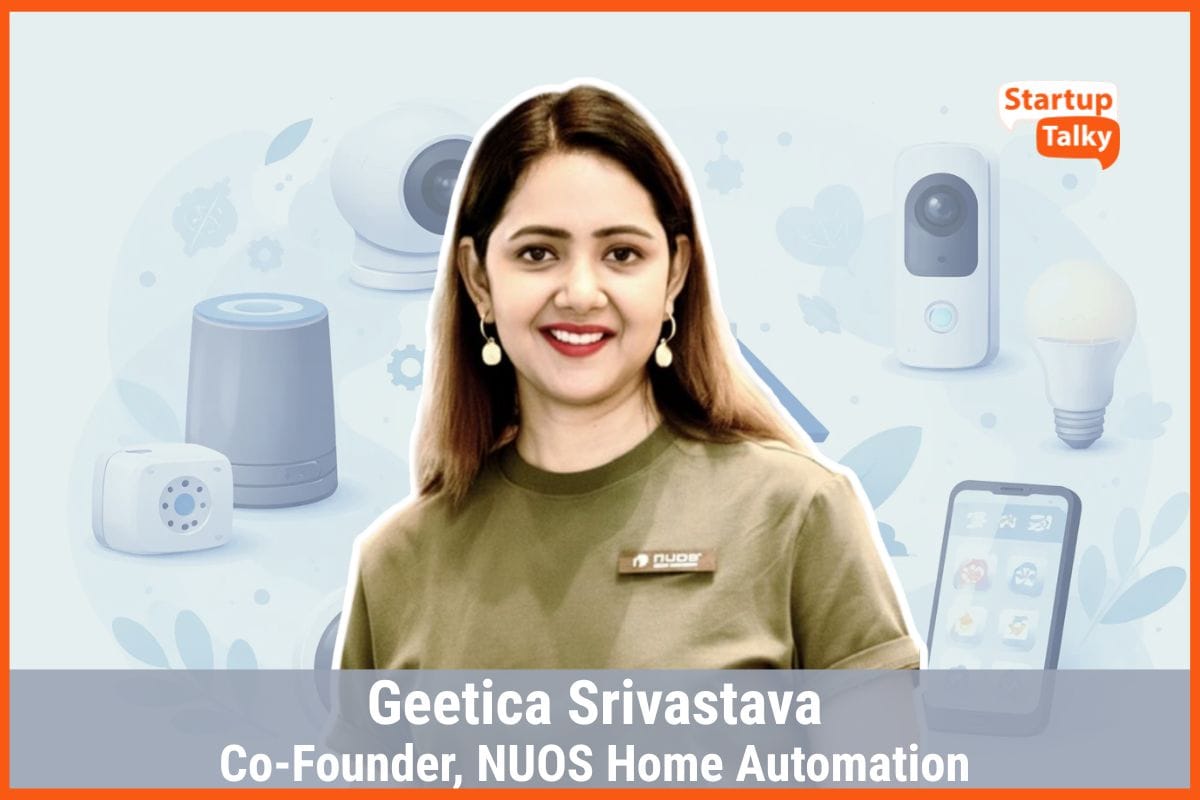
NUOS Home Automation is an Indian deep-tech company working in home automation and wireless building management systems. In this interview with StartupTalky, co-founder Geetica Srivastava shares how she built credibility in a male-dominated infrastructure sector, scaled NUOS to handle metro-scale projects, and developed Made-in-India smart automation technology focused on reliability, sustainability, and intelligent infrastructure.
StartupTalky: NUOS operates in home automation and building management systems, deep-tech spaces that remain heavily male-dominated. What was it like establishing credibility as a woman co-founder in this sector, and how did you earn trust with clients and partners?
Geetica Srivastava: When you work in deep-tech infrastructure, you have to earn credibility. Early on, I realized that the best way to establish authority was through clear technical understanding and excellent execution. I made it a priority to thoroughly grasp not just product design but also installation realities, compliance standards, and real-world integration challenges.
In infrastructure and automation, trust comes from being consistent. We completed projects on time, provided strong support after installation, and stayed actively involved in solving problems. Over time, results matter more than assumptions. Clients began to see not just a “woman founder,” but a technology partner who understands large systems. That change happens when performance is essential.
StartupTalky: NUOS has deployed wireless BMS for metro infrastructure, a significant scale for a startup. How did you go from early-stage company to winning large, complex infrastructure contracts?
Geetica Srivastava: Scaling up our infrastructure required discipline. We didn’t pursue size; we focused on strength. We tested our wireless BMS design multiple times in smaller projects before tackling larger opportunities.
To win metro-scale contracts, we needed three things: technical validation, compliance with regulations, and a commitment to long-term service. We invested in research and development early on, created thorough documentation, and made sure our system design included redundancy. Infrastructure companies don’t just buy innovation; they buy reliability. We positioned ourselves as a solution that simplifies wiring, improves monitoring, and lowers lifecycle costs. This clarity helped us transition from pilot projects to large-scale infrastructure execution.
StartupTalky: Your brand is built on Made-in-India R&D and patented innovation. What does building a genuinely indigenous deep-tech product actually look like in practice, and what are the biggest challenges that come with it?
Geetica Srivastava: Building indigenous deep-tech means owning your main structure, from firmware to hardware design, instead of putting together imported modules. It involves repeated prototyping, field testing, refining PCB layouts, strengthening cybersecurity layers, and designing for Indian voltage and environmental conditions.
The biggest challenge is balancing cost with innovation. Global components' prices fluctuate, certification processes are strict, and manufacturing precision needs constant oversight. But building in India also gives us agility, allowing for faster iteration cycles and better after-sales support. Indigenous R&D is not just a label; it is a long-term commitment to building capabilities.
StartupTalky: Smart automation needs to translate complex engineering into relatable everyday experiences. How does NUOS approach this communication and design challenge?
Geetica Srivastava: We believe engineering should blend seamlessly into the experience. A homeowner should not have to think about protocols or mesh networks; they should feel comfort, convenience, and control.
Our approach starts with keeping the interface simple. Touch panels, app design, and voice integrations are based on natural behavior patterns. We work closely with architects and interior designers to ensure that automation fits well with the overall space. Technology should improve lifestyle, not take over it. If users need to spend a lot of time learning the system, we see that as a design failure.
StartupTalky: NUOS champions sustainable and ESG-aligned smart living solutions. How are you integrating environmental responsibility into your product roadmap?
Geetica Srivastava: Automation has a direct link to sustainability. Smart lighting, HVAC optimisation, and occupancy-based controls can reduce energy consumption meaningfully in residential and commercial spaces.
We design our systems to enable energy analytics and remote monitoring so users can make data-backed consumption decisions. Wireless systems also reduce copper wiring and
installation waste. Sustainability in automation is not a marketing layer, it is about designing systems that reduce long-term energy load and improve efficiency across the building lifecycle.
StartupTalky: As a woman leader in IoT and smart infrastructure, what will genuinely move the needle in bringing more women into deep-tech leadership?
Geetica Srivastava: Representation is important, but what truly changes the landscape is access and visibility. Many women enter technology through roles in strategy, operations, product management, or business development, and those pathways are just as critical to building deep-tech companies. When women are part of decision-making conversations, whether around product direction, partnerships, or market strategy, they begin to shape the industry itself.
Equally important is creating ecosystems where women founders and leaders are supported over the long term. Deep-tech ventures often have longer development and capital cycles, so investors, partners, and industry networks need to recognise and back women building in these spaces.
Finally, role models matter. When more women are seen leading companies in sectors like IoT, infrastructure, and hardware innovation, it signals to the next generation that deep-tech leadership is not limited by background or role, it is defined by vision, resilience, and execution.
StartupTalky: What does the future of smart infrastructure in India look like over the next five years, and where does NUOS fit in that vision?
Geetica Srivastava: India is shifting toward intelligent infrastructure. This includes not just smart homes, but also connected residential areas, commercial spaces, and transit systems that communicate in real time.
Over the next five years, features like interoperability, wireless BMS adoption, and energy optimization will become standard instead of premium. NUOS wants to be part of this change by creating scalable, Made-in-India automation layers that work smoothly in homes and infrastructure. Our goal is to help create an ecosystem where smart living is the standard, not a luxury.
 Pratyusha Srivastava