The 18% You Are Probably Getting Wrong: GST on ChatGPT, Claude and Foreign AI Tools
Every Indian founder's card statement now carries a row of foreign AI subscriptions, and hidden inside each one is 18% GST. Most teams handle it in one of two wrong ways. Here is the single rule that governs all of it, in plain English, and the fix.

Open the company card statement of almost any Indian startup today and the same names repeat: ChatGPT, Claude, Cursor, Vercel, Perplexity. Useful tools, all billed from abroad, each charge small enough that nobody in finance stops to ask how it is taxed. They should. Sitting inside those charges is 18% GST, and the way most founders deal with it is quietly wrong in one of two directions. One direction costs you money. The other is a compliance gap that sits on your books until someone notices.
This is not a story about a tool doing something shady. It is about a rule almost nobody explains, and what it means for the line items you already pay every month.
One Rule Sits Under All of It
In GST language, a foreign software subscription delivered over the internet with little human involvement is an OIDAR service (Online Information and Database Access or Retrieval). ChatGPT, Claude and the rest all fall in this box. The rate is 18% IGST. What changes is who pays it, and that depends on one thing: whether you have given the tool your GSTIN.
- You do not give a GSTIN (treated as a consumer). The foreign company is supposed to charge the 18% itself and deposit it with the Indian government. You pay it inside the bill. Because this is consumer treatment, you generally cannot claim it back.
- You give your GSTIN (treated as a business). The foreign company does not charge GST. Instead the law shifts the duty to you under the Reverse Charge Mechanism (RCM): you self-deposit the 18%, and you can claim it back as input credit.
That fork is the whole story. Everything below is just what it means in practice.
 Muskaan Kapoor
What the Big Tools Actually Do Today
The two most common subscriptions on Indian startup cards behave differently, and the difference matters.
| Tool | Bills in | Adds 18% GST by default | Indian GST registration | If you add your GSTIN |
|---|---|---|---|---|
| ChatGPT (OpenAI) | ₹ (localized) | Yes, built into the sticker price | Yes, holds an Indian OIDAR registration (on public record) | Stops charging; reverse charge becomes yours |
| Claude (Anthropic) | $ (USD) | Yes, 18% added on top | Not confirmed; the GSTIN on its invoices has been publicly questioned by Indian CAs | Stops charging; reverse charge becomes yours |
OpenAI has gone the clean route: localized rupee pricing (ChatGPT Go at ₹399, Plus at ₹1,999, Pro at ₹19,900 a month), with GST handled as a registered non-resident provider. Anthropic still bills Claude in dollars (Pro is $20 a month, landing near ₹2,000 to ₹2,200 once your bank's forex fee and 18% GST are added), and adds the GST on top.
Mistake One: Paying the 18% With No GSTIN
This is the default for most small teams, because nobody entered a GSTIN when they signed up. The tool charges you 18%, and you pay it without thinking.
The problem: under consumer (OIDAR) treatment, that 18% is not input credit you can recover. It is a straight cost. On a ₹2,000 tool that is ₹360 a month, ₹4,320 a year, per subscription, gone. Across a stack of five or six foreign tools, it quietly adds up to real money you were entitled to recover and did not.
Mistake Two: Giving the GSTIN, Then Never Depositing the Tax
This is the subtler one, and the one that worries accountants more. You add your GSTIN, the tool correctly stops charging GST, the bill gets cheaper, and everyone moves on. What most founders miss is that the tax did not disappear. It moved to you.
Under reverse charge, you are now the one who must deposit that 18% with the government. Skipping it is not a saving. It is an unrecorded liability sitting on your books, and reverse-charge lapses carry interest and penalty if they surface in an audit. The cheaper bill is real; the obligation that came with it is the part teams forget.
Muskaan Kapoor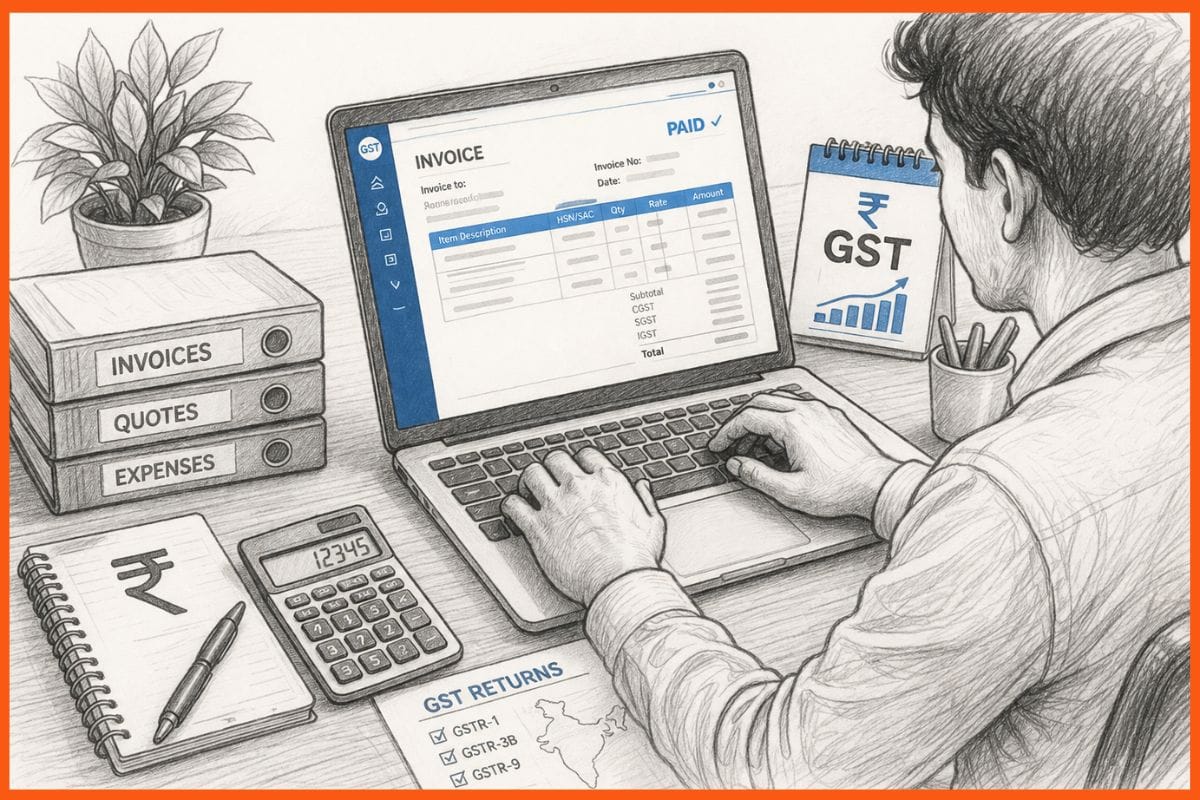
The Right Way, Step by Step
If you run a GST-registered business, here is the correct handling for every foreign AI tool. Your accountant can set it up once as a standing monthly entry.
- Add your GSTIN in the billing settings of each tool. They stop adding the 18%.
- Raise a self-invoice for the purchase. This is required when you buy from a supplier who is not registered in India.
- Deposit 18% IGST in cash through GSTR-3B, Table 3.1(d), by the 20th of the following month. Reverse charge has to be paid in cash; you cannot settle it using existing credit.
- Claim that same 18% back as input tax credit in Table 4 of the same return, as long as the tool is used for your taxable business.
A worked example. Take a tool at ₹2,000 a month. With your GSTIN added, the tool charges ₹2,000 flat. You then self-deposit ₹360 as IGST and reclaim ₹360 as credit in the same filing. Net tax cost: roughly zero. Compare that to mistake one, where you pay ₹2,360, cannot reclaim the ₹360, and lose it. Same tool, same month, ₹360 difference, repeated across every subscription and every month.
One detail worth knowing: the moment you are liable under reverse charge, GST registration is mandatory regardless of turnover. The usual ₹20 lakh or ₹40 lakh threshold does not let a small buyer off this hook.
The Claude Invoice Question
There is one reported wrinkle worth flagging plainly, because it affects whether your money is recoverable. Several Indian chartered accountants have publicly pointed out that Anthropic charges 18% labelled as GST on Claude invoices to Indian users, without an Indian GSTIN shown on the invoice, and have asked under which provision the tax is being collected. Anthropic's Indian GST registration could not be independently confirmed at the time of writing.
The practical takeaway for a founder is the same regardless of how that debate resolves: if a tool charges you "GST" but the invoice carries no valid Indian GSTIN, you cannot claim that amount as input credit. The safe path is to add your own GSTIN so the tool stops charging, and then route the tax through reverse charge, which you can reclaim. It is worth opening your latest Claude invoice and checking for yourself whether a GSTIN appears.
It Is Not Just These Two
ChatGPT and Claude are simply the most visible rows. The exact same rule covers every dollar-billed tool your team runs: Cursor, Vercel, Perplexity, Apify, Notion, Figma, GitHub. Each is an imported digital service, each carries the same 18%, each follows the same B2C-versus-reverse-charge fork. Set the treatment up once, apply it to the whole stack, and the monthly handling becomes a single repeatable entry rather than a surprise at audit time.
Bottom Line
Foreign AI tools all carry 18% GST. Give them no GSTIN and they charge it, but you lose it. Give them your GSTIN and they stop charging, but the duty to deposit and reclaim it under reverse charge becomes yours. Done right, the net cost is close to nothing and the credit is recoverable. Done by default, you are either leaking 18% or carrying a quiet liability. Neither is necessary.
This is general information for orientation, not tax advice. Your exact filing depends on your registration and how the tools are used, so confirm the treatment with your chartered accountant before relying on it.
FAQs
1. Do I have to pay 18% GST on ChatGPT and other foreign AI tools in India?
Yes. Foreign AI tools such as ChatGPT, Claude, Cursor, Vercel, Perplexity, and similar online software services are generally treated as OIDAR (Online Information and Database Access or Retrieval) services under GST and attract 18% IGST.
2. What happens if I provide my GSTIN when subscribing to a foreign AI tool?
If you provide your GSTIN, the foreign provider generally stops charging GST on your invoice. Instead, you become responsible for paying 18% IGST under the Reverse Charge Mechanism (RCM), after which you can claim input tax credit if the subscription is used for taxable business purposes and you meet the GST conditions.
3. Can I claim input tax credit on GST charged by ChatGPT or Claude?
If the subscription is treated as a consumer purchase and the provider charges GST directly, you generally cannot claim input tax credit. If you purchase the service as a business under the reverse charge mechanism, you can usually claim the tax back as input tax credit, subject to GST rules.
4. Which foreign software subscriptions are covered by these GST rules?
The same GST treatment generally applies to imported digital services and SaaS subscriptions, including ChatGPT, Claude, Cursor, Vercel, Perplexity, Notion, Figma, GitHub, Apify, and other foreign software platforms used by Indian businesses.