Follow the Money: How the Gulf Became FIFA's Paymaster
An oil major as a top FIFA partner. A sovereign fund inside FIFA's broadcaster, its new club tournament and one of its clubs. The men's World Cup heading to Saudi Arabia in 2034. How Gulf capital became central to football's finances, what each side gets, and what it costs.

In part three, we traced a loop: Saudi Arabia's Public Investment Fund taking a stake in DAZN, the broadcaster that funded FIFA's billion-dollar Club World Cup, while also sponsoring that tournament and owning one of its clubs. That loop is not an exception. It is the clearest example of a pattern that now runs through FIFA's entire balance sheet.
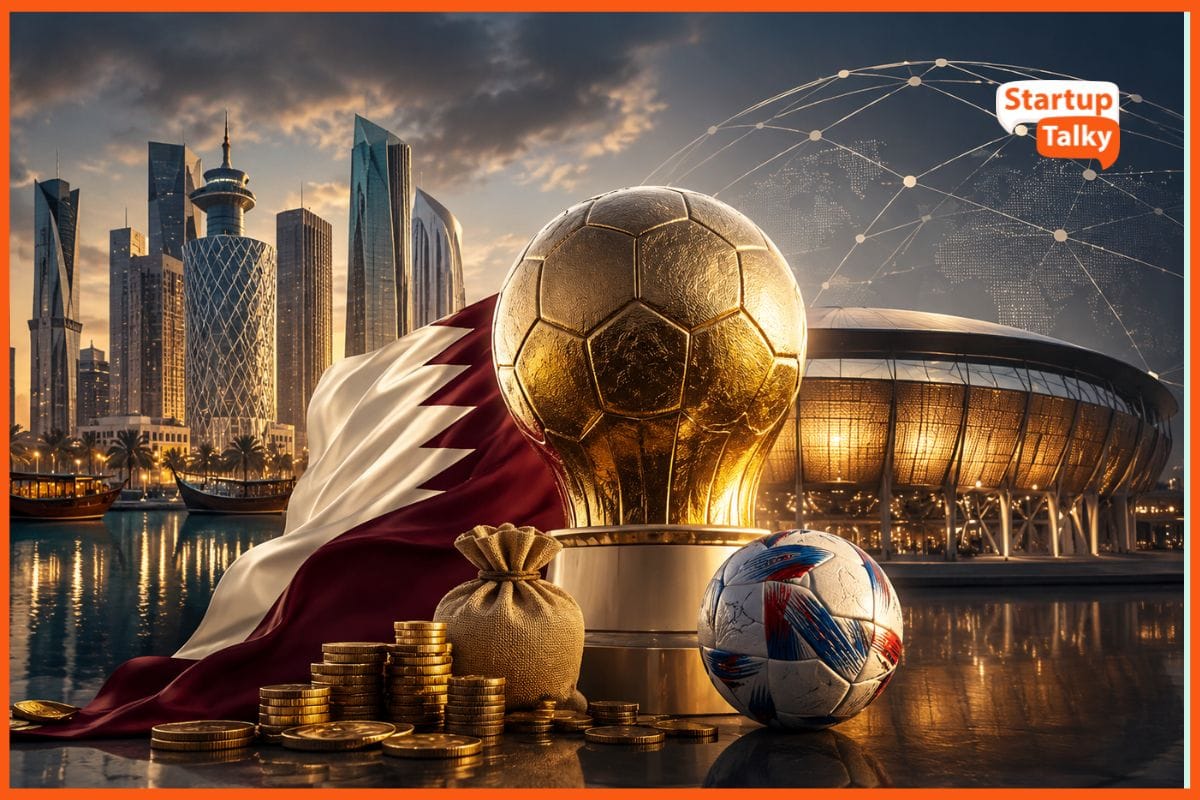
Over the last few years, the Gulf, and Saudi Arabia above all, has moved from the edge of football's economy to its center. FIFA gets deep, reliable capital. The Gulf gets the most-watched stage on earth. Both sides are getting what they want, which is exactly why the relationship keeps deepening, and why it is so contested.
The Gulf's Footprint in FIFA, at a Glance
| Link | What it is |
|---|---|
| Aramco | FIFA "major worldwide partner" (announced April 2024), reportedly ~$100M per year |
| PIF + DAZN | Saudi sovereign fund bought ~10% of FIFA's Club World Cup broadcaster for ~$1B |
| PIF + Club World Cup | PIF was a tournament sponsor |
| PIF + Al Hilal | PIF owns ~75% of a club that played in the Club World Cup |
| Qatar | Hosted the 2022 World Cup; Qatar Airways a long-running FIFA partner |
| 2034 World Cup | Awarded to Saudi Arabia (December 2024), uncontested |
Sources: FIFA, ESPN, Aramco, human-rights organisations; sponsorship values are reported figures.
The Deals
The Gulf's presence in FIFA is now structural, not occasional.
Aramco, the Saudi state oil company, became a FIFA "major worldwide partner" in April 2024, one of the most senior sponsorship tiers, in a multi-year deal reported at around $100 million a year. PIF, the kingdom's roughly trillion-dollar sovereign fund, chaired by Crown Prince Mohammed bin Salman, holds close to 300 sports sponsorships globally and sits inside FIFA's ecosystem at several points at once, as the part-owner of its Club World Cup broadcaster, a sponsor of that tournament, and the owner of a competing club. Qatar, which hosted the 2022 World Cup, keeps a standing presence through Qatar Airways.
And then there is the biggest prize of all.
The 2034 Prize
In December 2024, FIFA formally awarded the 2034 men's World Cup to Saudi Arabia. The bid was uncontested; the only candidate left standing after the process was structured in a way that effectively cleared the field.
To FIFA and Saudi Arabia, this is the natural endpoint of a serious, well-funded football project. To critics, the process was, in the words of several rights groups, a "sham", a human-rights assessment that waved through a host with deep concerns attached. Both readings start from the same fact: the world's richest sporting event is going to a state that has made sport central to its national strategy.
 Alan Joseph
What FIFA Gets
Strip out the politics, and FIFA's incentive is straightforward.
Gulf capital is deep, patient, and reliable. Where Western sponsors trim budgets in downturns and broadcasters squeeze rights fees, sovereign-backed money keeps spending through the cycle, which is precisely what a business with a feast-and-famine four-year clock craves. Gulf states also want to host and will build the stadiums and infrastructure that Western democracies increasingly balk at funding. For an institution whose entire model depends on selling one giant event, a partner that pays top dollar, hosts without political hand-wringing, and signs for the long term is close to ideal.
What the Gulf Gets
The Gulf's incentive is just as clear, and it is where the argument lives.
Saudi Arabia frames its sports spending as economic diversification, part of the Vision 2030 plan to build tourism, entertainment, and a post-oil economy, and to give a young population reasons to stay. Hosting a World Cup, on this view, is nation-building.
Critics call it sportswashing, the use of beloved global sport to soften the image of a state with a deep human-rights record problem. In October 2024, more than 100 female footballers signed an open letter urging FIFA to drop the Aramco deal, citing Saudi Arabia's restrictions on women's rights and Aramco's role in the climate crisis. Rights organisations have pressed FIFA on the same grounds. And the human cost is not abstract: in March 2026, a migrant worker died after falling during construction of a stadium named for Aramco in Al-Khobar, the kind of incident labour-rights groups warn will recur as 2034 construction scales.
Saudi Arabia rejects the sportswashing framing, points to ongoing social reforms, and argues that hosting invites scrutiny rather than hiding from it. Both the rationale and the criticism are part of the honest picture.
What Does It Cost FIFA?
The money is real, and so is the bill that comes with it.
By embedding Gulf capital this deeply, FIFA has tied its finances to states whose human-rights records it now, inevitably, shares ownership of in the public mind. Every Aramco logo and every 2034 headline drag FIFA into a debate about labour, women's rights, and the climate that has nothing to do with football and everything to do with its sponsors. It also raises a structural question the DAZN loop made vivid: when a single source funds your broadcaster, your new tournament, one of your clubs, and your future host, how independent is the governing body that is supposed to sit above all of them?
Vivek Dev Jacob
What It Means
Football's financial center of gravity is moving toward the Gulf, and FIFA's business model is the reason. An institution that must monetise one event every four years has found, in sovereign wealth, the deepest and steadiest pockets in the world. The trade is capital for credibility: FIFA gets the funding to keep the machine growing and accepts the reputational weight and the questions about its own independence that come with it.
That is the throughline of this whole series. FIFA's non-profit structure, its expanded World Cup, its billion-dollar Club World Cup, and its Gulf partnerships are not separate stories. They are one strategy, the relentless growth of a single-event revenue machine, and the Gulf has become the financier that makes the next phase possible.
If you have information related to this story, reach out through StartupTalky's tips line. Anonymity is the default.
FAQs
What is Saudi Arabia's role in FIFA today?
Saudi Arabia has become one of FIFA's biggest financial partners through Aramco sponsorships, PIF investments, and by hosting the 2034 FIFA World Cup.
Why is the Gulf investing so heavily in football?
Gulf countries see football as a way to diversify their economies, boost tourism, enhance their global influence, and support long-term national development strategies.
Why are FIFA's Gulf partnerships controversial?
Critics argue that FIFA's partnerships with Gulf states raise concerns about human rights, labor conditions, women's rights, climate issues, and the governing body's independence from major financial backers.
How does Gulf investment benefit FIFA?
Gulf-backed sponsors and sovereign wealth funds provide FIFA with long-term funding, reliable commercial partners, and hosts willing to invest heavily in stadiums and infrastructure, helping finance the organization's expanding tournaments.