

Behind the Scenes: How IPL Matches Are Organised
IPL matches may look seamless, but behind the scenes lies a complex system of planning, logistics, and coordination that ensures every game runs perfectly from start to finish.


If you’ve ever sat down to watch an IPL match, it probably feels like everything just… happens. Lights come on. Players walk in. Toss. First ball. No delays. No confusion. However, the process is rather misleading.
What you are witnessing is just the topmost layer of an entire system that is quite complicated beneath. Not chaotic, just not simple. An IPL match isn’t just organised. It’s assembled. Piece by piece. And then taken apart again. Every single time.
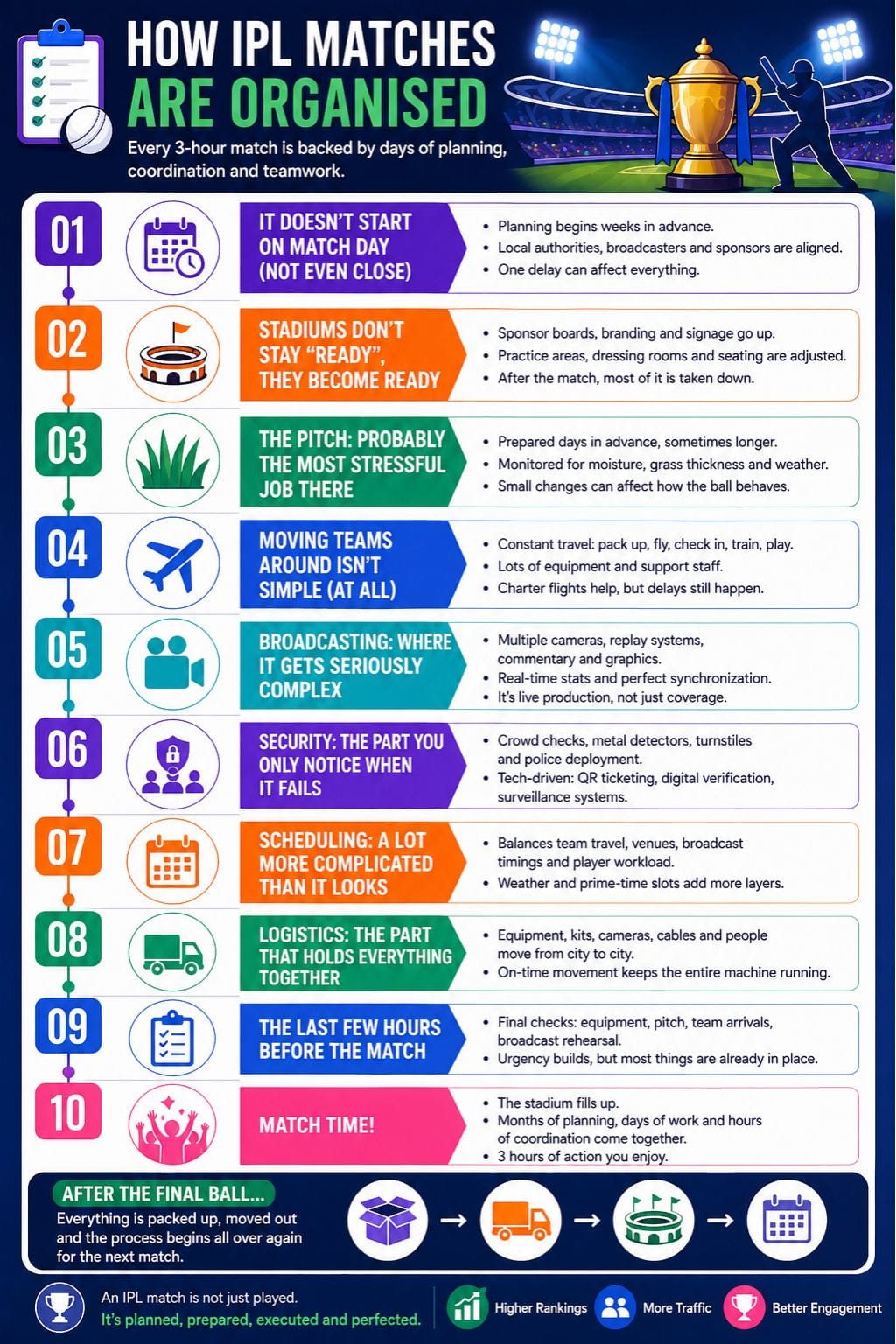
It Doesn’t Start on Match Day (Not Even Close)
There’s this assumption that preparations begin a day or two before the match. It isn’t so. When the teams arrive, it is just about finishing off the work that was completed well in advance. Local authorities are involved. Broadcasters are in sync. Even sponsor placements are pre-decided.
And because IPL moves fast, sometimes a match every day in a different city, there’s barely any breathing room between games. Which means planning isn’t just important. It’s everything. One delay somewhere tends to ripple outward.
Stadiums Don’t Stay “Ready”, They Become Ready
This is something people don’t usually think about. Stadiums aren’t permanently set up for IPL. They’re adapted for it. A few days before the match, things start changing:
- Sponsor boards go up
- Branding appears almost everywhere
- Practice areas are marked out
- Dressing rooms are adjusted
Even seating layouts and hospitality sections get modified depending on the match.
And once it’s done? Most of it is removed again.
So in a way, every match involves building a temporary event space inside a permanent structure.
The Pitch: Probably the Most Stressful Job There
You can fix a delayed light. You can replace a broken mic. You cannot redo a pitch five minutes before the match. Ground staff start working on it days in advance. Sometimes longer.
They watch:
- Moisture levels
- Grass thickness
- Weather patterns
Even at that point, it is still not fully predictable. A small difference in the weather may make the ball behave differently. That’s why captains tend to say, “We don’t know how it will play.” Because, quite frankly, nobody does. And then there’s the outfield, which needs to be flat, not too quick, but not too slow either. It is a very unassuming role, yet it can be quite noticeable when done wrongly.
 PV Vyshnavi
Moving Teams Around Isn’t Simple (At All)
Here’s something easy to overlook: IPL teams are constantly travelling. Not once. Not occasionally. Constantly. Every few days:
- Pack up
- Fly out
- Check in
- Train Play
And they don’t travel light either. There’s gear, support staff, analysts, and medical kits, all moving together. Most teams prefer charter flights now, just to avoid delays. Commercial travel would be too unpredictable with such tight schedules. And still, even with planning, things don’t always go perfectly.
Flights get delayed. The weather interferes. Timelines shift. But the match still starts on time.
Broadcasting: Where It Gets Seriously Complex
What you see on TV is probably the most coordinated part of the whole setup. It is also the most complex. There are several cameras stationed around the stadium, some fixed, some portable, others operated handheld.
Then there’s:
- Replay systems
- Commentary feeds
- Graphics overlays
- Real-time stats
All of this runs simultaneously. And everything has to sync perfectly. There’s no pause button if something breaks. It just has to work. A broadcast team arrives early enough to test everything, but there is still last-minute tweaking required. It is not a matter of reporting on a game but rather producing a live event.
Security: The Part You Only Notice When It Fails
Crowd management in IPL games is a huge responsibility. Thousands and thousands of fans come and go from the stadium. There are security checks, metal detectors, turnstiles, and even a police force. In some cities, even traffic routes are adjusted on match days. And over the years, things have become more tech-driven:
- QR ticketing
- Digital verification
- Surveillance systems
If everything runs smoothly, you don’t notice it. If it doesn’t, it becomes the headline.
Rishi Mundra
Scheduling: A Lot More Complicated Than It Looks
The IPL schedule might look straightforward, but it isn’t. It has to balance:
- Team travel
- Venue availability
- Broadcast timings
- Player workload
Even the weather sometimes plays a role. You can’t have a team playing in Chennai one evening and in Mohali the next day. It has to be spaced out. At the same time, broadcasters want prime-time slots. That adds another layer. So what you see as a simple calendar is actually a fairly tight puzzle.
Logistics: The Part That Holds Everything Together
The one quiet thing that ties all of this together is logistics. Equipment, kits, cameras, cabling, and personnel all must be moved from city to city. On time, every time. In fact, any delays will affect more than one group. Some people describe the IPL as a “moving supply chain,” and honestly, that’s not far off. Because that’s exactly how it operates.
The Last Few Hours Before the Match
This is when things get intense. Final checks happen:
- Equipment testing
- Pitch inspection
- Team arrival timing
- Broadcast rehearsal
Everyone is working, but quietly. There’s a sense of urgency but not panic. Because by this point, most things should already be in place. And then, slowly, the stadium starts filling up. From the outside, it feels like the beginning. But for the people behind the scenes, most of the work is already done.
Rishi Mundra
Final Thoughts
An IPL match lasts about three hours. What you don’t see is everything that came before it. Days of preparation. Constant movement. Small adjustments. Backup plans. And then it all disappears once the match is over.
That’s probably the most interesting part. If everything works perfectly, it feels like nothing special happened behind the scenes. But that’s exactly what makes it work.
FAQs
How are IPL matches organised?
IPL matches are organised through detailed planning that starts weeks in advance. It involves coordination between teams, stadium authorities, broadcasters, security, and logistics teams to ensure everything runs smoothly on match day.
How long does it take to prepare for an IPL match?
Preparation for an IPL match usually takes several days or even weeks. This includes pitch preparation, stadium setup, team travel planning, and broadcast arrangements.
What is the most important part of IPL match preparation?
The pitch is one of the most critical elements because it cannot be changed at the last moment. Ground staff carefully manage factors like moisture, grass, and weather to ensure fair play.
Why is IPL scheduling so complex?
IPL scheduling is complex because it must balance team travel, venue availability, broadcast timings, player workload, and even weather conditions while ensuring matches happen on time.