How to Invoice Clients as a Freelancer in India: GST, TDS, and Getting Paid on Time
Most Indian freelancers send invoices on WhatsApp and hope for the best. That works until a client asks for a GSTIN and SAC code, or until INR 15,000 disappears as TDS and you do not know how to claim it back. Here is how to invoice correctly, handle GST, and actually get paid.
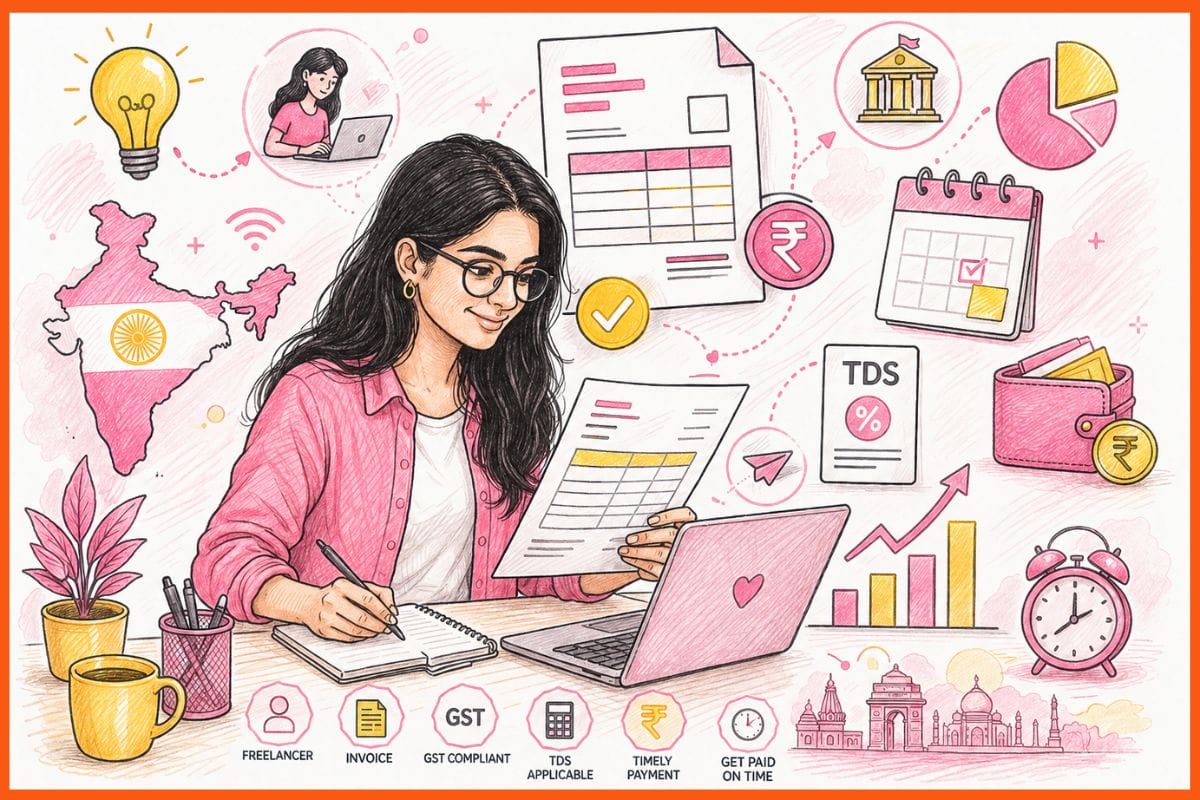
Most Indian freelancers send invoices on WhatsApp as a PDF and hope for the best. That works until a corporate client asks for a GST invoice with your GSTIN and SAC code, or until you realise INR 15,000 was quietly deducted from your payment as TDS, and you do not know how to claim it back.
Invoicing correctly from the start saves you from payment delays, rejected invoices, GST notices, and money left unclaimed at the income tax department. If you want to raise a GST-compliant invoice in under a minute without setting up an accountant, that part is easier than most freelancers assume.
Here is everything you need to know.
Do You Need to Register for GST as a Freelancer?
GST registration is mandatory if your annual freelance income crosses INR 20 lakh. For freelancers based in special category states (Jammu and Kashmir, Himachal Pradesh, Uttarakhand, and the north-eastern states), the limit is INR 10 lakh.
There is one exception that catches many freelancers off guard. If you provide services to clients outside India and get paid in foreign currency, that counts as export of services. Export of services is zero-rated under GST, meaning no GST is charged to the client. But your total turnover still includes these export earnings when calculating whether you cross INR 20 lakh. If your combined income from Indian and international clients crosses INR 20 lakh, GST registration applies.
Voluntary registration below these limits is also possible. It makes sense if your clients are GST-registered businesses who want to claim ITC on your invoices. Without your GSTIN on the invoice, they cannot.
What GST Rate Applies to Freelance Services?
Most freelance services fall under 18% GST. This covers writing, design, development, consulting, marketing, photography, video production, legal drafting, accounting, and most professional services.
When you charge a client INR 1,00,000 for a project, the invoice shows:
- Service value: INR 1,00,000
- GST at 18%: INR 18,000
- Total payable: INR 1,18,000
For clients based in the same state as you, this splits into CGST (9%) and SGST (9%). For clients in a different state, it is IGST (18%) on the full amount. The place of supply determines this, and it is the client's registered address, not yours.
What Goes on a Freelancer's GST Invoice?
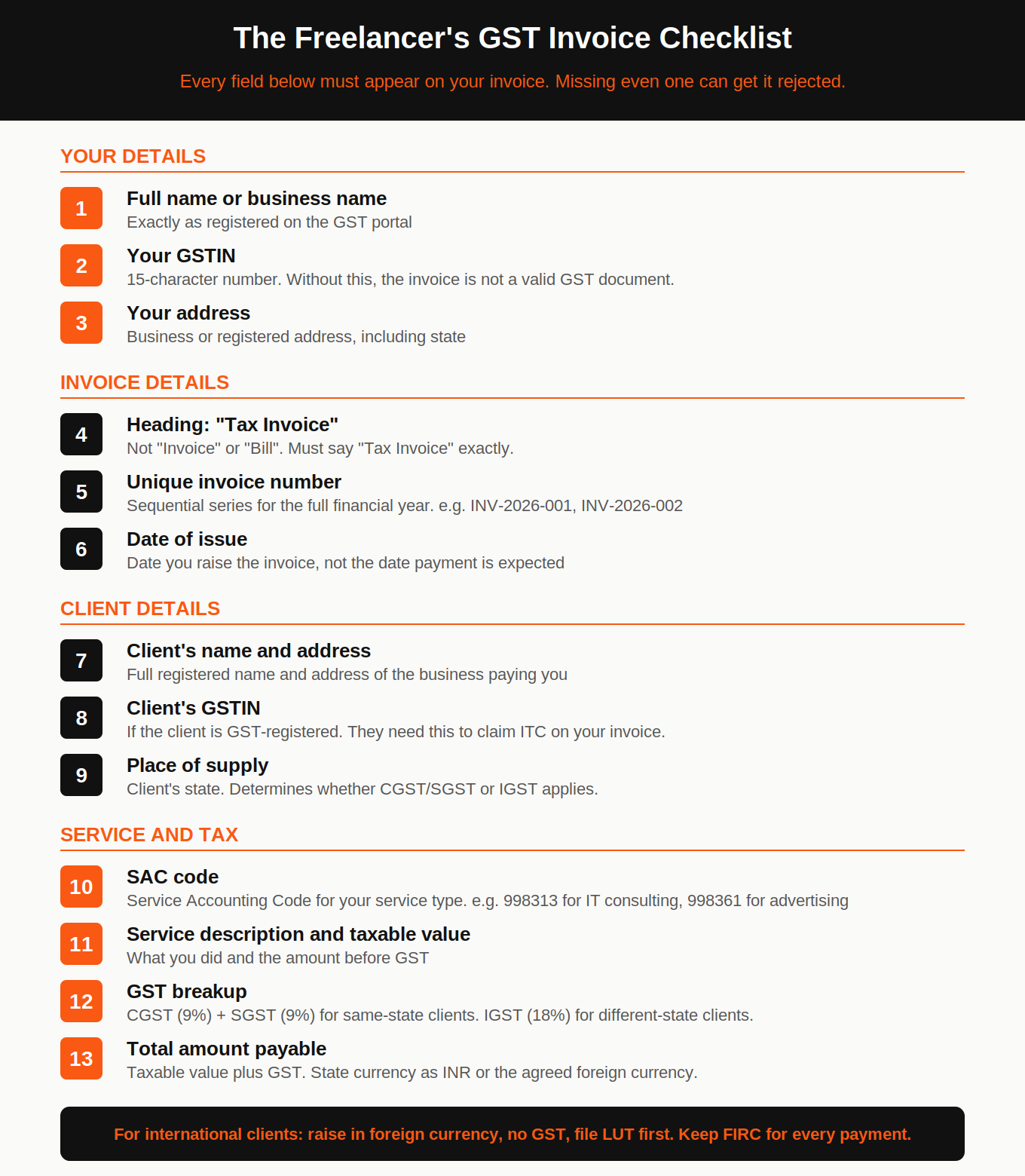
A valid GST invoice must have:
- The heading "Tax Invoice"
- Your full name or business name
- Your GSTIN
- Your address
- A unique invoice number (sequential, one series for the full financial year)
- Date of issue
- Client's name and address
- Client's GSTIN (if they are GST registered)
- SAC code for your service (most professional services fall under SAC 998300 to 998399)
- Description of the service
- Taxable value
- GST rate and amount split into CGST/SGST or IGST
- Total amount payable
Missing any of these can get the invoice rejected by the client's accounts team or trigger a compliance issue.
What Is TDS and Why Does Your Client Deduct It?
TDS stands for Tax Deducted at Source. When a company pays you for professional or technical services, they are required to deduct tax before releasing the payment and deposit it with the income tax department on your behalf.
Under Section 194J of the Income Tax Act, TDS on professional fees is 10% of the invoice value, applicable when the payment to you in a financial year crosses INR 30,000.
So if your invoice is INR 1,00,000, the client pays you INR 90,000 and deposits INR 10,000 with the income tax department as TDS. You are not losing that INR 10,000. It shows up as a credit in your Form 26AS on the income tax portal. When you file your ITR, you claim it back or adjust it against your tax liability.
The TDS is on the taxable value, not on the GST portion. GST is not income, so TDS is not deducted on it.
 Muskaan Kapoor
Upwork, Fiverr, and Platform TDS
If you earn through online platforms like Upwork, Fiverr, or Freelancer, there is a separate TDS that applies. Under Section 194O, e-commerce operators must deduct TDS at 1% on the gross transaction value before paying you.
One mistake many freelancers make in GSTR-1: they report the net amount credited to their bank (after the platform's fee and TDS have been deducted) instead of the gross invoice value. The gross value is what you should report in GSTR-1. The platform deducts TDS on the gross amount, which reflects in your Form 26AS. If your GST return and Form 26AS do not match, it triggers a notice.
How to Invoice International Clients
Services provided to clients outside India are zero-rated exports. You do not charge GST on the invoice. But you need to handle this correctly.
File a Letter of Undertaking (LUT) on the GST portal before invoicing international clients. The LUT is filed once per financial year and takes a day or two. With a valid LUT, you raise invoices without GST and report them as exports in GSTR-1.
Without an LUT, you would have to charge 18% IGST on the invoice, collect it from the client, and then apply for a refund. That is a slow and avoidable process.
For the invoice amount, convert the foreign currency to INR using the RBI exchange rate on the date of the invoice. The official exchange rate is available at fbil.org.in under the Foreign Exchange tab. Use this rate for both the invoice and your GST return. When the actual payment hits your bank, book the difference as an exchange gain or exchange loss. No GST applies to that exchange difference.
Keep your FIRC (Foreign Inward Remittance Certificate) from your bank for every international payment. Your bank issues this document as proof of foreign currency receipt. It is required if you ever claim a GST refund on exports.
How to Get Paid Faster
Late payments are the biggest cash flow problem for Indian freelancers. A few things that help:
- Add payment terms clearly on the invoice: "Payment due within 15 days of invoice date" is better than nothing. "Payment due by 15 July 2026" is better still.
- Add a payment link: Clients pay faster when they can click a link and pay via UPI or net banking directly from the invoice, instead of having to initiate a bank transfer separately.
- Follow up on the due date, not after: Send a polite reminder on the day payment is due, not a week after. Most delays come from the invoice slipping through someone's inbox.
- Mention late payment interest: For invoices to corporate clients, you can charge interest on delayed payments under Section 16 of the MSME Development Act if you are registered as an MSME. The rate is three times the bank rate notified by the RBI. Even if you do not claim it, mentioning it on the invoice nudges clients to pay on time.
What to Do When a Client Does Not Pay
First, send a formal written reminder by email with the invoice attached. Keep a record of all communication.
If the client is a large or medium enterprise and you are registered as an MSME, payments delayed beyond 45 days are a violation of Section 43B(h) of the Income Tax Act. The buyer cannot claim the payment as a tax deduction until it is paid. This is a genuine lever, and more freelancers are using it.
For amounts above INR 1 lakh, you can file a complaint on the MSME Samadhaan portal. For smaller amounts, a legal notice from a lawyer often resolves the matter before it goes further.
GST Returns for Freelancers
Once registered, you file two returns:
- GSTR-1: Filed monthly or quarterly. You report all the invoices you raised during the period. Include both Indian client invoices and international invoices (reported as zero-rated exports under the exports section).
- GSTR-3B: Filed monthly. You declare the total GST collected from clients, the ITC you are claiming on your expenses, and pay the net tax due.
If your annual turnover is under INR 5 crore, you can opt for the QRMP scheme and file GSTR-1 quarterly instead of monthly, with a simplified monthly payment process.
What Expenses Can You Claim ITC On?
As a GST-registered freelancer, you can claim ITC on business expenses that have an 18% GST invoice in your name. Common ones:
- Laptop and computer equipment
- Software subscriptions (Adobe, Figma, GitHub, Notion, and so on)
- Internet and mobile broadband
- Coworking space membership
- Professional courses and books
- Advertising and marketing spend
- Accountant or CA fees
You cannot claim ITC on food, entertainment, or personal expenses even if you have a GST bill for them.
Common Mistakes Freelancers Make
- Sending invoices without GSTIN after crossing INR 20 lakh: Once you cross the limit, every invoice needs to be a proper GST tax invoice.
- Reporting net bank credits in GSTR-1 instead of gross invoice value: For platform payments, always report the full value before platform fees and TDS.
- Not filing LUT before invoicing international clients: Without an LUT, you have to charge IGST and then wait for a refund.
- Ignoring Form 26AS: All TDS deducted by clients shows up here. If you do not reconcile it when filing your ITR, you leave money on the table.
- Mixing up CGST/SGST and IGST: An intra-state invoice with IGST, or an inter-state invoice with CGST/SGST, is a compliance error. The client cannot claim ITC on a wrongly split invoice.
Muskaan Kapoor
FAQs
Do freelancers need to pay GST in India?
Yes, if annual income crosses INR 20 lakh (INR 10 lakh in special category states), or if you make inter-state supplies regardless of income. Export of services is zero-rated but still counts toward your aggregate turnover.
What is the GST rate for freelance services?
Most freelance and professional services attract 18% GST. This applies to design, development, writing, consulting, marketing, legal, accounting, and similar services.
How does TDS work for freelancers?
Clients deduct 10% TDS under Section 194J when total payments to you in a financial year cross INR 30,000. They deposit it with the income tax department. It shows in your Form 26AS and is adjusted against your tax liability when you file your ITR.
How do I invoice international clients without charging GST?
File a Letter of Undertaking (LUT) on the GST portal before raising the invoice. With a valid LUT, raise invoices in foreign currency without GST and report them as exports in GSTR-1. Keep FIRC documents from your bank for each payment received.
What is the SAC code for freelance services?
Most professional freelance services fall under SAC 9983 (other professional, technical, and business services). Specific codes vary by service type: for example, 998311 for management consulting, 998313 for IT consulting, 998361 for advertising services, 998392 for photography. Use the code that most closely matches what you do.