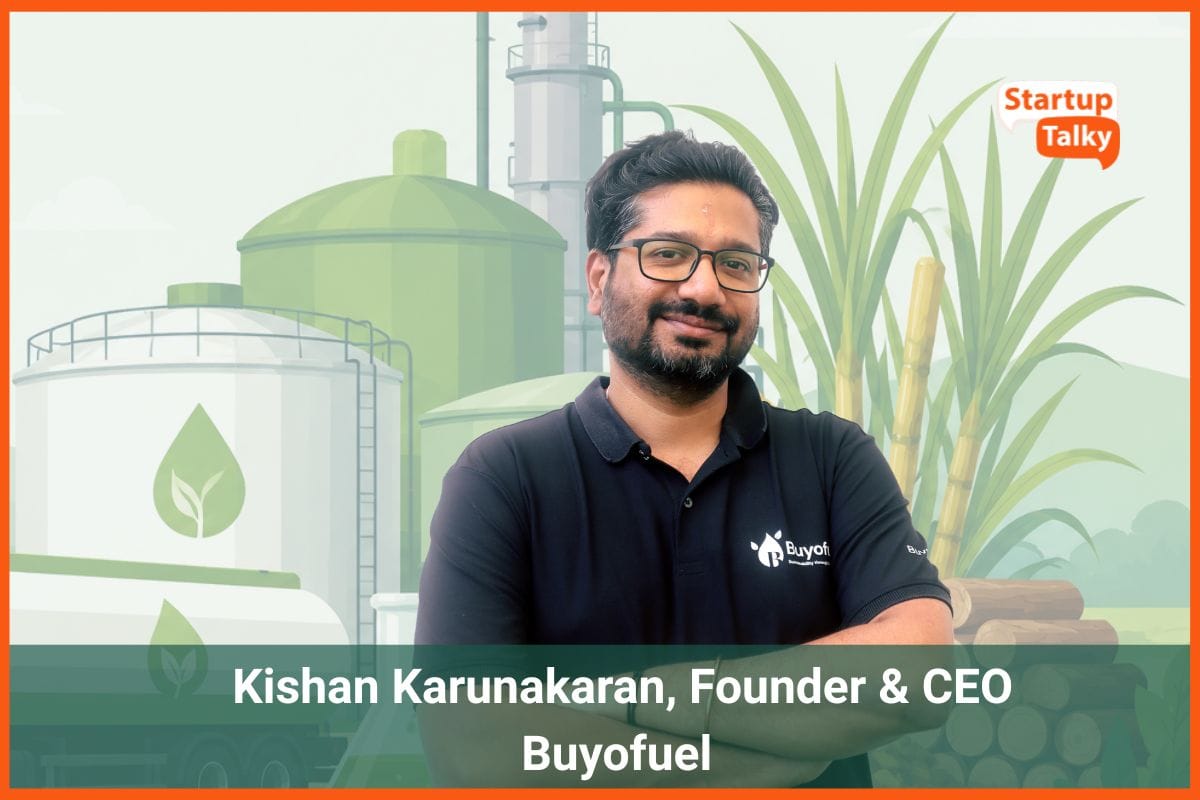
India's Biofuel Market Moves Toward Profitability and Scale: Buyofuel's Kishan Karunakaran on Marketplace Economics, Ethanol, and Energy Security
Kishan Karunakaran, Founder & CEO of Buyofuel, shares insights on building a profitable biofuel marketplace, ethanol blending, energy security, supply-chain transparency, and how AI and blockchain are shaping India's biofuel future.
India's biofuel industry is emerging as a key pillar of the country's energy transition strategy. Driven by ethanol blending mandates, industrial decarbonization goals, and growing concerns around energy security, the Indian biofuels market is expected to grow at a CAGR of over 10% through 2030. Government initiatives targeting 20% ethanol blending and increased biomass utilization are creating significant opportunities across the biofuel value chain, while digital platforms are helping address long-standing challenges related to feedstock aggregation, quality assurance, and market access.
In this exclusive conversation with StartupTalky, Kishan Karunakaran, Founder & CEO of Buyofuel, discusses how the company achieved profitability, built trust with fuel buyers, leveraged technology for traceability, and positioned itself at the center of India's growing biofuel ecosystem.
How Buyofuel Achieved Profitability in a Capital-Intensive Clean-Tech Sector
StartupTalky: Buyofuel has achieved EBITDA and PBT profitability in a segment where most clean-tech players are still burning cash. What operational decisions made that possible, and what does a sustainable unit economics model actually look like for a biofuel marketplace in India?
Kishan Karunakaran: We never accepted the idea that clean-tech has to burn cash to grow. We built Buyofuel as an asset light platform from day one. No warehouses, no stock holding. Our technology runs a clean bill-to ship-to flow where material moves directly from the supplier to the buyer in a single leg. That removes the unloading, re-loading and storage costs that would otherwise eat into already thin biofuel margins.
The second decision was being patient with topline. We chose clients carefully, the ones who pay on time, place repeat orders, and where deal economics make sense. That discipline, plus technology that has let us grow revenue close to five times in the last two to three years while keeping operating expenses largely flat, is what built the unit economics.
It has shown up cleanly on the books. We turned EBITDA positive in October 2024, PAT positive in January 2025, and we are on track to close FY25-26 as a profitable startup.
Earning the Trust of Oil Marketing Companies
StartupTalky: Winning ethanol supply tenders from Oil Marketing Companies was described as a breakthrough for Buyofuel. How does competing against established fuel supply chains work in practice? What did it take to earn that institutional trust?
Kishan Karunakaran: Fuel procurement at scale is a trust business before it is a price business. An OMC is not just buying litres. They are buying assurance that the volume will arrive at the right specification, on the right day, at the right depot, every single time. Most biofuel suppliers in India are still organised at a regional or single-feedstock level, which makes that level of dependability hard to demonstrate. What helped us is that this is not new ground for me. I set up Tamil Nadu's first biodiesel plant in 2008 and have been working in the biofuel sector ever since. That long understanding of how feedstock behaves, how testing protocols work, and how industrial buyers actually think went directly into how Buyofuel is built.
We are already supplying leading private OMCs, and we are in active discussions with PSU OMCs which we expect to begin servicing soon. What got us in was not aggressive pricing. It was the ability to aggregate volumes consistently from a fragmented supplier base, hold quality across batches through independent testing, and deliver without slipping.
Can India Realistically Achieve 20% Ethanol Blending?
StartupTalky: India is targeting 20 percent ethanol blending by 2025. Given the fragmented nature of biomass feedstock supply across the country, how large is the gap between policy ambition and ground-level supply chain readiness, and what specifically needs to change to close it?
Kishan Karunakaran: The gap is real, but it is closing faster than people assume. India has the biomass. What it has lacked is organised aggregation between the farmer and the distillery. Two things are now changing this in parallel.
On the supply side, a wave of grain-based ethanol plants has come up, taking in reject maize, broken rice and similar materials that earlier had no clean off-take channel. That has opened up an additional feedstock route alongside sugarcane and biomass. On the demand side, as electric two-wheelers and cars gain share, growth in petrol consumption is moderating, which means the same blending ratio displaces a larger relative share of crude imports. Together these trends make 20% blending genuinely reachable and accelerate the broader goal of energy security.
What still needs to change is upstream procurement. We are doing exactly this through farm-level feedstock aggregation across our six core states, Tamil Nadu, Andhra Pradesh, Telangana, Karnataka, Maharashtra and Gujarat, ensuring the farmer is paid directly.
 Akshat Hawelia
Do Geopolitical Oil Shocks Create a Structural Opportunity for Biofuels?
StartupTalky: With the Iran conflict having closed the Strait of Hormuz and oil prices rising sharply, India's dependence on imported crude has come under intense scrutiny. Does this geopolitical shock create a structural opening for domestic biofuels, or are the timelines for scale still too long to provide near-term relief?
Kishan Karunakaran: The honest position is that biofuels cannot replace crude in the timeframe of a single geopolitical shock. The refining infrastructure, the vehicle fleet and the distribution network are all built around fossil fuels. So, the shift towards biofuel is a long-term strategic move, not an impulsive response to one event at the Strait.
But it is a shift that is going to stay. Every additional litre of ethanol blended, every tonne of biomass that displaces imported coal in an industrial boiler, every litre of biodiesel used by a fleet operator, takes pressure off the import bill and the rupee. That value is permanent, not temporary. Events like this one make the rationale obvious and should accelerate the policy and capital allocation decisions that build resilience for the next shock. Those decisions, in our view, are already overdue.
Ensuring Quality and Traceability Across Diverse Biofuel Feedstocks
StartupTalky: Buyofuel's platform spans solid biofuels, used cooking oil, biodiesel, and now ethanol. How do you manage quality standardisation and traceability across such a diverse set of feedstocks and suppliers, and why does that matter for industrial buyers making long-term procurement decisions?
Kishan Karunakaran: Quality is the single biggest reason industrial buyers hesitate before signing a long-term biofuel contract. They worry about specification drift, contamination, and not being able to trace a problem back to its source.
Quality profiling sits at the core of how Buyofuel is built. Every seller goes through strong KYC verification before they can transact on the platform, and the material itself is regularly tested through our partner network of NABL accredited laboratories spread across the country. Beyond testing, the platform records every batch against its origin, its lab report and its destination, which gives the buyer a clean audit trail.
For an industrial procurement head who has to justify a long-term contract internally, that combination of verified supplier identity and independently tested material is what turns biofuel from an experiment into a dependable input.
Solving Carbon Measurement and ESG Reporting Challenges
StartupTalky: Many industrial firms want to reduce their carbon footprint but struggle to verify the actual emissions reduction from biofuel substitution. How is Buyofuel addressing the measurement, reporting, and verification challenge for its buyers?
Kishan Karunakaran: Verification is where most carbon claims fall apart. A buyer can say they have reduced emissions, but unless the underlying data is captured at the point of substitution, the claim is hard to defend in front of an auditor.
We have built a Sustainability Dashboard that measures and reports, in real time, the emissions our buyers have avoided by switching from fossil fuels to the biofuels they procure through us. Because every transaction on the platform already records the feedstock type, the quantity, the calorific value from the lab report and the end use, the dashboard runs on structural data rather than retrospective estimation. The methodology currently follows the GHG Protocol.
We are now building the next version of this framework, so the output is directly usable by buyers for their ESG reporting mandates rather than only as an internal reference.
How Blockchain and AI Are Transforming Biofuel Supply Chains
StartupTalky: You have spoken about blockchain-based traceability and AI-led demand forecasting as the next frontier for the platform. What problem does each of these solve that conventional supply-chain operations cannot, and how close is Buyofuel to deploying them at scale?
Kishan Karunakaran: Both technologies solve a problem that the conventional biofuel supply chain has never been able to fix on its own.
Blockchain solves provenance. When a buyer wants to know whether a tonne of biomass came from a specific district, whether the lab report attached to it is the original, and whether the same batch has been double sold anywhere else in the chain, a traditional ERP cannot answer that with confidence. A tamper-evident ledger can. We already have blockchain-based traceability running on the platform. AI-led demand forecasting solves matching. Biofuel demand is seasonal, weather sensitive and policy sensitive at once. Our grassroot, multi-node data collection has given us a dataset that very few players in this sector have, and we are using it to build forecasting models that help suppliers plan production and buyers plan procurement well in advance.
Our cofounders, Sumanth and Venkat, both come from a deep tech background, and they make sure the platform keeps adopting whatever is needed to keep the user experience ahead of the curve.
Apoorva Bajj