

‘I Never Asked for Permission’: Meghna Agarwal on Women Leadership, Workspaces, and Taking IndiQube Public
startuptalkers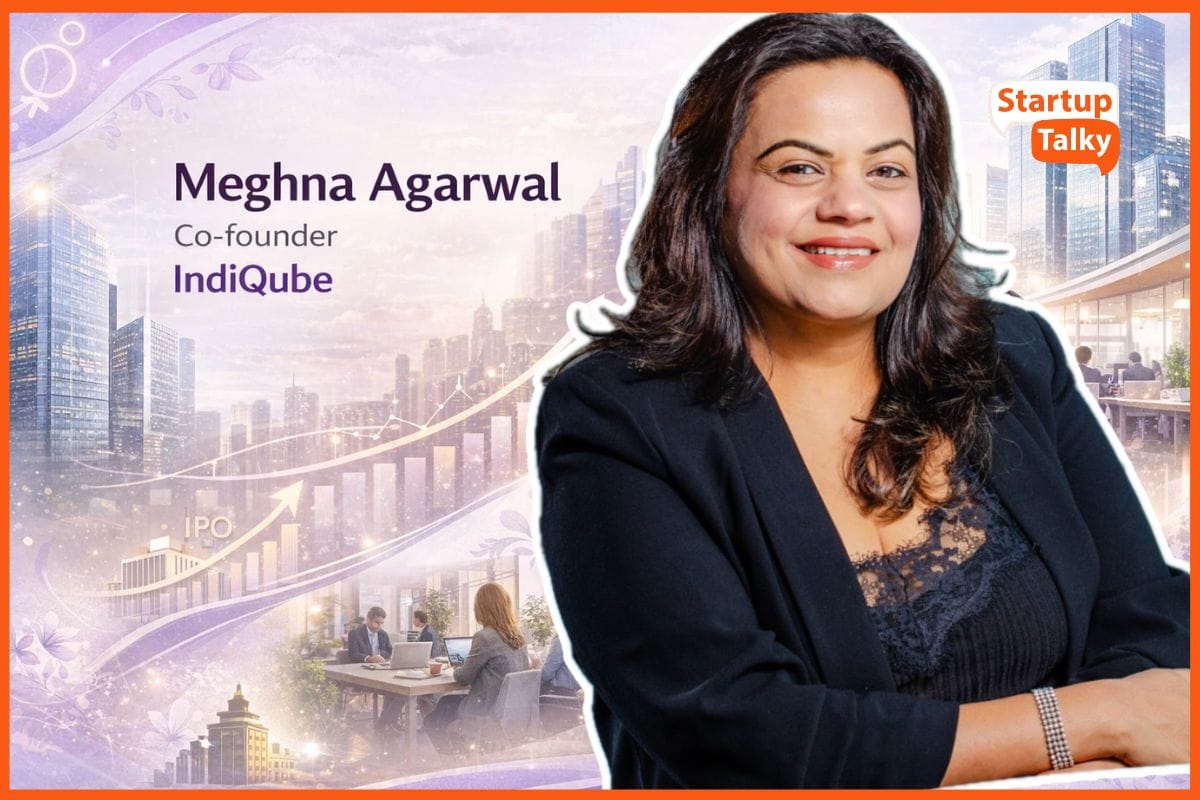
This International Women’s Day, we feature Meghna Agarwal, co-founder of IndiQube, who has made her mark in India’s male-dominated real estate sector. Since starting IndiQube in 2015, Meghna has focused on building workspaces that combine design, technology, and employee experience. From founding the company to taking it through a successful IPO, her journey shows determination, smart decision-making, and a focus on results. In this interview, Meghna talks about breaking into male-driven networks, adapting to hybrid work, and creating opportunities that give women meaningful roles in real estate.
StartupTalky: IndiQube was co-founded by a woman in real estate, a sector with minimal female representation. What does your entry into this space say about how the industry is changing, and what had to change within her to make it happen?
Meghna Agarwal: I'm not sure the industry changed to let me in. I think I never asked for permission.
When we started IndiQube in 2015, we saw a gap, from an unorganised to an organised, pay-as-you-go model, shared services, lack of service and employee experience. The industry is changing, but not because it has decided to be more inclusive. It's changing because the nature of the product has changed. Managed workspaces require design sensibility, technology integration, employee experience thinking, and areas where the old real estate assumptions don't hold. That created an opportunity for us, and we walked in.
StartupTalky: Taking a company through an IPO is one of the hardest things a founder can do. What was the most gruelling part of IndiQube’s IPO journey, and what surprised you most about the process?
Meghna Agarwal: Taking a company through an IPO is intense because it compresses multiple layers of work into a very short timeline. What was most gruelling for us was the constant coordination required across stakeholders. Even though you have experienced partners guiding the process, founders have to stay deeply involved at every stage. From bankers and auditors to legal teams, research analysts and PR firms, aligning everyone around a single objective while maintaining speed of execution requires continuous intervention.
Also, navigating the new accounting standards was equally gruelling. Under Ind AS, we report an accounting loss because lease liabilities under Ind AS 116 generate notional depreciation and interest charges that are non-cash in nature. But our underlying business is PAT positive. For 9M FY26, our IGAAP equivalent PAT was INR 95 crore. We had been consistently paying income tax. The business was clearly profitable. But the reported number created a narrative problem that we had to correct in every investor conversation, every analyst meeting, every disclosure.
What surprised me most was how much of the process depends on organisational readiness rather than the length of planning. There is a common perception that companies need three or four years to prepare for an IPO. In our case, from the time we first floated the idea in a board meeting to ringing the bell at the NSE, it took exactly one year, and we saw a strong subscription of nearly 12 to 13 times to our issue. What really matters is having disciplined governance, clean processes and predictable performance already in place.
StartupTalky: Real estate is deeply relationship-driven and traditionally male-networked. How did Meghna build credibility and access in rooms that weren’t designed for her?
Meghna Agarwal: The traditional real estate network in India, the landlord relationships, the broker networks, and the industry associations, was built over decades by families who were already in the business. I was never going to inherit that access. So, I didn't try to replicate it.
What I did instead was focus completely on delivery. The first clients who came to us were our own clients from HirePro and CareerNet, people who already trusted us from our previous ventures.
When we delivered our commitment, they stayed and expanded. Our first institutional validator was a large consulting firm that picked up space from us. Then there are a few early-stage startups, some of which have been listed today. Then in 2018, WestBridge came on board and gave further impetus to our growth.
The rooms started opening because the results were visible, not because I was invited. Having results that speak for themselves means people see value and come looking for you. I'll also say this, I stopped reading the room for whether I was welcome and started reading it for whether the opportunity was real. That shift in focus made a significant practical difference
StartupTalky: IndiQube operates in the managed workspace and commercial real estate space. How has the shift to hybrid work reshaped the business, and how are you positioning for what comes next?
Meghna Agarwal: COVID was the moment everyone predicted our model would collapse. Offices are dead, work from home is permanent, who needs managed workspaces? We heard it constantly.
What actually happened was the opposite. Post-COVID, the question stopped being "do we need offices" and became "what should offices actually do?" Companies stopped thinking about the office as a fixed overhead and started thinking about it as an employee experience decision. That shift, from real estate as cost to real estate as culture, is exactly where our model lives.
Our thesis from the beginning was that work should go where talent is, not the other way around. Distributed centres, walk-to-work options, flexible seat configurations, pay-as-you-go, we had been building for that future before the pandemic forced it. COVID accelerated the adoption of everything we already believed.
What's coming next is deeper integration of Tier II cities. Coimbatore, Kochi, Indore, and now Bhubaneswar, we're already there. The talent in these cities is real. GCCs and large Indian enterprises are waking up to that. Our "follow the talent" approach means we're already in those micro-markets before the mainstream real estate conversation catches up.
Technology is the other bet. Our MiQube platform now processes close to a million transactions with 107k downloads. Space management, desk booking, facility services, employee engagement, that's not a feature, it's what makes our workspace stickier and harder to replicate at scale.
StartupTalky: What does it mean to co-found a company? How do you divide vision, ownership, and decision-making between co-founders in a high-stakes business like real estate?
Meghna Agarwal: Rishi and I have now built three companies across different industries. So, the co-founder experience is long-standing, which makes it different from two people who meet and decide to start something.
The division was never formally negotiated. It evolved based on where each of us naturally added more. Rishi leads the overall business strategy and landlord relationships. I run the operations, sales, client delivery and technology. In practice, that means I look at the top line while he looks at the bottom line, and we meet somewhere in between.
What makes it work is that we are genuinely aligned with the fundamentals. Customer Centricity is the non-negotiable. Frugality with capital. Building for the long term, not for the next quarter. When you agree on those things, most of the tactical disagreements resolve themselves because you're both pointing at the same outcome.
The harder truth about co-founding is that you have to trust someone else's judgment in the areas they own, even when your instinct says something different. That requires a kind of professional trust that takes years to build. But I won't pretend it's always easy. High-stakes decisions in a rapidly scaling business with a lot of external scrutiny, which pressure-test any relationship. What matters is that the disagreement stays productive and never becomes personal.
StartupTalky: Women in real estate leadership remain rare. What structural or cultural barriers does the industry still need to dismantle, and what role can companies like IndiQube play?
Meghna Agarwal: The most honest structural barrier is that the industry still runs largely on informal networks, landlord relationships built over time in spaces where women are rarely present. Deals get discussed in associations that skew heavily towards their male counterparts. If those informal channels remain the primary route to opportunity, formal commitments to diversity won't move the needle much.
The second barrier is the assumption that real estate, particularly the project delivery and landlord relationship side, is physically demanding in a way that disadvantages women. That assumption is outdated. The skills that matter in this industry now are relationship management, data-driven decision-making, design and experience thinking, and technology integration. None of those is gendered.
What IndiQube can do and is doing demonstrates through the business itself that these assumptions are wrong. We have women in design leadership, in sales, in technology, in client experience. Not in token roles. In roles where they own outcomes. When a woman from our design team presents a workspace plan to a Fortune 50 client and closes it, that is more powerful than any statement we could make about inclusion.
StartupTalky: Looking back at the journey from founding to IPO, what is the one decision you’d make differently, and what’s the one you’d make exactly the same?
Meghna Agarwal: The decision I'd make differently - I would have invested in senior leadership depth earlier. For a long time, Rishi and I were too close to too many decisions. It worked while the company was smaller, but as we scaled, centralisation was leading to bottlenecks. We eventually built the leadership team we needed, and today I trust my team with full responsibilities.
The decision I'd make the same- staying disciplined on capital through COVID. In 2020, when the narrative around offices was at its lowest, the tempting thing would have been to either panic and contract dramatically or raise capital opportunistically in unfavourable terms. We did neither. We protected the balance sheet, supported our clients through that period, and kept building quietly. We didn't cut corners with landlords. We didn't walk away from commitments.
That discipline is why, when the market came back, we were best positioned to capture it. The business you build in a crisis is often the truest version of what you are. I'm proud of the one we built.
 Sakshi Jadhav