

Muskan Rathod on Building Maverick Digitals and Growing a Powerful LinkedIn Brand
news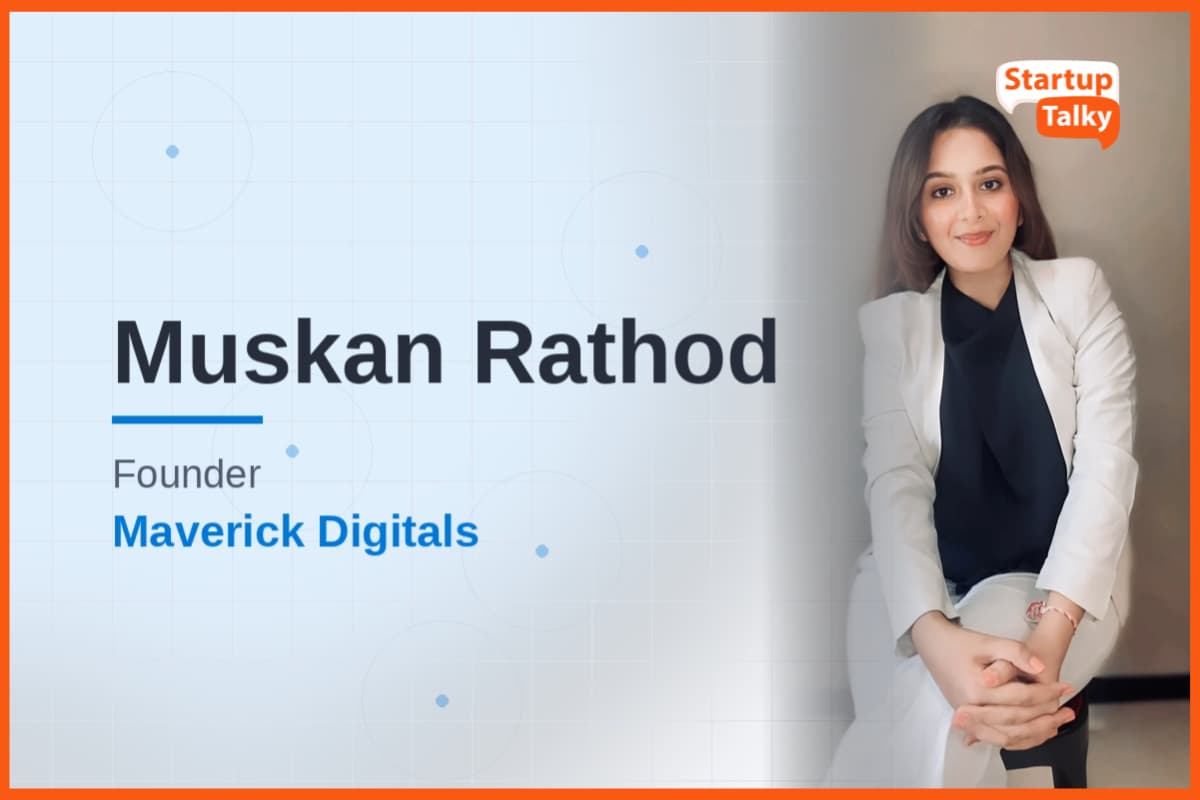
Building a digital brand today requires more than just tactics—it demands clarity of audience, consistency, and measurable results. Muskan Rathod, Founder of Maverick Digitals, has demonstrated this by growing her LinkedIn presence to 26K followers in just eight months and turning it into a powerful client acquisition channel while scaling her company across multiple countries.
In this conversation with StartupTalky, she shares the mindset shifts behind her growth, what it means to build a founder-led marketing tech company, and the lessons she learned while establishing credibility and visibility as a young woman entrepreneur in the marketing industry.
Startuptalky: Muskan, you grew LinkedIn to 26K followers in just 8 months, turning it into a genuine client acquisition engine. What was the single most important mindset shift — not tactic — that made that growth possible?
Muskan Rathod: For the first two months, my posts were getting maybe eight to ten reactions. Half of those were people I already knew personally. I'd put something out and just watch it sit there. Wasn't a great feeling.
What's funny is the post that finally broke through wasn't some big personal story or a viral hook. It was just me sharing what had actually worked for growing on LinkedIn, specific things, real things I'd tested myself. Nothing borrowed from someone else's playbook. And that one travelled in a way nothing before it had.
Looking back, I think the reason it worked wasn't the topic. It was that I'd stopped writing like I was auditioning for something. There's a version of posting where you're essentially performing competence for an imaginary audience, and people can smell that from a mile away. What changed for me was getting very narrow about who I was actually talking to. Not marketers broadly. Not the founders generally. Specifically, the person who's spent real money on their digital presence and has almost nothing to show for it. Once I had that person in mind, the writing just got more direct. Less polished in the performative sense, more useful in the actual sense.
The followers came eventually. But that was never really the thing I was optimising for.
StartupTalky: Going from 0 to 45+ brand clients across 5 countries in just over a year is remarkable. What does staying “founder-led” actually mean in practice when you’re scaling that fast, and why is it non-negotiable for you?
Muskan Rathod: Our first international client was Biocompass, a longevity company out of Europe. We heard about them through a friend, looked them up, reached out on LinkedIn, had a discovery call, and signed them. When that first payment came through in euros, I genuinely just sat there for a moment. There's something about that milestone, your first client paying you in a foreign currency, that makes the whole thing feel real in a different way than it did before.
The first few weeks weren't smooth, though. There's always a gap between what someone describes wanting in a discovery call and what they actually mean, and you only close that gap through a lot of direct conversation. I was on everything. Not because I didn't trust the team, but because a client's real preferences, the subtle stuff, the things they can't quite articulate yet, don't survive being passed through other people. It just doesn't.
That's still what founder-led means to me. Not doing every task myself. Staying close enough to every client relationship that nothing important gets lost in translation. The moment I'm only hearing about clients through summaries and updates is the moment we start becoming generic. I've seen that happen to other agencies, and it's a slow decline that's hard to reverse once it starts.
StartupTalky: As a young woman founder in marketing, you’ve spoken candidly about skepticism and “prove yourself” moments. How did you position yourself as a strategist rather than just another marketer — and what did that shift do for how clients and peers perceived you?
Muskan Rathod: There was a client early on, a SaaS platform, who was perfectly civil, but you could feel from the first call that they weren't fully convinced. Not hostile, just that particular kind of polite skepticism where they're
technically listening but have already decided how much weight to give you. I was younger, they knew that, and I think the expectation was that I'd be accommodating and grateful and would defer to whatever they thought they wanted.
We just got to work instead.
About three to four months in, they were seeing around 50% growth on Instagram. And the dynamic on calls shifted in this way that was hard to miss. They stopped briefing me and started asking me. Stopped telling me what they wanted and started wanting to know what I thought. That change in posture, from vendor to someone whose opinion they were actually seeking, that was the thing.
I've thought about that client a lot since then. There's no version of that story where I talk my way into being taken seriously. You can frame yourself as a strategist all you want, but it means nothing until the results make the argument for you. So that's where I've always put my energy. Not on how I'm perceived, but on making the work so good that the perception becomes obvious.
StartupTalky: You chose to build a marketing tech company rather than a traditional agency. What’s the core philosophical difference, and how does blending creativity with data change the kind of results you can deliver for brands?
Muskan Rathod: The simplest way I can explain the difference is this. An agency sells you output. Posts, campaigns, a website, whatever you've briefed them for. You receive the thing, the transaction is complete, and whether it connects to anything real in your business is somewhat beside the point.
What we built around the ACE Framework is different because it starts from the other end. Attention, Connection, Execution. Every piece of content, every campaign, every touchpoint is doing a specific job at a specific stage of how a customer moves toward a brand. Nothing exists just to exist. And when creativity operates inside that kind of clarity, it actually gets sharper, not more constrained. You stop making things that look good and start making things that do something.
There's also a bigger shift coming for us. We're launching an AI-powered vertical soon, with new tools and services that will make a lot of what currently requires serious budget accessible to brands at much earlier stages. That's genuinely what I'm most focused on right now. Not just doing better marketing for brands, but changing what they can actually do.
StartupTalky: You’ve built your business largely by growing “in public.” How do you decide what to share, what to keep private, and how do you handle the vulnerability that comes with tying your personal brand so closely to your company?
Muskan Rathod: Early on, I used to post about the results we'd gotten for clients. Nothing that named anyone, just numbers, growth we'd driven, campaigns that had worked. And some people came to those posts. Comments suggesting the results were exaggerated, that I hadn't really done the work, the usual stuff that happens when you're young and claiming to have built something.
I ignored most of it. Responded to a few where I felt a response was worth it. But I didn't take anything down, and I wouldn't know.
What that period taught me wasn't really about what to share. It was more about the energy behind why you're sharing something. There's a version of posting wins that is essentially just performing for people you want to impress, and you can feel it when you're writing it, this slight anxiety underneath the words. That version invites exactly the response you're afraid of. When I post now, it's because I think
something is genuinely useful or honest, not because I'm trying to establish anything.
The one line that doesn't move is client confidentiality, anything about team members, anything that involves a relationship where someone trusted me with something. That's not negotiable, and it never has been. Everything else I'm fairly open about because the version of entrepreneurship where everything was intentional and nothing went sideways is just not real, and pretending otherwise helps nobody.
StartupTalky: What’s the most common mistake you see women founders making when trying to build credibility and visibility online — and what would you tell them to do differently based on what’s actually worked for you?
Muskan Rathod: Honestly, the thing I see most often is just waiting. Women with real expertise, actual track records, things genuinely worth saying, who are holding back because the platform isn't big enough yet, or the timing isn't right, or the content doesn't feel ready enough.
The person I think about most when this comes up is Falguni Nayar. She spent decades building real expertise before Nykaa existed. When she started, she wasn't waiting to feel ready; she was ready, she'd just been building in a different direction before that. What she did was back herself with everything she'd actually earned.
That's the thing most women founders I see aren't doing. Not because they haven't earned it, but because there's always a reason to wait a little longer. The platform needs to be bigger. The business needs to be more established. The content needs to be more polished.
The other thing I'd say is stop optimising for impressive and start optimising for useful. Those are genuinely different targets. Impressive is how you come across. Useful is about what the person reading it actually walks away with. In my experience, useful outlasts
impressive every single time, not immediately always, but over any meaningful stretch of time it does.
StartupTalky: What’s next for Maverick Digitals, and how do you see your own role evolving as the company scales — especially in keeping the quality and founder-level care that got you here?
Muskan Rathod: The thing I care most about in what we're building, and I mean this beyond the business case for it, is what it does for creators who are currently getting almost nothing.
I've done collabs myself. Fashion brands, restaurants, hospitality. I know what those conversations look like from inside. And for most nano and micro creators, people with genuinely engaged audiences, real trust, sometimes eight or ten percent engagement, the reality is they're receiving products. A gifted outfit. A free dinner. I specifically remember doing cosmetic brand collabs, posting content that was performing well, getting real traction, and walking away with products instead of income. You do the work, the brand gets the visibility, and the financial exchange is essentially zero on your end.
That's what the AI platform is designed to change. Brands stop getting a 48-hour spike and start building a sustained presence. Creators get paid based on actual results, real money, not barter. Alongside that, we're launching AI tools on the website for founders, agency owners, D2C brands, and anyone who wants to grow their digital presence without a full retainer being realistic yet.
My own role through all of this is shifting. Less in the execution, more in making sure that as the company grows, the quality of thinking behind everything stays intact. That's the part I'm least willing to let go of. The scale can come. That standard has to come with it.
 Sakshi Jadhav