
YOGa Clean Air Raises ₹20 Cr Led by Info Edge Ventures
YOGa Clean Air has raised ₹20 crore led by Info Edge Ventures, with Deepinder Goyal joining. It is the first institutional money the company has taken, and it comes straight after its first profitable year on ₹12.6 crore of revenue.
On Delhi's worst days the air outside crosses 900 micrograms of particulate matter per cubic metre, sixty times the level the World Health Organization treats as safe over 24 hours. YOGa Clean Air says the air inside the buildings it fits stays in single digits on those same days.
On 31 August 2026 the company raised ₹20 crore, led by Info Edge Ventures, with Deepinder Goyal, founder of Zomato's parent Eternal, and Three Words Capital joining.
It is the first institutional money the business has taken.
Its first year in profit, and then its first cheque
YOGa trades as YOGAN Solutions Private Limited, registered in Delhi. Its filed accounts for the year to 31 March 2025 show revenue of ₹12.6 crore and a net profit of ₹64.8 lakh, with revenue up 64% on the year before.
That profit is new. The company lost money in each of the four years before it, including ₹53.1 lakh in the year to March 2023 and ₹4.5 lakh in the year to March 2024, while revenue climbed from ₹83.5 lakh in FY2021 to ₹12.6 crore last year. It crossed into profit in the same year it went out to raise. Most companies announcing a first institutional round are selling a plan; this one is selling a business that has just started paying for itself, at a size where ₹20 crore is about 1.6 times everything it booked last year.
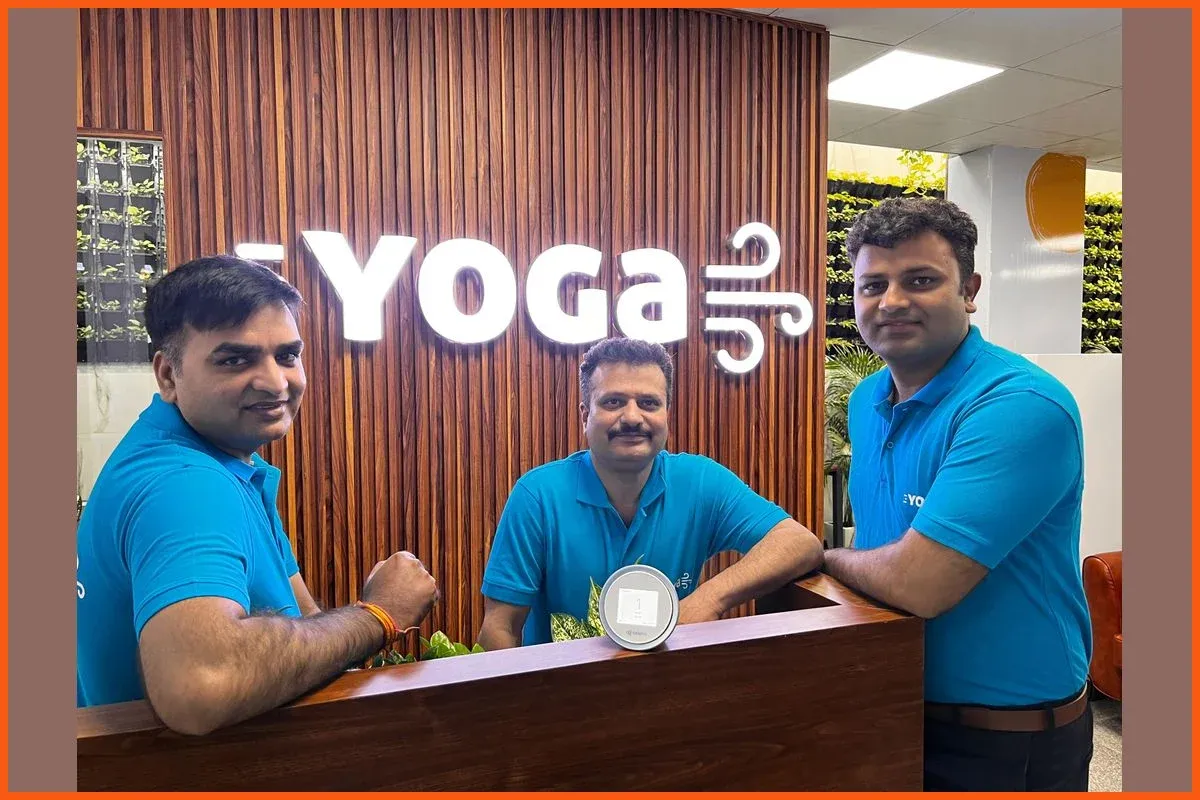
Sachin Panwar started the business in 2010. The company was formally incorporated in 2019, alongside co-founders Deepak Raina and Gaurav Nagar. Sixteen years passed between the first version of this idea and the first venture cheque, and the company says it got there on customer referrals with no conventional marketing spend.
"No one should have to shift their homes because of air pollution. Every system we install is a commitment to the people inside that space, to the air they breathe, and to the belief that clean air in India is not a privilege but a right," said Sachin Panwar, Co-founder and CEO, YOGa Clean Air.
A pressurised room, not a better purifier
The product is not a purifier, and the distinction is the whole business. A standalone purifier cleans the air already in a room while more of it leaks in around doors, windows and gaps. YOGa treats the space as a sealed system: it filters air on the way in, then holds the room at slightly higher pressure than the outside, so contaminated air cannot push its way through the gaps. Because a sealed room accumulates carbon dioxide from the people breathing in it, the system manages that too, which is the difference between air that is clean and air that is also fresh. The company holds two patents on the approach.
It says its systems protect more than 5,000 families and a set of schools, hospitals, offices and gyms across 11 cities, and reports a 100% renewal rate on annual maintenance contracts. It attributes independent validation of its air quality readings to IIT Delhi. Prof. Mukesh Khare of IIT Delhi is the company's non-executive chairman.
Why a profitable company raises at all
The obvious question about a business that funds itself is what it needs the money for. The answer sits in the plan attached to the round: deeper coverage in existing cities, expansion into new Tier-1 and Tier-2 markets, and an extension of the systems into public transport and other outdoor environments.
That last item is the expensive one. Sealing a home or a school is a contained engineering job with a paying customer at the end of it. Putting engineered clean air into public transport means longer procurement cycles, government or operator counterparties, and hardware that has to work in a moving vehicle. Referral-led growth also has a natural ceiling, because referrals only reach as far as the existing customer base does, and a company that has never bought demand does not yet know what it costs.
"YOGa has built a differentiated technology platform in a large and increasingly important market, with strong evidence of product-market fit. Its referral-led growth, customer retention and operating track record stood out for to us," said Chinmaya Sharma, Partner at Info Edge Ventures.
India has no shortage of companies selling anti-pollution technology, and most of them sell devices. The harder claim here is architectural, that the unit of clean air is a room rather than a machine, and it is a claim that gets tested at a completely different scale once the buyer is a transport operator rather than a family in Gurugram.
What the ₹20 crore really buys is the answer to whether a business built on word of mouth in India's most polluted cities can be bought into existence somewhere new.
Common questions
What is YOGa Clean Air's Clean Air Bubble technology?
It filters incoming air and holds the indoor space at slightly higher pressure than outside, so polluted air cannot leak in through gaps, while managing carbon dioxide so the air stays fresh and not only filtered.
Is YOGa Clean Air profitable?
Yes, as of its most recent filed accounts. For the year to 31 March 2025 it reported revenue of ₹12.6 crore and a net profit of ₹64.8 lakh, its first profitable year after four years of losses.
Who invested in YOGa Clean Air's ₹20 crore round?
The round was led by Info Edge Ventures, with participation from Deepinder Goyal, founder of Zomato's parent Eternal, and Three Words Capital.
Round size, investor names, product claims and quotes come from the company's announcement. Revenue, net profit and the five-year history come from the filed accounts of YOGAN Solutions Private Limited as aggregated by Tracxn, retrieved 31 August 2026, in the filing currency. The WHO 24-hour guideline for PM2.5 is 15 micrograms per cubic metre.