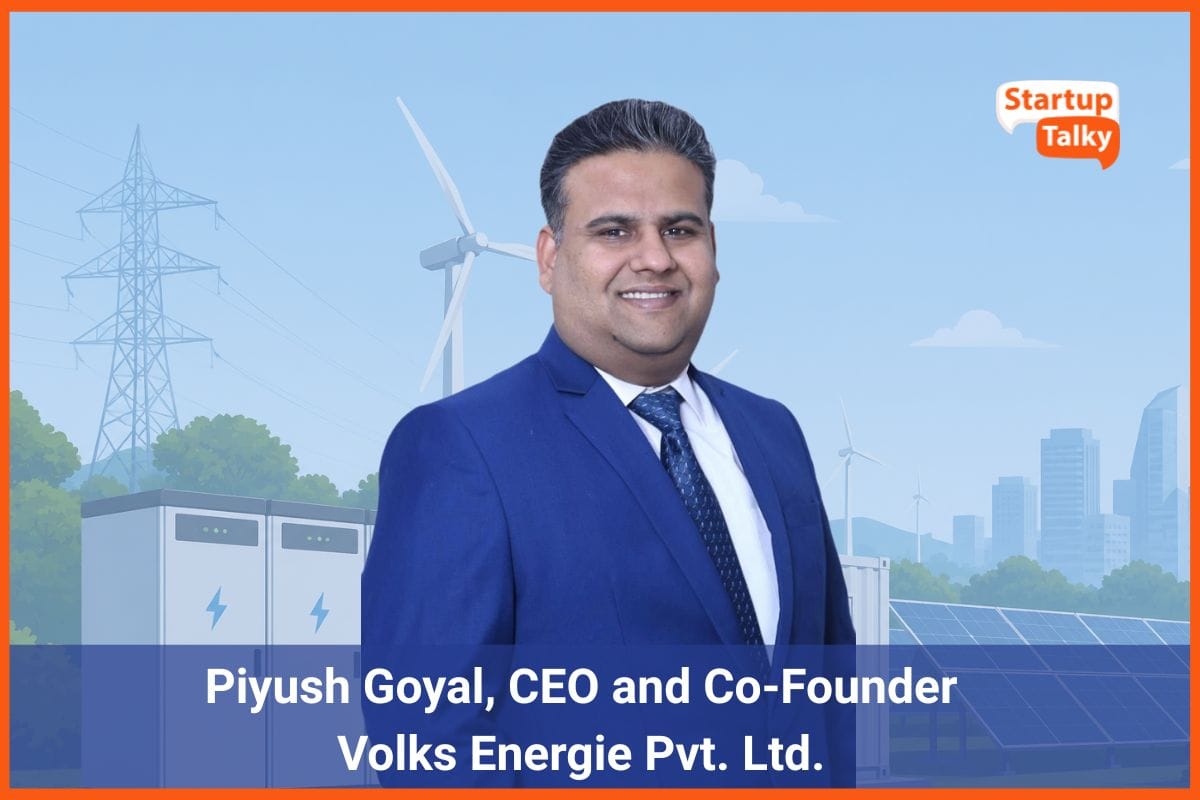
As India Strengthens Energy Security, Energy Storage Takes Center Stage: Piyush Goyal Explains Why
Piyush Goyal, CEO and Co-Founder of Volks Energie, discusses energy storage, Ni-Cd batteries, pipeline infrastructure, EV charging, energy security, and the future of resilient power systems in India.
India's energy storage sector is entering a period of accelerated growth as the country strengthens its renewable energy capacity, EV infrastructure, and critical energy assets. The Indian battery energy storage market has been expanding rapidly, supported by grid modernization, renewable integration, and energy security requirements, with industry estimates projecting a CAGR of over 20% through the decade. As geopolitical uncertainties and rising energy demand place greater emphasis on resilience, energy storage is becoming a strategic component of national infrastructure.
In this exclusive conversation with StartupTalky, Piyush Goyal, CEO and Co-Founder of Volks Energie Pvt. Ltd., discusses the role of Nickel-Cadmium batteries, energy storage for pipelines and EV charging infrastructure, policy challenges, AI-driven tendering, and the future of resilient energy systems in India.
When Nickel-Cadmium Batteries Outperform Lithium-Ion Storage
StartupTalky: Volks Energie has built a reputation around Nickel-Cadmium batteries for critical infrastructure, while the mainstream market has largely moved to lithium-ion. In which specific use cases is Ni-Cd genuinely superior, and what are the conditions under which lithium-ion storage is inappropriate for a mission-critical installation?
Piyush Goyal: Ni-Cd works where downtime cost exceeds battery cost. Three conditions push us toward it. Sites with extreme temperature swings, where Ni-Cd holds capacity while Li-ion derates or shuts down, and where Li-ion's air conditioning requirement adds OPEX that Ni-Cd avoids. Assets that must run 15 to 20 years without replacement. Installations near combustible material, where Ni-Cd's alkaline chemistry carries no thermal runaway risk.
Li-ion fails the spec sheet when the site lacks fire suppression, when ambient conditions exceed its rated envelope, or when servicing visits are rare.
Why Remote Pipeline Infrastructure Depends on Solar-Plus-Storage Systems
StartupTalky: India's pipeline infrastructure carries fuel across thousands of kilometres of difficult terrain. Volks recently completed solar-plus-storage deployments for GAIL's JHBDPL pipeline project. What are the unique power reliability and safety requirements of remote pipeline monitoring stations that make off-grid solar-plus-storage the only practical solution?
Piyush Goyal: A pipeline is a continuous chemical asset. Power failure means lost visibility on flow, pressure, and leak detection. Cathodic protection is even more sensitive. Short interruptions cause measurable degradation over the asset's life.
These stations sit where the grid cannot reach economically. Our 9-site JHBDPL deployment for GAIL spans rural Bihar, Jharkhand, West Bengal, and Uttar Pradesh. Grid extension needs kilometres of new transmission. Diesel generators add fire risk near a hydrocarbon pipeline and need a fuel chain no operator wants.
Solar plus battery storage removes fuel logistics, grid dependency, and thermal hazard. The 15 kWp solar plant with Ni-Cd storage at each site can sit untouched for years.
Rising Geopolitical Risks Are Accelerating Energy Resilience Investments
StartupTalky: With the Iran conflict exposing India's dependence on Gulf oil imports and creating urgent pressure to secure domestic energy infrastructure, how are PSUs and government infrastructure operators responding? Are you seeing a shift in the urgency or scale of energy storage and resilience projects?
Piyush Goyal: Yes, and the numbers tell part of the story before I even get to our pipeline. Roughly 40 percent of India's crude imports pass through the Strait of Hormuz, according to India Briefing. The Indian crude basket touched USD 113.57 per barrel on March 11, 2026. The ISAS NUS brief from January 2026 puts Middle East crude at about 45 percent of total imports.
What that translates to on the ground: PSU procurement teams that were running 18-month evaluation cycles are now asking for commercial proposals in weeks. Storage sizing on new RFPs has gone up. I've also seen more pointed questions about indigenous supply chains for cells, BMS, and inverters than at any point in the last two years. The CFO of a PSU infrastructure company now has a live number in his quarterly fuel bill that policy memos could never produce. That changes how fast decisions move. We expect it to stay that way through FY27, geopolitics aside.
How Solar-Plus-Storage Improves EV Charging Economics and Grid Stability
StartupTalky: Volks also works in the EV charging space, advocating for solar-plus-storage hybrid systems at charging stations. What is the actual grid impact of an EV charging station that charges without any local storage, and how does adding solar and storage change the economics and grid stability equation for a charging hub operator?
Piyush Goyal: A 60 kW DC fast charger on a small feeder is roughly equivalent to adding 20 typical Indian homes for the duration of a charge. A four-bay hub places 240 kW peak load on infrastructure never sized for it: voltage sag, demand charge spikes, stress on the local transformer.
With solar plus a battery buffer, the charger draws steadily while the battery refills from solar and off-peak supply. Demand charges come down, the hub can offer faster charging without breaching sanctioned load, and once storage is on site, the operator can earn revenue from grid stabilisation.
The Policy Gaps Facing Critical Infrastructure Energy Storage Projects
StartupTalky: You have been a vocal advocate for performance-linked incentives and green CAPEX financing for private companies working with public enterprises on renewable-plus-storage projects. What specific policy gap does the current framework leave for companies doing pioneering work in off-grid and critical infrastructure energy, and what would change if those policies existed?
Piyush Goyal: The current framework covers cell manufacturing at scale and grid-connected utility BESS. The ACC PLI scheme allocated Rs 18,100 crore for 50 GWh of manufacturing capacity, and Viability Gap Funding of around Rs 145 billion covers roughly 73 GWh of grid storage. Companies like us sit outside both.
We deploy off-grid critical infrastructure for pipelines, refineries, telecom, defence, and remote PSU sites. Project sizes are small; complexity and reliability requirements are high. A performance-linked incentive tied to uptime SLAs rather than nameplate MW would help.
So would a green CAPEX financing line with longer tenures and lower interest, moving capital into projects that look small on a banker's spreadsheet but matter disproportionately to national energy security.
Using AI to Transform Infrastructure Tendering Processes
StartupTalky: Volks is building an AI-based tendering platform to improve how it responds to infrastructure tenders. In a sector where technical specifications, compliance requirements, and pricing are all highly complex, what inefficiencies does the current tendering process create for suppliers, and how does AI help navigate them?
Piyush Goyal: Public infrastructure tenders run hundreds of pages. Specifications, compliance annexures, bid formats, and eligibility criteria cross-reference each other, and one tender can consume 60 to 80 person-hours before pricing begins. Smaller suppliers miss tenders they qualify for. Larger ones over-resource bid teams and still miss compliance gaps. The platform scans new tenders against the company's eligibility profile, extracts compliance requirements into a checklist, and benchmarks pricing against historical data.
One tender used to mean 40 hours of reading before the bid manager could think about strategy. The platform cuts that down to a fraction, so the team spends time on pricing judgment and partner selection instead of document archaeology.
What It Takes to Execute Energy Storage Projects in India's North-East
StartupTalky: India's North-East presents extreme logistical and climatic challenges for energy infrastructure deployment. What does executing a reliable energy storage project in a remote location in Assam or Manipur actually require in terms of supply chain, local partnerships, and commissioning expertise, and what lessons from those projects apply to the rest of India?
Piyush Goyal: A project in Manipur or eastern Assam looks simple on paper. The complexity sits in everything around the hardware. Road’s change with the season. A site reachable in 14 hours in March can be unreachable in July. Monsoon windows compress commissioning into a five-month calendar. Bridge and road constraints decide what equipment you can move. Local customs, language, land ownership, working norms and culture, all must be known and familiar to the civil contractor. Trained local technicians cut commissioning time by half. EPC reliability is mostly logistics, not engineering. Teams that succeed in the North-East tend to succeed anywhere.
 Apoorva Bajj