Profitable Govt Schemes You Can Turn into Businesses
Explore profitable Indian government schemes that can be turned into businesses. Learn how MUDRA, PMEGP, PMFME, PM Vishwakarma, CSC, and PM SVANidhi help entrepreneurs start and grow low-risk income-generating ventures.

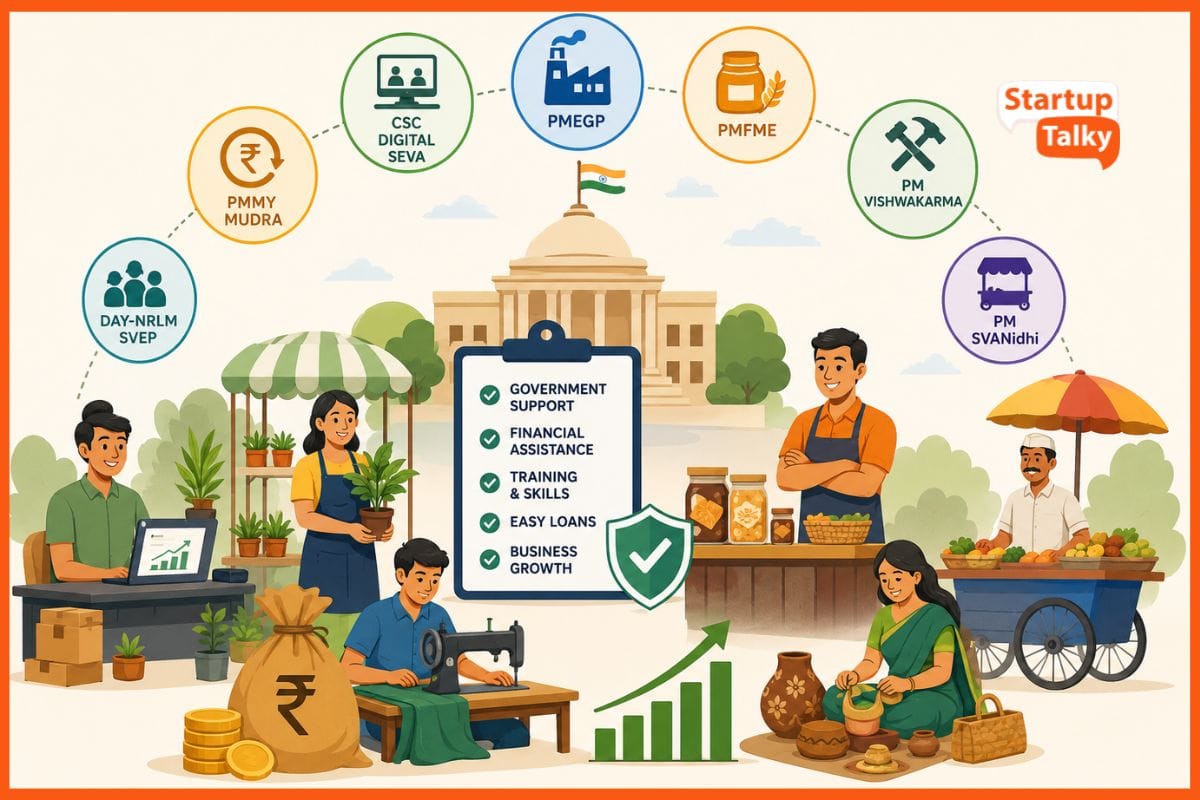
When it comes to starting a business in India, the roadblocks usually boil down to the same factors: unavailability of capital, lack of formal support, and not knowing where to start. These obstacles can make even a simple business idea seem risky to many first-time entrepreneurs, particularly in small towns and rural areas. Government schemes can assist in mitigating that risk by decreasing the starting point cost and providing a more stable starting point.
The silver lining is that not all central schemes are simply welfare schemes but can also be transformed into viable business models. Others offer loans, others promote delivery of digital services, others fund food processing, and others assist artisans, vendors, and self-help groups to develop income-generating businesses. When in the right hands, such schemes are the foundation of a small yet lucrative business.
This article discovers the most feasible plans that can be employed to begin or grow up a business.
Government Schemes at a Glance
| Scheme | Best For | Business Potential |
|---|---|---|
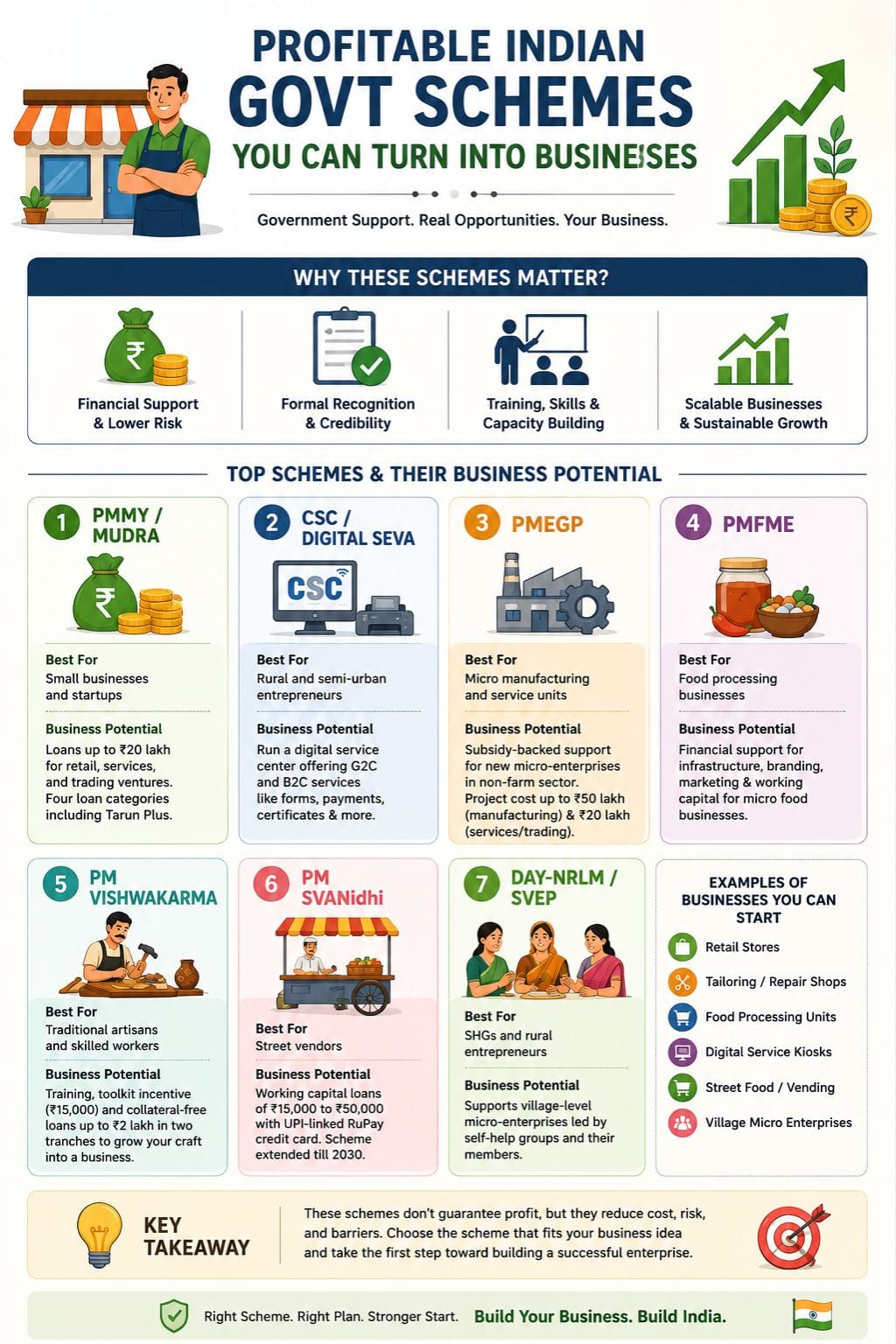
| PMMY / MUDRA | Small businesses and startups | Loan support for retail, services, and trading ventures. The scheme now has four categories, including Tarun Plus with loans up to ₹20 lakh. |
| CSC / Digital Seva | Rural and semi-urban entrepreneurs | A service-based business model built around government-to-citizen and business-to-citizen digital services. |
| PMEGP | Micro manufacturing and service units | Subsidy-backed support for new micro-enterprises in the non-farm sector. |
| PMFME | Food processing businesses | Support for micro food brands, local food units, and processing businesses. |
| PM Vishwakarma | Traditional artisans | Training, toolkit support, and collateral-free loans for skilled craft-based trades. |
| PM SVANidhi | Street vendors | Working capital support for vending businesses, with new credit features and extension till 2030. |
| DAY-NRLM / SVEP | SHGs and rural entrepreneurs | Village-level micro-enterprises led by self-help groups and their members. |
Profitable Govt Schemes You Can Turn into Businesses
Here are the schemes that can actually be turned into practical, income-generating business models.
PMMY / MUDRA Scheme
PMMY is among the least complicated entry points for micro-entrepreneurs since it serves non-corporate and non-farm small and micro-enterprises by providing loans through banks and other lending institutions. The scheme consists of four loan buckets Shishu, Kishor, Tarun and Tarun Plus, with the latter reaching 20 lakh to eligible borrowers who have already repaid a Tarun loan.
This is helpful in small retail stores, salons, tailoring shops, repair shops, food stands, and other low-investment businesses. The plan is most effective when the company requires inventory, equipment, or working capital on a small scale as opposed to massive infrastructure.
CSC / Digital Seva Scheme
Common Service Centres are government-supported access points to digital services, and the Digital Seva portal defines them as points of delivery of G2C and B2C e-services. In plain language, a CSC has the potential to be a local digital service enterprise in a village, town or semi-urban market.
The model is lucrative since the online forms, certificates, payments, registrations, and online accesses always require assistance. The CSC 2.0 is also intended to reinforce the network to ensure that at least one CSC is present in each Gram Panchayat, demonstrating how central the model still is in rural digital provision.
 Sakshi Jadhav
Prime Minister's Employment Generation Programme (PMEGP)
PMEGP is a credit-based subsidy programme of new micro-enterprises in non-farm sector. The Ministry of MSME indicates that the maximum eligible project value is 50 lakh in case of manufacturing and 20 lakh in case of service or trading units, which makes it one of the most robust projects of small business formation.
This plan suits companies like small packaging plants, bakeries, printing shops, local factories, repair facilities and service facilities that require a well-organised project and bank-financed assistance. It fits entrepreneurs that are willing to formalise a business concept rather than operating it as a home-based enterprise.
PM Formalisation of Micro Food Processing Enterprises (PMFME) Scheme
PMFME is a good choice for those who intend to start a food-based micro-business. The scheme assists micro food processing businesses and offers financial assistance in branding, marketing and infrastructure and capital assistance to eligible projects. Formal records 50% grant financial assistance on branding and marketing of groups like FPOs, SHGs, cooperatives or SPVs.
This is very appropriate in pickles, spices, snacks, flour blends, bakery items, and sweets, among other foods that can be sold locally. Recent official and media coverage reveals that states are also busy taking advantage of the scheme to assist small food businesses in modernising equipment and increasing production.
PM Vishwakarma Scheme
PM Vishwakarma is designed for traditional artisans and skilled tradespeople. The official portal lists recognition, skill verification, short training, a INR 15,000 toolkit incentive, and collateral-free enterprise loans of INR 1 lakh and INR 2 lakh in two tranches.
This scheme is especially useful for tailors, carpenters, potters, masons, barbers, blacksmiths, and similar trades that already have a service market. Instead of starting from scratch, the scheme helps modernise an existing skill and turn it into a better-organised business.
Sakshi Jadhav
PM SVANidhi Scheme
One of the most feasible schemes that can be offered to street vendors is PM SVANidhi since it is not a complicated long-term funding but working capital. The new framework comprises 15,000, 25,000, and 50,000 rupee loans and UPI-based access to RuPay credit cards to use instantly for both business and personal use.
The programme suits tea peddlers, snack carts, fruit vendors and other mobile or roadside establishments that require a rapid inventory turnover. It is also particularly helpful as street businesses tend to rely on the cash flow every day, and even a small credit line can enhance stability.
DAY-NRLM / SVEP Scheme
DAY-NRLM and its Start-up Village Entrepreneurship Programme help self-help groups and their family members set up small non-farm enterprises in rural areas. Official PIB updates state that SVEP is meant to support small village businesses and strengthen rural entrepreneurship through a block-level model.
This scheme works well for women-led ventures, community businesses, stitching units, local food production, agri-support services, and village-level retail activities. The advantage is that the enterprise grows with group support, which often lowers both financial and operational risk.
Stand-Up India, as a background note
Even though Stand-Up India is no longer an active new-lending route, it deserves to be mentioned. Reported official PIB The scheme, introduced to SC, ST and women entrepreneurs, has its lending termination date as 31 March 2025.
It previously assisted greenfield businesses with bank loans of 10 lakh to 1 crore; thus, it is still pertinent as a benchmark in the bigger debate on government-sponsored enterprise aid. In the case of a current how-to-start article, however, it must be considered background, not a new application alternative.
Archana Karthikeyan
Which Scheme is Best for Which Business?
| Business Goal | Recommended Scheme(s) | Why These Schemes Work |
|---|---|---|
| Start a small business quickly | MUDRA (PMMY), PM SVANidhi | Provide working capital and credit support, making them ideal for low-investment businesses and first-time entrepreneurs. |
| Run a service-based business | CSC / Digital Seva | Enables entrepreneurs to offer digital and government services, creating a steady source of income. |
| Build a product-based business | PMFME, PMEGP | Support manufacturing, food processing, branding, and formal production units for market-ready products. |
| Monetize traditional skills | PM Vishwakarma | Offers recognition, training, toolkit incentives, and collateral-free loans for artisans and skilled workers. |
| Start a rural or group-based enterprise | DAY-NRLM, SVEP | Promote self-help groups and village-level entrepreneurship while reducing financial and operational risks. |
If the goal is to start small and fast, MUDRA and PM SVANidhi are the most direct options because they focus on credit and working capital. If the goal is to run a service business, CSC is one of the most practical models because demand for digital assistance is ongoing. If the goal is to build a product business, PMFME and PMEGP are stronger because they support formal production units and market-ready products.
For artisans and skilled workers, PM Vishwakarma is the most targeted scheme because it combines recognition, training, tools, and loans. For rural group-based entrepreneurship, DAY-NRLM and SVEP are useful because they are designed around self-help groups and village enterprise development.
Final Takeaway
Government schemes do not create profit by themselves, but they can dramatically lower the cost and risk of starting a business. The best opportunities are usually the simplest ones: a local service kiosk, a small food brand, a repair or tailoring unit, a vending business, or a village micro-enterprise. When the scheme fits the business model, the path to profitability becomes much easier.
FAQs
Which government scheme is best for starting a small business in India?
PMMY (MUDRA) is one of the best schemes for small businesses because it provides loans for retail, service, and trading ventures with minimal collateral requirements.
Can government schemes help first-time entrepreneurs?
Yes. Several Indian government schemes offer loans, subsidies, training, and digital support, making it easier for first-time entrepreneurs to start and grow businesses.
Which government scheme is best for food processing businesses?
The PMFME Scheme is designed for micro food processing units and provides support for infrastructure, branding, marketing, and business expansion.
Are there government schemes for rural entrepreneurs in India?
Yes. Schemes such as CSC Digital Seva and DAY-NRLM/SVEP help rural entrepreneurs and self-help groups establish service-based and village-level enterprises.