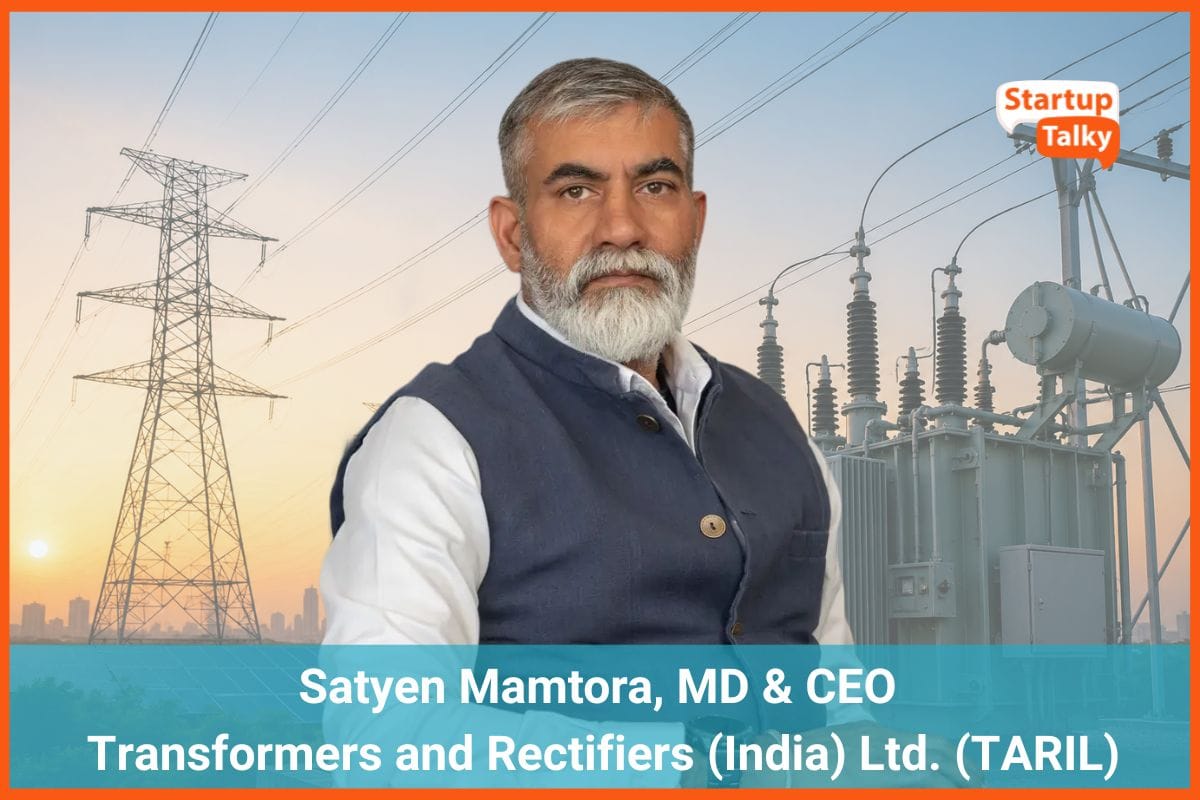
"India Isn't Just Generating More Power, It's Rebuilding the Entire Grid": Satyen Mamtora on Transformers, Grid Expansion, and the Renewable Energy Boom
India's transformer industry is at the center of the country's energy transition. Satyen Mamtora of TARIL shares insights on renewable energy growth, grid expansion, supply chain resilience, and the infrastructure needed to support India's 500 GW clean energy ambition.
India's power infrastructure sector is witnessing rapid growth as the country accelerates investments in renewable energy, transmission networks, railway electrification, and grid modernization. The Indian transformer market is expected to grow at a CAGR of around 8-10% through 2030, driven by the government's ambitious target of achieving 500 GW of non-fossil fuel energy capacity by the end of the decade.
As demand for reliable and efficient power infrastructure rises, transformer manufacturers are playing a critical role in enabling India's energy transition. In this interview, Satyen Mamtora, Managing Director of Transformers and Rectifiers (India) Ltd. (TARIL), shares his insights on surging transformer demand, supply chain resilience, renewable energy integration, global expansion, and the future of India's power ecosystem.
Managing India's Rising Demand for Transformers Amid Infrastructure Expansion
StatupTalky: India is simultaneously scaling up renewable energy capacity, upgrading transmission lines, and electrifying railways, each demanding transformers. How is TARIL managing this simultaneous surge in demand, and what does the order pipeline reveal about where infrastructure investment is flowing?
Satyen Mamtora: The demand convergence is very real, and in many ways unprecedented for the power equipment industry. India is simultaneously expanding renewable energy capacity, strengthening its transmission network, modernising distribution infrastructure, and accelerating railway electrification. All of these initiatives require significant transformer capacity.
Our unexecuted order book stood at INR 5,005 crore as of March 31, 2026, while inquiries under negotiation exceeded INR 23,000 crore. This gives us a strong view of where investments are currently being directed across the power ecosystem.
A significant portion of demand is coming from transmission expansion and grid strengthening projects, particularly those linked to renewable energy evacuation. We are also seeing growing opportunities from private transmission developers, railways, industrial infrastructure, and energy-intensive sectors that require reliable power networks.
The message from the pipeline is clear: India is no longer investing only in power generation; it is making equally significant investments in the infrastructure required to transmit, distribute, and efficiently utilise that power. To support this opportunity, we have expanded our manufacturing capacity from 40,000 MVA to 75,000 MVA and continue to focus on execution excellence, capacity enhancement, and disciplined order selection to ensure sustainable long-term growth.
Supply Chain Risks: How Geopolitical Disruptions Impact Transformer Manufacturing
StartupTalky: The global energy crisis and geopolitical tensions have put energy infrastructure security in the spotlight. What risks does India's transformer supply chain face if disruptions affect the availability of key raw materials like silicon steel or copper?
Satyen Mamtora: The events of the past few years have reinforced the fact that energy infrastructure security is closely linked to supply-chain security. For the transformer industry, critical inputs such as grain-oriented electrical steel, copper, and certain specialised components continue to be influenced by global supply availability, pricing cycles, logistics constraints, and geopolitical developments.
Any prolonged disruption in the availability of these materials can impact lead times, project execution schedules, and overall infrastructure rollout timelines. As India accelerates investments in transmission networks, renewable energy integration, and grid modernisation, ensuring reliable access to these critical inputs becomes increasingly important.
As a result, the industry today is focused not only on expanding manufacturing capacity but also on building greater supply-chain resilience. At TARIL, we are strengthening this through backward integration initiatives across CTC, bushings, pressboard, and fabrication. These investments are aimed at improving supply security, enhancing quality control, reducing external dependencies, and creating a more resilient manufacturing ecosystem capable of supporting India's long-term energy infrastructure requirements.
Meeting the Technical Demands of Solar, Wind, and Green Hydrogen Projects
StartupTalky: The renewable energy transition demands a fundamentally different transformer profile compared to conventional thermal generation. What technical specifications do solar and wind projects require, and how has TARIL retooled to meet those requirements?
Satyen Mamtora: Renewable energy projects place very different demands on transformers compared to conventional thermal power systems. Solar and wind generation are inherently variable in nature, which means transformers must be designed to handle fluctuating loads, frequent operating cycles, varying power flows, and increasingly complex grid-integration requirements. At the same time, developers are looking for higher efficiency, lower losses, and greater reliability, particularly as many renewable installations are located in remote or challenging environments.
As renewable penetration increases, the grid also requires equipment that can support greater operational flexibility and maintain stability under changing generation patterns. This is driving a shift towards more advanced transformer designs focused on efficiency, durability, and long-term performance.
Recognising this transition early, TARIL has expanded its portfolio to include specialised solutions such as Solar Application Transformers and Green Hydrogen Application Transformers. In parallel, we have strengthened our engineering, testing, and quality-validation capabilities, including our NABL-accredited electrical steel testing laboratory. These investments ensure that our products are aligned with the evolving technical requirements of renewable energy, grid modernisation, and the broader energy transition.
Competing Globally: How Indian Transformer Manufacturers Win International Orders
StartupTalky: TARIL has established a presence in African, Asian, and South American markets. What does winning a global transformer order require that is different from serving domestic utilities, and how does India compete with established global players?
Satyen Mamtora: Winning export orders requires much more than competitive pricing. International customers typically evaluate manufacturers on a broad range of parameters, including technical capability, engineering expertise, quality systems, testing infrastructure, compliance with global standards, project execution track record, and long-term service support. In many cases, suppliers must go through extensive qualification and approval processes before becoming eligible to participate in projects.
Global customers are increasingly looking for partners who can deliver technically advanced products while meeting stringent performance, reliability, and delivery expectations. This is particularly important for critical infrastructure applications where operational reliability is non-negotiable.
For Indian manufacturers, the opportunity has expanded significantly in recent years. Our recent export order from the United States and the successful execution of a 220/253 MVA EAF transformer are examples of how Indian companies are increasingly being trusted for complex and high-value applications. These projects help demonstrate that Indian manufacturing is capable of competing at global benchmarks for technology, quality, and execution.
India's competitive advantage lies in its combination of strong engineering talent, manufacturing scale, cost competitiveness, and a rapidly evolving supplier ecosystem. As companies continue to invest in advanced manufacturing, testing infrastructure, and quality systems, India is steadily strengthening its position as a reliable global sourcing and manufacturing hub for power equipment.
Managing Working Capital Challenges in India's Power Sector
StartupTalky: Power distribution companies in India carry significant debt and often delay payments to equipment suppliers. How does TARIL navigate working capital risk when public sector utilities are both your largest customers and your most payment-uncertain ones?
Satyen Mamtora: Working capital management is a critical aspect of the power equipment industry, particularly in a market where infrastructure projects often involve multiple stakeholders and long execution cycles. While utilities continue to play a central role in India's power sector growth, payment cycles can vary depending on project structures, funding mechanisms, and implementation timelines.
Our approach is centred on maintaining a diversified business mix across utilities, private transmission developers, industrial customers, renewable energy projects, and export markets. This diversification helps create greater balance and reduces concentration risk from any single customer segment.
Equally important is a disciplined approach to project selection, contract structuring, milestone-based execution, and receivables management. Over the years, we have focused on strengthening our balance sheet and improving operational efficiencies, which provides greater flexibility in managing varying payment cycles.
As India's power infrastructure investments continue to accelerate, companies that combine execution excellence with financial discipline will be best positioned to capture growth opportunities while maintaining long-term business resilience.
Why High-Voltage and Specialty Transformers Are a Strategic Growth Area
StartupTalky: High-voltage and specialty transformers are a strategic priority for TARIL. What makes them harder to manufacture, which segments demand them most, and why do they represent a long-term competitive moat?
Satyen Mamtora: High-voltage and specialty transformers represent one of the most technologically demanding segments of the power equipment industry. Unlike standard transformers, they require advanced engineering capabilities, highly the , stringent quality controls, and extensive testing to ensure reliable performance over decades of operation. The complexity spans every stage, from design and insulation systems to thermal management, transportation logistics, and long-term operational reliability.
Demand for these products is being driven by transmission utilities, renewable energy integration projects, railways, industrial infrastructure, data centres, and other critical applications where reliability and performance are essential. As power systems become more interconnected and renewable penetration increases, the need for advanced transformer solutions continues to grow.
What makes this segment particularly attractive is that it creates a strong technological and execution barrier. Building capabilities in high-voltage and specialty transformers requires years of investment in engineering expertise, testing infrastructure, manufacturing excellence, technology partnerships, and skilled talent. These capabilities cannot be developed overnight.
At TARIL, we have steadily built this expertise over decades through continuous investments in technology, advanced manufacturing, and the successful execution of complex projects. Our recent HVDC transformer repair order from PGCIL is an important example of how these capabilities are opening opportunities in highly specialised areas of the industry. As India's grid modernisation and energy transition gather pace, we believe high-voltage and specialty transformers will remain a key long-term growth and differentiation area for the company.
Is India Ready for 500 GW of Renewable Energy? The Capacity Question
StartupTalky: India's FY26 peak demand crossed 256 GW. Based on what you see in order books and project pipelines, is India's transformer manufacturing capacity on track to support grid expansion toward 500 GW renewable capacity by 2030?
Satyen Mamtora: India's peak power demand crossing 256 GW is a strong indicator of the scale at which the power sector is evolving. As the country moves towards its 500 GW renewable energy target by 2030, the focus will need to extend beyond generation capacity to include transmission expansion, grid modernisation, renewable energy evacuation infrastructure, and system reliability.
Based on current order books and project pipelines, there is clear evidence that the industry is preparing for this next phase of growth. We are seeing sustained demand across transmission projects, renewable integration initiatives, substation upgrades, and grid-strengthening programmes, all of which are essential to supporting a larger and more renewable-intensive power system.
The encouraging aspect is that transformer manufacturers across the country have been proactively expanding capacity, investing in advanced manufacturing, strengthening testing infrastructure, and enhancing execution capabilities. At TARIL, we have increased our manufacturing capacity from 40,000 MVA to 75,000 MVA and continue to invest in technology, quality systems, and future-ready capabilities.
The 500 GW target is certainly achievable, but it will require coordinated progress across manufacturing capacity, transmission infrastructure, raw material availability, and long-term grid planning. The good news is that strong order visibility and ongoing industry investments indicate that the ecosystem is already moving in that direction. As India's energy transition accelerates, transformer manufacturers will play a critical role in enabling the grid infrastructure needed to support that growth.
 Apoorva Bajj