How Tamanna Gupta is Redefining Startup Marketing with Strategy, Impact, and Purpose
👨💻 StartupTalkersTamanna Gupta explains how startups can move beyond vanity metrics to build marketing strategies that drive real business outcomes. From fundraising to category creation, she shares practical insights on scaling with purpose and impact.
The Indian startup ecosystem continues to expand rapidly, with over 100,000+ startups and growing contributions to innovation, employment, and economic growth. As competition intensifies, the role of strategic marketing has become more critical than ever, especially for startups and SMEs operating with limited resources.
At the same time, the marketing consulting industry is evolving from traditional brand-building to business-outcome-driven strategies, where success is measured by revenue growth, fundraising, and market expansion rather than vanity metrics.
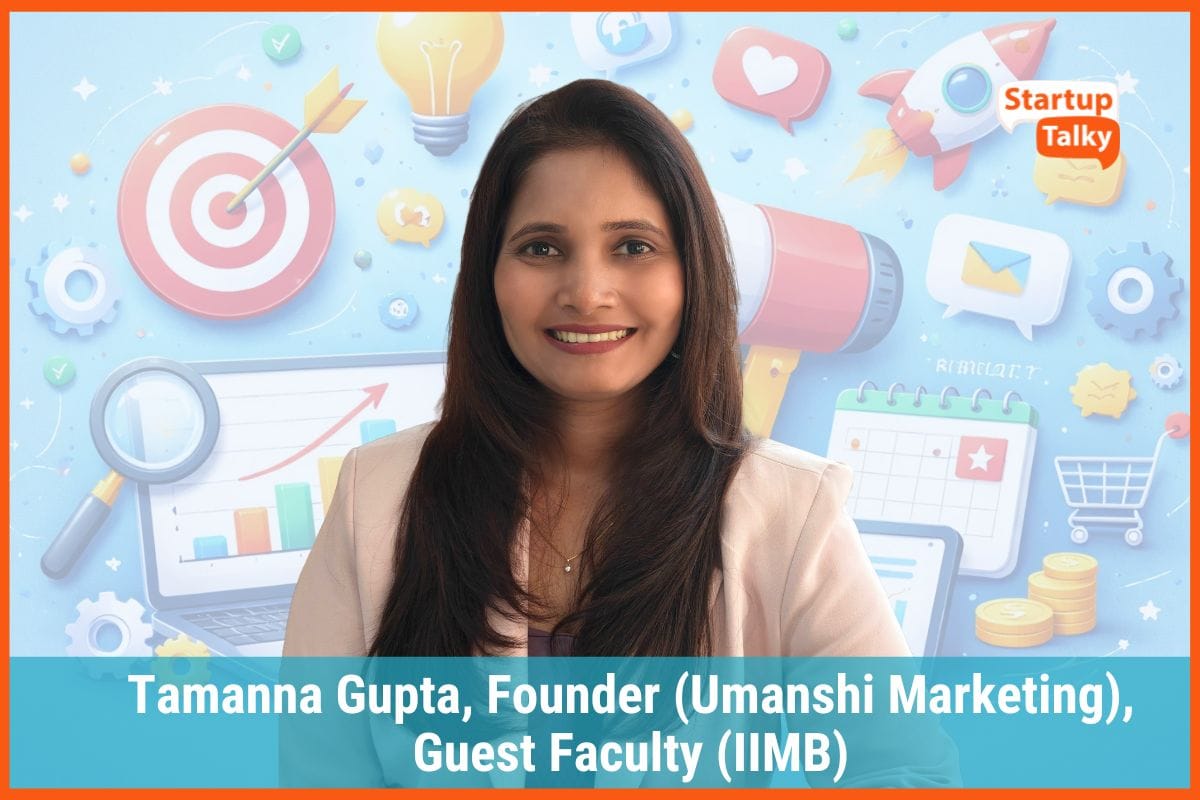
As part of StartupTalky’s International Women’s Day series, we spoke to Tamanna Gupta, Founder of Umanshi Marketing and Guest Faculty at IIM Bangalore, who is helping startups rethink marketing as a strategic growth engine rather than just a promotional function.
From Global Brands to Building Impact with Startups
StartupTalky: You transitioned from leading marketing for global brands to founding Umanshi Marketing and championing startups and SMEs. What drove that shift, and what did you give up and gain in making it?
Tamanna Gupta: Working with global brands taught me marketing at scale. The best practices, the fundamentals, all of that came from those years. And when you're working at that level, the ideas and possibilities feel limitless.
But that's not the reality for startups, SMEs, and family businesses. They're resource-constrained, relatively speaking. Working with them taught me pithiness, innovation, empathy, and how to think out of the box. Most importantly, it taught me how to value every rupee spent and align that spend to a business quest. At Umanshi, marketing isn't measured by brand awareness or top-of-mind recall. It's measured by whether it helps solve a real business ambition: category creation, fundraising, entering newer markets, and employer branding.
Why make the shift at all? Because smaller brands are doing the most interesting work. They are truly creating categories. Large brands, by contrast, tend to play it safe, repeating what's already made them successful. And yet, despite being the real innovators, smaller brands don't have access to the marketing muscle that could propel their cause. Large agencies with real ideas come at a high cost. Smaller ones often fail to align marketing goals with business goals. That gap felt like exactly the right place to work.
What did I give up? I gave up large-scale thinking. I gave up predictability and stability, in terms of role and income. The title says founder, but the reality is chief everything officer. Initially, there was no monthly take-home. It was quarterly, and when you look back honestly, sometimes it was really an annual take-home. I gave up the comfort of having structures already in place. Starting from scratch was genuinely hard.
What I gained was impact. Helping a startup raise INR 100 crore. Helping companies hire 500% better. Helping regional businesses go national. That ownership of business outcomes and the satisfaction it brings is very different from being a cog in a wheel, however well-placed.
The Philosophy Behind ‘Give to Gain’
StartupTalky: Your "Give to Gain" philosophy sets a distinct tone for how you work with clients. What does that look like in practice, and how has it shaped the growth of Umanshi Marketing?
Tamanna Gupta: I'd actually reframe it. I don't give to gain. I give because it's the right thing to do.
In practice, it looks like mentoring: entrepreneurs, including women entrepreneurs, through incubation centres like IIMB's NSRCEL and ISB's AIC Incubation Centre. But the giving isn't for personal or professional gain. It comes from a belief that we need a world where resources and opportunities are more equitable. That's what makes a better world for all of us.
That's my real philosophy on it.
Common Marketing Mistakes Startups Must Avoid
StartupTalky: Startups and SMEs often face marketing challenges that large brand playbooks don't solve. What are the most common mistakes you see them make, and how do you help them course-correct?
Tamanna Gupta: I see two mistakes repeatedly, and honestly, they're connected.
The first is jumping straight to the channel. Founders walk in asking which platform they should be on, whether to run ads, and whether to invest in PR. And I have to stop them right there, because those are the wrong first questions.
The second is getting obsessed with vanity metrics. Followers, views, website impressions. These things feel like forward momentum, but they rarely have anything to do with what the business is actually trying to achieve.
Both come from the same place: skipping what really matters at the start. What positions this business distinctly? What problem is it solving? Why should someone choose it over everything else out there? Without clarity on these things, all the marketing in the world just adds to the noise. Another press release, another social media post. There's already a plethora of those.
So at Umanshi, we step back before we do anything else. We work with founders to frame the problem statement, nail the positioning, get the messaging right, and make sure it's all tied to where the business actually needs to go. That's where the work begins.
Navigating the Shift from Corporate to Entrepreneurship
StartupTalky: Moving from a high-powered corporate career to building your own firm comes with real risk and uncertainty. How did you manage that transition, practically and emotionally?
Tamanna Gupta: The corporate world has everything ready for you: structure, team, resources, and even problem statements. When you go out on your own, you have to dig up your own value. You have to figure out whether you need a well or whether a hand pump will do.
But here's the honest trade-off: I wasn't happy in large corporations. A lot of the time, instead of doing actual work, you end up doing stakeholder management. Decisions get made. They feel safe because everyone is in their comfort zone. That's not work I could take pride in.
A large part of my identity is my professional life. I didn't want to wake up every day going to a place where the work wasn't meaningful, work I'd be proud to put my name on anywhere. I didn't want to be someone who is professionally decaying for decades, or waiting for that quarterly or annual leave to run away from their work. I wanted to build a culture where people feel genuinely happy to be there.
The freedom came with a price. But it depends on what price you're ready to pay for what you believe is worth it. For me, the value was doing impactful work and building something meaningful.
One more thing: I didn't set out knowing I'd build an organisation. It was the market acceptance, the product-market fit, that made it clear this needed to become something structured. And when your purpose is clear, genuinely clear, it keeps you steady. Clients come and go. People come and go. But clarity of purpose means you stay on the route.
Building Effective Marketing Strategies with Limited Budgets
StartupTalky: Marketing strategies for startups often need to punch far above their weight. What are your go-to principles for building brand presence with limited budgets?
Tamanna Gupta: I'd push back on the premise. If a startup's marketing strategy requires it to punch above its weight, something is off with the strategy. It hasn't been designed for the space in which that business actually operates.
We always start from the ambition. Whether the goal is INR 100 crore in revenue, INR 300 crore, or moving from 2 cities to 10, the ambition comes first. Once that's defined, the investment required, whether it's 4%, 5%, or 50%, gets built around it. Not the other way round.
A startup going from 2 cities to 5 doesn't need an MNC-level national campaign across 30 to 40 cities. That's a different problem entirely. The strategy has to match the actual ambition.
And I always ask founders directly: what price are you ready to pay? If the goal is INR 100 crore in funding, or an INR 500 crore jump in revenue, what are they willing to invest to get there? There's no right or wrong answer. But there has to be clarity. That's where most marketing spend goes wrong: ambiguity about what the business is actually willing to commit.
Building Credibility as a Woman Founder in Marketing
StartupTalky: As a woman founder in the marketing consulting space, what has your experience been with being taken seriously, and how have you built credibility with clients?
Tamanna Gupta: Honestly, it hasn't been a problem for me. A large part of my professional network comes from Mumbai, Bengaluru, and Delhi, the metros, and most of the founders we work with come from the same ecosystem. I've never looked at my clients or stakeholders through a gender lens, and I'm not sure I was ever perceived primarily as a woman founder rather than simply as a professional.
Being taken seriously comes down to how well you've researched the client, how well you know the category, and what your experience allows you to bring to the table. The background helps: IIMB, organisations like Percept Sports and Entertainment, brands like HSBC, Citi, Bridgestone, Qatar Airways. These are established markers. At a certain point, they become almost standard operating procedure.
This might be a different experience for someone just starting. But after two decades in the industry, I haven't encountered it as a barrier. And a large part of our business comes through referral, which is the strongest form of validation there is.
The Vision for Umanshi Marketing and the Startup Ecosystem
StartupTalky: What does Umanshi Marketing look like in 3 years, and what's the bigger mission you're working toward in the Indian startup ecosystem?
Tamanna Gupta: In three years, I want Umanshi to be the trusted strategic, outsourced, and extended marketing team for startups and high-growth companies, at any stage, from seed-funded to multinational. Anyone who is ambitious and wants meaningful, impactful marketing should think of us first.
The bigger mission is about how founders think about marketing itself. We want to help founders build categories and build brands, brands that create products the world actually needs, that solve real problems. Unlike large brands, which are often in their comfort zone.
And beyond the work, we want to create awareness within the founder community so that founders start thinking of marketing as a strategic business partner that can help them achieve their business quest, not as hygiene, not as a feel-good activity.
 Rishabh Rathi