

Top AI Threat Intelligence Tools: Best Platforms Compared (2026)
🏆 Lists & RankingsAI threat intelligence tools use artificial intelligence to detect cyber threats, analyze risks, and automate responses. This guide compares the top platforms, their features, pricing, and use cases to help you choose the right solution.

The AI develops its understanding of risk through threat intelligence, which utilizes AI technology. It delivers immediate situational awareness by integrating multiple data streams, including distributed logs, dark web intelligence, and indicators of attacks. It performs continuous monitoring operations that cover both endpoints and the network, as well as all boundaries of cloud infrastructure.
It creates standard behavior patterns that help security teams detect security incidents that deviate from established normalcy. It identifies real security breaches at high speed while it reduces the number of alerts that need to be addressed.
What AI Threat Intelligence Tools Do
- Provide real-time situational awareness
- Monitor endpoints, networks, and cloud environments
- Detect anomalies using behavioral patterns
- Reduce false alerts and improve accuracy
- Enable faster response to real threats
How to Choose the Right Threat Intelligence Tool
Choosing the right platform depends on your organization’s needs:
If you are a startup or small team:
- Go for IBM X-Force Exchange (free tier)
- Consider ThreatConnect for scalability
If you need automation:
- Choose Cortex XSOAR or Anomali
If you want deep intelligence:
- Use Mandiant Advantage or Recorded Future
If you are in the Microsoft ecosystem:
- Microsoft Defender Threat Intelligence is best
For endpoint-heavy environments:
- CrowdStrike Falcon X or SentinelOne
AI Threat Intelligence Tools Comparison Table
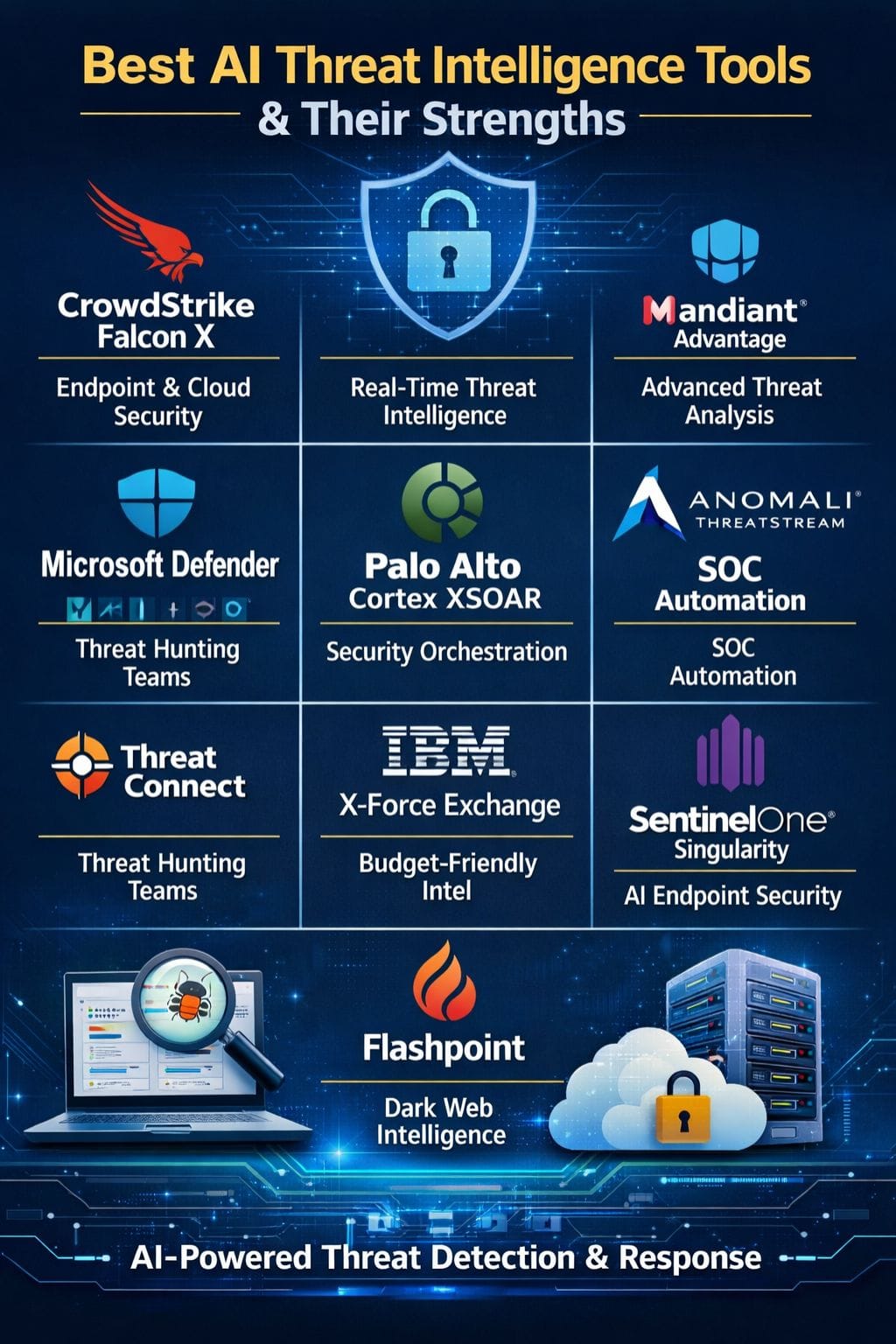
| Tool | Best For | Key Features | Pricing Level | Drawbacks |
|---|---|---|---|---|
| CrowdStrike Falcon X | Endpoint + Cloud Security | Threat intelligence, sandboxing, automated response | Mid | Complex setup, high alerts if misconfigured |
| Recorded Future | Real-time Threat Intelligence | Intelligence Graph, predictive insights | High | Steep learning curve |
| Mandiant Advantage | Advanced Threat Analysis | MITRE ATT&CK mapping, breach intelligence | High | Expensive, UX issues |
| Microsoft Defender Threat Intelligence | Microsoft Ecosystem Users | Global signals, kill chain visibility | High | Costly for small teams |
| Anomali ThreatStream | SOC Automation | Data enrichment, SIEM/SOAR integration | Mid-High | Premium features locked |
| ThreatConnect | Threat Hunting Teams | Risk scoring, ATT&CK mapping | Mid-High | Playbook complexity |
| Palo Alto Cortex XSOAR | Security Automation | Playbooks, war room collaboration | High | Complex setup |
| IBM X-Force Exchange | Budget Teams | Open-source + IBM data | Low-Mid | Data inconsistency |
| SentinelOne Singularity | AI Endpoint Security | AI detection, data lake | High | False positives |
| Flashpoint | Dark Web Intelligence | Deep web monitoring, fraud detection | High | Not SMB-friendly |
CrowdStrike Falcon X
CrowdStrike Falcon X is a cloud native platform that discovers and eliminates threats with rapid response capabilities. The solution protects both endpoints and cloud workloads through its unified security platform.
It employs basic AI technology to monitor user behavior and identify potential security threats. The combination of built-in threat intelligence, sandboxing capabilities, and automated response functions enables organizations to achieve faster detection of security breaches.
Security teams acquire knowledge about attacks and analyze malware, and execute emergency responses through their quick response capabilities. It presents user activity data together with attacker profile information.
Pros
- Strong endpoint + cloud protection
- Detailed adversary profiles
- Scalable deployment
Cons
- Complex for small teams
- High alert volume if misconfigured
Pricing
| Plan | Price |
|---|---|
| Falcon Go | $7.99/device/month |
| Falcon Pro | $14.99/device/month |
| Falcon Enterprise | $19.99/device/month |
Recorded Future
Recorded Future Intelligence Platform provides organizations with live threat intelligence gathered from various online sources, including technical sites, dark web content, and open web information. The software enables users to swiftly identify, prioritize, and respond to potential threats.
The platform integrates all its data into one Intelligence Graph, which employs basic predictive models to display the most significant information. It provides essential context information for security teams to enhance their response capabilities to various security tools, including SIEM, SOAR, and ticketing systems.
It provides essential security capabilities that enable users to gather threat intelligence.
Pros
- Rich threat context
- Predictive insights
- Strong integrations
Cons
- Steep learning curve
- AI features may fall short
Pricing
| Plan | Price |
|---|---|
| Custom | Request for pricing (RFP) |
Mandiant Advantage
Mandiant Advantage is a cloud tool that helps security teams act fast. It transforms actual incident information together with attacker research material and ongoing threat monitoring into clear, practical insights.
It displays attack patterns through its MITRE ATT&CK mapping function, which shows how attackers execute their attacks. It establishes threat levels through its assessment of actual attack likelihood.
The platform unites threat intelligence with information about attack points and security protection tools. It enables organizations to decrease operational interruptions while using fewer resources. Teams can focus on the most serious risks and respond.
Pros
- Real-world breach intelligence
- Strong ATT&CK mapping
- Deep threat insights
Cons
- Expensive
- UX friction
Pricing
| Plan | Price |
|---|---|
| Custom | Request for pricing (RFP) |
 Vivek Dev Jacob
Microsoft Defender Threat Intelligence
Microsoft Defender Threat Intelligence uses Microsoft global signal data and artificial intelligence together with its complete internet mapping feature to help security teams identify and investigate current cyber threats while enabling them to conduct quick threat mitigation efforts.
It enhances alerts while decreasing response time and displaying the complete kill chain, which enables you to stop malicious domains, IP addresses, and tools from reaching other tools.
Security analysts can use Microsoft Sentinel and Defender XDR, and Security Copilot to create a single interface that supports their tracking activities and automated processes, and initial evaluation work.
Pros
- Massive global data
- Strong integration with Defender & Sentinel
- Full attack visibility
Cons
- Expensive
- Best only within the Microsoft ecosystem
Pricing
| Plan | Price |
|---|---|
| Custom | Request for pricing (RFP) |
Anomali ThreatStream
Anomali ThreatStream is an AI-powered threat intelligence platform. It collects information from multiple sources in a centralized database. It evaluates and categorizes data to identify the most important information.
It connects threats to your alerts so that your team can respond immediately. It detects current attacks while decreasing false alarm rates. It transmits important indicators to SIEM, SOAR, and XDR tools.
It enables organizations to respond to security events in almost real-time. The platform provides data enrichment capabilities and establishes threat levels according to risk assessment.
Pros
- Strong automation
- Real-time threat detection
- SIEM/SOAR integration
Cons
- Premium features locked
- Sync issues
Pricing
| Plan | Price |
|---|---|
| Custom | Request for pricing (RFP) |
ThreatConnect
The security framework of threat intelligence platform ThreatConnect utilizes artificial intelligence technology to enhance operational speed for security teams. It consolidates data from all internal and external sources into a single centralized database.
It enhances data through enrichment processes, which evaluate its relevance through established scoring methods. It uses the MITRE ATT&CK framework to create threat maps that connect identified threats to their impact on business operations. This helps teams concentrate on their highest priority tasks.
The organization achieves faster operational capacity through its integrated workflows, which benefit SOC teams and incident response teams.
Pros
- Strong enrichment
- Risk scoring
- Scalable for small teams
Cons
- Playbook complexity
- Performance issues
Pricing
| Plan | Price |
|---|---|
| Custom | Request for pricing (RFP) |
StartupTalky Official
Palo Alto Networks Cortex XSOAR
Palo Alto Networks Cortex XSOAR provides security teams with an easy-to-use operational platform. It combines all security alerts into a centralized monitoring system. It collects threat intelligence from multiple data centers.
Security teams can respond to threats with better visibility and tracking capabilities. The platform uses playbooks to automate routine tasks. It improves operational efficiency by processing tasks through automated features.
The platform enables collaborative work through its common war room feature. XSOAR enhances indicator understanding by providing additional details about potential threats. The information helps teams determine their next operational steps.
Pros
- Powerful automation
- Collaboration via war room
- Threat enrichment
Cons
- Complex setup
- Limited guidance
Pricing
| Plan | Price |
|---|---|
| Custom | Request for pricing (RFP) |
IBM X-Force Exchange
The IBM X-Force Exchange functions as a cloud-based platform that delivers threat intelligence services. It enables users to quickly discover dangerous IP addresses, web links, and harmful software.
It operates by utilizing IBM research data together with open source information and user-generated content. The analysts can investigate threats while they connect attacks and discover patterns through simpler methods.
The platform enables teams to exchange information about their discoveries while working together in real time. It offers security teams immediate response capability by linking to their existing security equipment.
Pros
- Strong dataset
- Free tier available
- API access
Cons
- Data inconsistency
- Expensive at scale
Pricing
| Plan | Price |
|---|---|
| Custom | Request for pricing (RFP) |
SentinelOne Singularity
SentinelOne Singularity serves as one platform that provides security for both endpoint devices and cloud computing environments. It uses artificial intelligence to detect and eliminate security threats in ongoing operations.
It connects alerts to known attackers and their malware and active campaigns, which helps teams to understand context instead of receiving irrelevant information. It responds to threats with immediate speed.
It uses a single-button operation to eliminate threats, create device separation, and restore functionality. The data lake feature enables security teams to perform large-scale threat investigations through their search capabilities.
Pros
- Strong contextual insights
- Unified data lake
- Fast response
Cons
- False positives
- Resource usage issues
Pricing
| Plan | Price |
|---|---|
| Singularity Complete | $179.99/endpoint |
| Singularity Commercial | $229.99/endpoint |
| Enterprise | Contact Sales |
Apoorva Bajj
Flashpoint
Flashpoint threat intelligence platform employs AI technology together with dark web information and human experts to identify risks at an early stage. It gathers information from open web sources, deep web content, and dark web materials, together with fraud detection and vulnerability tracking tools.
The team cleans the data before they examine it to create useful information. The team uses the tool to monitor threat sources while studying ransomware patterns and connecting cyber attacks to existing CVE entries. It generates alerts for potential threats that protect individuals and organizations and specific locations.
Pros
- Extensive data coverage
- Strong dark web monitoring
- Valuable reports
Cons
- Learning curve
- Not SMB-friendly
Pricing
| Plan | Price |
|---|---|
| Custom | Request for pricing (RFP) |
Final Thoughts
The analysis of ten AI-based threat intelligence tools reveals that guesswork disappears while evidence continues to exist. It transforms unprocessed and disordered information into straightforward warnings that your team can use for immediate action.
The alerts provide actual background information, which shows the affected individuals and their situation, and the subsequent actions required. It maintains dashboard visibility through expanded attack surface detection. Automation simplifies the search process for security teams while human analysts maintain their authority over decision-making.
The security tools enable organizations to protect themselves from ongoing attacks by providing them with time and focused resources.
FAQs
What are AI threat intelligence tools?
AI threat intelligence tools are cybersecurity solutions that use artificial intelligence to collect, analyze, and detect potential threats in real time. They help organizations identify risks, reduce false alerts, and respond faster to cyberattacks.
Which is the best AI threat intelligence tool?
The best tool depends on your needs. CrowdStrike Falcon X and SentinelOne are great for endpoint security, while Recorded Future and Mandiant Advantage are strong for deep threat intelligence and analysis.
How do AI threat intelligence platforms work?
These platforms gather data from multiple sources like logs, networks, and the dark web. They use AI to detect unusual behavior, identify attack patterns, and provide actionable insights for faster response.
4Are AI threat intelligence tools suitable for small businesses?
Some tools, like IBM X-Force Exchange, offer free or lower-cost options, making them suitable for small teams. However, many advanced platforms can be expensive and require skilled teams to manage them effectively.