UPI's New Fee Pool: Who Gets Paid, Explained
The government doesn't collect UPI's new 0.4% fee, banks and payment apps do. Here's the actual money math, cross-checked against NPCI's own transaction data rather than taken on brokerage word.
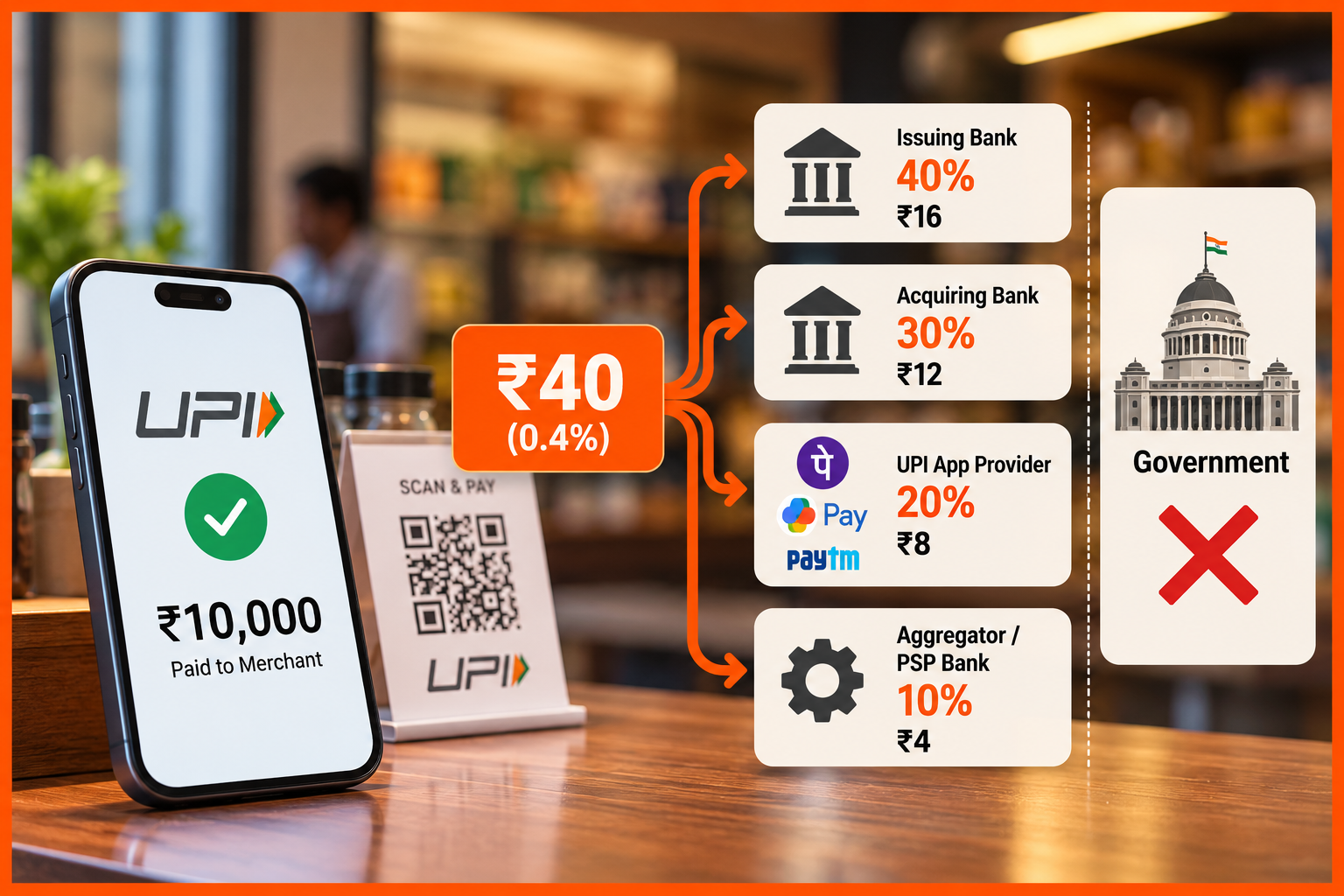
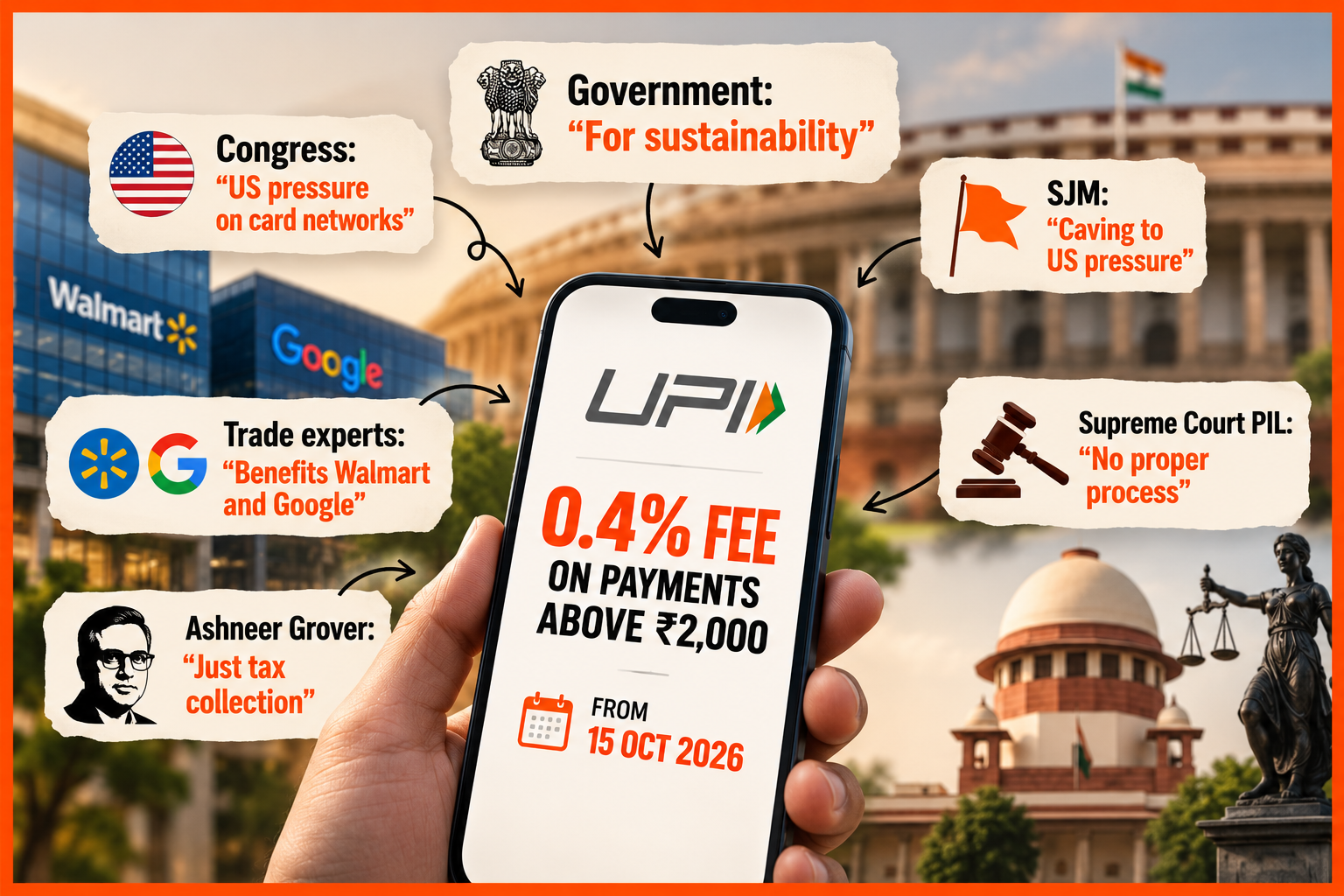
The most common assumption about India's new UPI fee is also the one that's wrong: that the government is now taking a cut of UPI payments. NPCI has said this explicitly in its own FAQ: the Merchant Discount Rate is "not a tax or fee collected by the Government." It's a private-sector charge, paid by merchants to banks and payment companies, the same basic mechanism applied to debit and credit cards for decades.
So who actually gets paid, how much, and what does the government get out of a policy it enabled but doesn't cash in on directly?
The pool: three estimates, one real range
Nobody has an exact number yet because the charge hasn't started. Brokerage estimates published after NPCI's 15 September circular don't agree: Goldman Sachs put the annual pool at roughly ₹20,600 crore, assuming around half of all UPI value eventually attracts the full 40 basis points. Citi estimated ₹16,000-17,000 crore, with about 60% to banks, 25% to UPI app providers, and 15% to non-bank aggregators. UBS came in lowest, at ₹10,000-15,000 crore, with banks retaining 60-70%. The spread comes from each firm modelling a different assumption about how much UPI volume actually clears the ₹2,000 threshold once the small-merchant exemption and ₹300 cap are factored in, none of it observable until October.
Building an independent number
It's worth checking this against NPCI's own data rather than taking the brokerages on faith. In FY26, UPI moved ₹314.23 lakh crore in total. P2M payments made up about 29% of that value, and roughly 67.2% of P2M value was above ₹2,000. Multiply those shares and about 19.5% of all UPI value in FY26, close to ₹61.3 lakh crore, would have qualified for the MDR bracket.
Apply the full 0.4% rate with no cap and no exemption, and the theoretical ceiling comes to roughly ₹24,500 crore a year. Every brokerage estimate sits below that, at 65-84% of the uncapped maximum, a gap explained by the ₹300 cap on transactions ₹75,000-plus and the small-merchant exemption pulling volume out of the base. A ₹16,000-20,600 crore range, arrived at independently from NPCI's own percentages, lines up with the brokerages, reassuring, though it's still an estimate no one can confirm until real October data lands.
Who actually gets paid
Two breakdowns circulate, modelling different things. One splits the MDR four ways by role: issuing bank 40%, acquiring bank 30%, UPI app (PhonePe, Google Pay, Paytm) 20%, PSP bank partner 10%. On a ₹10,000 transaction carrying a ₹40 MDR, that's ₹16 to the issuing bank, ₹12 to the acquirer, ₹8 to the UPI app, ₹4 to the bank partner.
Citi groups the same money by category instead: roughly 60% to banks overall, 25% to UPI app providers, 15% to non-bank aggregators like Razorpay and Cashfree. Both agree banks take the largest single share and UPI apps a meaningful but smaller one; they diverge on how "aggregators" and "bank partners" get counted, a modelling choice, not a contradiction.
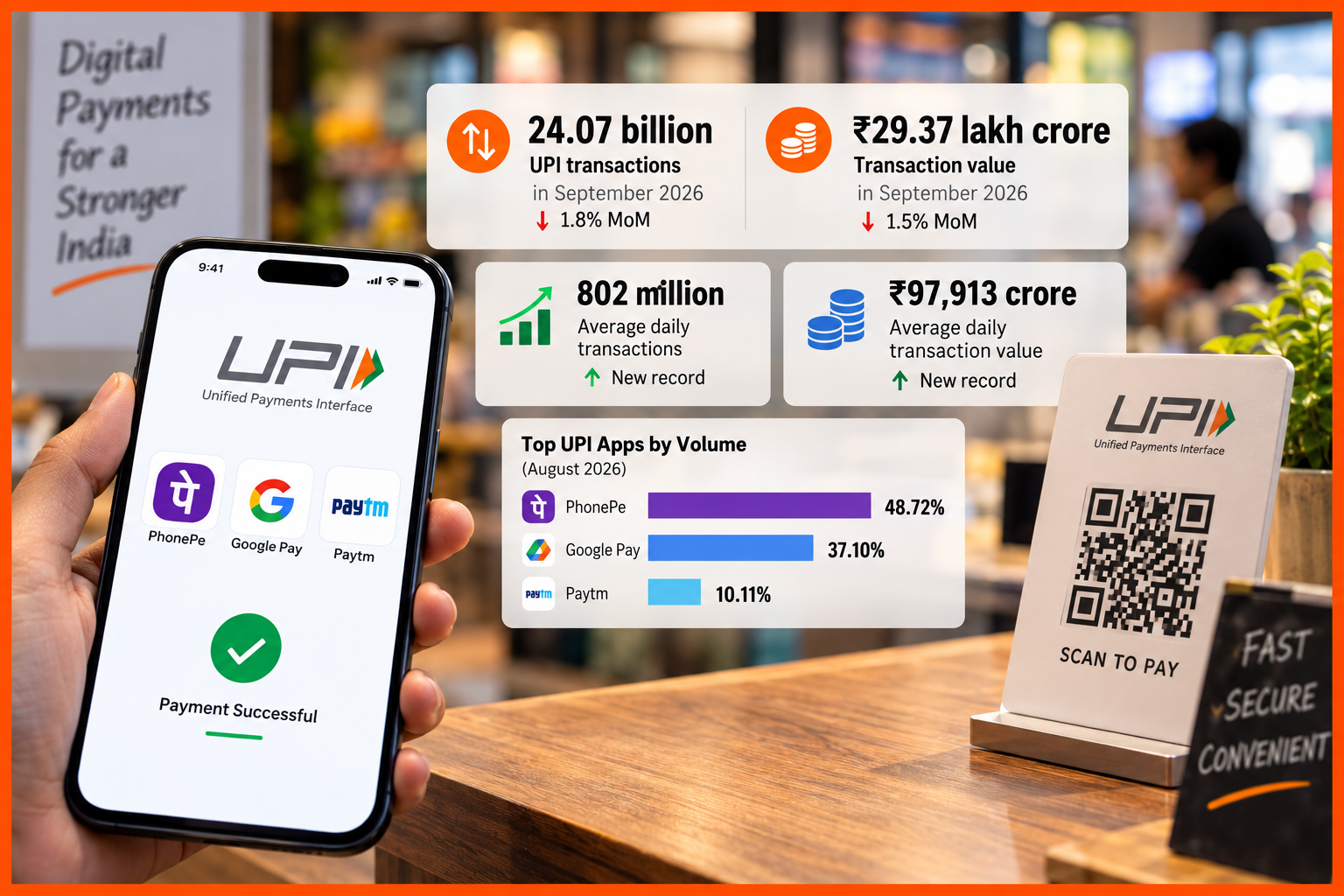
At the company level, analysts put PhonePe's annual take at roughly ₹700 crore, Paytm's similar, and Google Pay's around ₹500 crore, with banks collectively taking home more than any single app. The market has already made its own call: shares of Paytm, Axis Bank, and Yes Bank rose two to eight percent the day after the MDR was announced.
What the government actually gets
Not a share of the ₹16,000-20,600 crore pool. What changes for the government's own books is what it stops paying, not what it starts collecting.
Since the zero-MDR mandate took effect in January 2020, the Centre has subsidised "free" UPI through a budgeted incentive scheme paid to banks: ₹1,389 crore in FY22, ₹2,210 crore in FY23, ₹3,631 crore in FY24, roughly ₹1,500 crore budgeted for FY25, about ₹8,276 crore cumulatively, money that made up for the MDR banks weren't allowed to charge. Once merchants above ₹2,000 start paying directly, the case for continuing that annual budget line weakens, and NPCI's own framing, moving UPI "from public subsidies to a commercial revenue model," points at exactly that.
Whether the subsidy is actually withdrawn, reduced, or continues for the parts of UPI still free (P2P transfers, and P2M under ₹2,000, roughly 95-96% of volume) hasn't been confirmed in any government statement found for this piece. That's the open question worth tracking once a post-October budget document says so, rather than assumed from the policy's own logic.
If you have information related to this story, contact us through StartupTalky's tips line. Anonymity is the default.