8 Accounting Mistakes Freelancers Make in India (And How to Fix Each One)

Freelancers in India lose money in two ways: by not getting paid on time, and by not knowing what they owe in taxes until it is too late. Both come from the same root problem: not keeping proper financial records throughout the year.
The eight mistakes below are the most common ones, drawn from what Indian freelancers consistently get wrong on GST returns, income tax filings, and client payments. Most are fixable without an accountant once you know they exist. If you are still setting up your invoicing process, the complete freelancer invoicing guide for India covers GST registration, TDS, and how to invoice international clients before you tackle the mistakes here.
What Are the Most Common Accounting Mistakes Freelancers Make?
Not tracking TDS deductions and mixing personal and business money cause the most financial loss. Not registering for GST after crossing INR 20 lakh and reporting net bank credits instead of gross invoice values in GSTR-1 cause the most notices. Missing advance tax deadlines and not keeping business expense records cost the most in unnecessary tax payments. All eight mistakes below are avoidable with a simple system and the right tools.
Mistake 1: Not Tracking TDS Deductions Through the Year
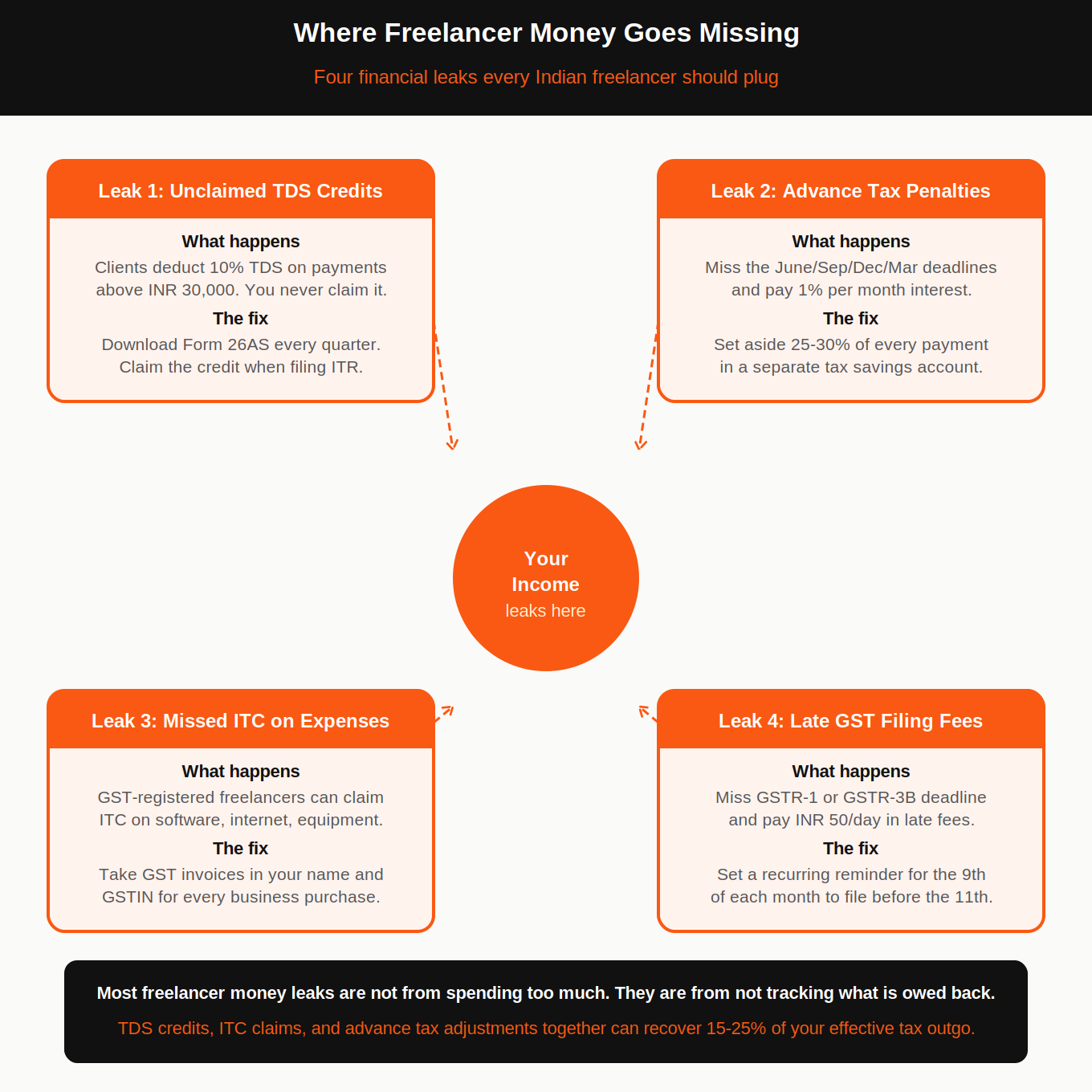
Every time a company pays you for professional services, they deduct 10% TDS under Section 194J before releasing the payment. If you invoiced INR 1,00,000, you receive INR 90,000. The INR 10,000 is sitting in your income tax account at the government, waiting for you to claim it.
Most freelancers do not track this deduction month by month. They discover it only when filing their ITR, and sometimes not even then. Unclaimed TDS is money left on the table.
The fix: download your Form 26AS from the income tax portal (incometax.gov.in) every quarter and verify that every TDS deduction your clients should have made is actually showing up. If a client deducted TDS but entered your PAN wrong, the credit will not appear. Raise it with them immediately before the financial year ends.
If you use invoicing software with TDS auto-calculation, each invoice shows the net amount the client will pay after TDS so you are never surprised.
 Muskaan Kapoor
Mistake 2: Mixing Personal and Business Money
Running freelance income and personal expenses through the same bank account makes accounting a mess. You cannot quickly identify business expenses, your tax deductions become harder to claim, and reconciling your books at filing time takes hours instead of minutes.
Open a separate current account for your freelance business. All client payments go in. All business expenses go out. Personal transfers happen through a designated transfer, not ad hoc. This separation takes ten minutes to set up and saves hours every March.
Mistake 3: Not Reporting Gross Invoice Value in GSTR-1
If you work through Upwork, Fiverr, or any other platform, the platform deducts its commission and 1% TDS under Section 194O before crediting your bank. You receive the net amount. The mistake: reporting this net amount in GSTR-1 instead of the gross invoice value.
Your GSTR-1 must show the gross value of every invoice. The platform's commission and TDS deductions happen after the invoice value is set. The platform reports the gross amount to the income tax department through its own filings. If your GSTR-1 shows a lower figure, it creates a mismatch when compared to Form 26AS, which can trigger a notice.
Report the full invoice value in GSTR-1. The platform deductions are a separate accounting entry.
Mistake 4: Delaying GST Registration After Crossing INR 20 Lakh
Many freelancers cross the INR 20 lakh annual income mark quietly, sometimes in October or November, and do not register for GST until March or later. Every invoice raised after crossing the limit without a GSTIN is non-compliant. The GST on those invoices becomes payable in retrospect, with interest.
Beyond the tax liability: GST-registered business clients cannot claim ITC on invoices from an unregistered supplier. Once they find out, they will stop working with you or delay payment until you are registered and can reissue compliant invoices.
Track your cumulative income from April 1 every year. Register when it becomes clear you will cross INR 20 lakh before March 31. Registration takes 7-10 working days and can be done entirely online.
Mistake 5: Not Setting Aside Advance Tax Through the Year
If your total tax liability for the year is INR 10,000 or more, you are required to pay advance tax in four instalments: 15% by June 15, 45% by September 15, 75% by December 15, and 100% by March 15. Freelancers who do not pay advance tax pay a 1% per month interest penalty on the shortfall under Sections 234B and 234C.
The mistake is assuming you can pay everything in March and be fine. You cannot, at least not without paying interest. And the March rush often means freelancers underestimate what they owe, leading to more interest and a last-minute scramble.
The fix is simple: estimate your income at the start of each quarter, calculate your approximate tax, and set aside 25-30% of every payment you receive into a separate savings account earmarked for taxes. Pay advance tax from that account at each deadline.
Muskaan Kapoor
Mistake 6: Missing the 30-Day Invoice Deadline for Services
Rule 47 of the CGST Rules requires a GST invoice for services to be issued within 30 days of the date of supply. For most freelance services, the date of supply is when you complete the project or the agreed delivery date.
Many freelancers raise invoices weeks or months after completing work, either because the client delayed approval or because they forgot. A late invoice is still a valid invoice, but it creates a problem: the GST period it gets reported in does not match the period the supply happened in. This mismatch shows up in GSTR-1 reconciliation and can attract scrutiny.
If a client is delaying approval, raise a provisional invoice on day 29 and revise it once approved.
Mistake 7: Not Keeping Records of Business Expenses
Many legitimate business expenses reduce your taxable income under income tax. Software subscriptions (Figma, Adobe, GitHub), internet and phone bills, home office costs, professional development courses, equipment, and CA or legal fees can all be claimed as deductions under Section 37(1) of the Income Tax Act.
Freelancers who do not keep records of these expenses pay more income tax than they legally need to. The deductions are legitimate, but they require documentation: bills, receipts, invoices with your name on them.
Keep a folder (digital or physical) for every business expense receipt through the year. If the vendor is GST-registered and provides a GST invoice in your name and GSTIN, you can also claim ITC on those expenses to offset your GST liability.
Mistake 8: Ignoring Form 26AS and AIS
Form 26AS shows all TDS deducted against your PAN, advance tax paid, and high-value transactions reported by banks and other institutions. The Annual Information Statement (AIS) goes further: it shows income reported against your PAN by every entity you transacted with.
The income tax department uses both to cross-check your ITR. If your ITR declares lower income than what appears in AIS, the system flags it automatically and may issue a notice under Section 143(1).
Download both from the income tax portal before filing your ITR. Check that every income entry matches what you actually received. Discrepancies should be explained or reported to the entity that filed incorrect information about you.
Muskaan Kapoor
FAQs
Do freelancers need to pay GST in India?
Yes, once annual income crosses INR 20 lakh (INR 10 lakh in special category states), or for any inter-state supply of services regardless of income. Export of services is zero-rated but still counts toward aggregate turnover.
What is TDS for freelancers under Section 194J?
When a company pays you for professional or technical services and total payments in a financial year exceed INR 30,000, they must deduct 10% TDS before releasing payment. The deducted amount appears in your Form 26AS as a tax credit and is adjusted against your total income tax liability when you file your ITR.
How do freelancers avoid GST notices in India?
File GST returns on time, report gross invoice values (not net bank credits) in GSTR-1, claim only ITC that appears in your GSTR-2B, and register for GST before crossing INR 20 lakh annual income. Most notices come from data mismatches that are avoidable with correct record-keeping.
Can freelancers claim business expenses as tax deductions?
Yes, under Section 37(1) of the Income Tax Act. Software subscriptions, internet, home office costs, equipment, professional courses, and CA or legal fees can be claimed as deductions, provided you have documentation. Always take invoices with your name on them.
What is advance tax and do freelancers have to pay it?
If your total tax liability for the year is INR 10,000 or more, you must pay advance tax in four instalments. Missing or underpaying instalments attracts 1% per month interest under Sections 234B and 234C. Setting aside 25-30% of every payment received for tax is the simplest way to stay on track.