
Inside VCMint: Aditya Vuchi Reveals What Most Startups Get Wrong About Raising Venture Capital
In this interview, Aditya Vuchi shares how VCMint is redefining patient capital, what founders often miss while fundraising, Hyderabad’s startup rise, and the signals that make early-stage startups investment-worthy.
India’s venture capital ecosystem is evolving rapidly, with the market projected to grow at a CAGR of nearly 15–18% over the next five years as startup investments become more selective and founder-focused. Alongside traditional VC firms, family offices and proprietary capital platforms are playing a bigger role in early-stage funding, bringing greater flexibility and long-term investment horizons to the ecosystem.
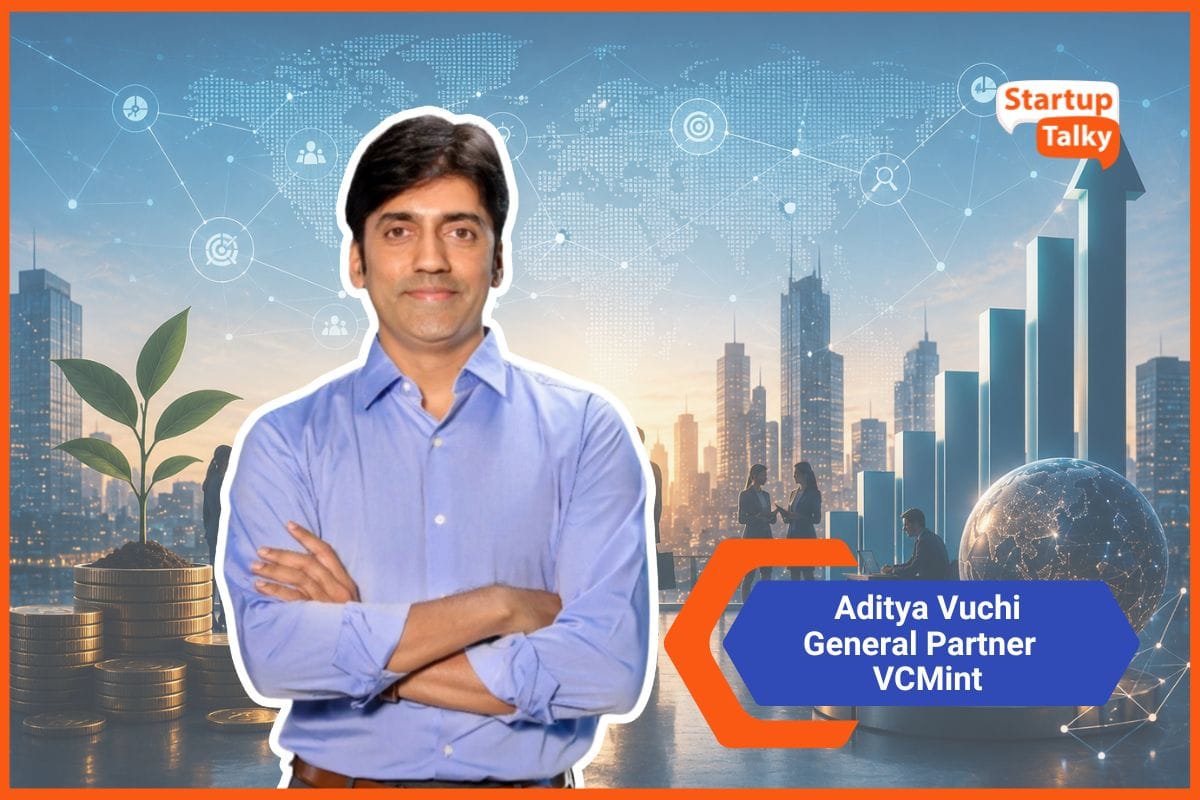
In this interview, StartupTalky speaks with Aditya Vuchi, General Partner, VCMint, about what patient capital means in practice, how his bootstrapped founder journey shapes investment decisions, Hyderabad’s growing startup ecosystem, and what early-stage founders need to know to attract long-term capital.
StartupTalky: VCMint describes itself as 'patient, founder-first capital from bootstrapped exits.' In a market where most VCs are under pressure to deploy on schedule, what does patient capital actually mean in practice. how does it change your portfolio monitoring, follow-on decisions, or founder conversations?
Aditya Vuchi: For us at VCMint, patient capital is not just a positioning statement. It shapes how we make decisions every day, especially in an industry where most institutional funds operate at a fixed fund cycles and remain under pressure to optimise IRR within defined timelines. Since our capital is proprietary built through bootstrapped exits, we are not bound by those constraints.
That changes three things for us.
First, follow-on decisions are based on business strength rather than portfolio markups.
Second, we do not push founders into premature scale just to manufacture a Series B/C narrative.
Third, founder conversations become more candid.
Without quarterly LP pressure, we discuss openly whether a pivot is needed instead of repackaging a struggling business.
StartupTalky: You founded MediaMint and scaled it before transitioning to investing. How does your experience as a bootstrapped founder shape the kind of due diligence you run, specifically, what do you look at that a career investor might overlook?
Aditya Vuchi: Having scaled MediaMint without institutional capital, I pay close attention to areas often treated as line items.
The first is the founder’s relationship with numbers and metrics. I want to hear the familiarity of someone who has genuinely operated the business, not someone repeating figures from a pitch deck. If the understanding feels rehearsed instead of lived, it says a lot about how the company operates.
The second is operational fragility. Most early-stage businesses depend heavily on one or two functions still managed personally by the founder, and those vulnerabilities rarely appear in financial models. We ask directly about those dependencies because they often reveal the real operational pressure points.
The third is the cost of the next dollar of growth. Many decks present a clean customer acquisition cost averaged across channels, but acquiring the next set of customers often becomes significantly more expensive as a business scales. We spend time understanding how sustainable that growth really is, because it determines whether the company will need another fundraise within 12 months or whether it can choose its own timing.
StartupTalky: With cheque sizes of $100–200K, VCMint sits at a very specific stage of the funding stack. How do you think about your role in a startup's capital journey, as a bridge to the next round, a long-term partner, or something else, and how do you communicate that to founders upfront?
Aditya Vuchi: Our typical first cheque is USD 100-200K, although we selectively write larger cheques across stages, including Series B and beyond. We sometimes lead rounds where we have strong conviction and the ability to set terms, but we are equally comfortable investing alongside others. Whether a lead investor or not, we always conduct our own diligence. We have also walked away from rounds where our assessment did not support the thesis.
We set the rules very clearly with the founders in our initial conversation itself. If the business performs well, we are willing to follow on because we deploy proprietary capital without LP approvals or fund cycle constraints. Our aim is to be a long-term partner rather than a one-time investor. Many portfolio companies have received multiple cheques from us over time, and we want to be the investor they call first when there are any developments or challenges.
StartupTalky: Hyderabad has a strong but often underrepresented startup ecosystem. As someone with roots in both the city and the Bay Area, how would you characterise the current state of Hyderabad's venture capital density, and what would it take to truly accelerate it?
Hyderabad already has the foundations of a strong startup ecosystem. The infrastructure is world class, with T-Hub 2.0, the world’s largest startup incubation centre, alongside institutions such as IIIT Hyderabad, ISB and a strong life sciences cluster. SpaceTech is an emerging sector with nearly 25 startups within a broader deeptech ecosystem of more than 400 companies, including leaders such as Skyroot Aerospace and Dhruva Space. With India’s projected USD 44 billion space economy by 2033, Hyderabad has a real opportunity to become the country’s SpaceTech capital.
The remaining gap is early-stage capital density. The city needs more local investors backing seed-stage companies, more successful exits that recycle talent and capital, with a culture of founders supporting other founders. We are proud that VCMint has been contributing meaningfully to fill this gap.
StartupTalky: Family offices entering venture capital often struggle with the discipline of saying no, especially to warm introductions. How have you built frameworks to maintain investment discipline without sacrificing the founder-first culture VCMint is known for?
Aditya Vuchi: At VCMint, we manage investment discipline through three filters.
First, every opportunity goes through the same diligence framework, whether it comes through a warm introduction, cold outreach or a repeat founder.
Second, every investment must fit into a defined thesis, so a “no” is based on business alignment rather than relationships.
Third, we maintain a deliberate cap on annual deployment. The benchmark is not whether a deal is good enough, but whether it stands out relative to the next ten opportunities we may see.
We also encourage strong internal debate before any cheque is written, which helps balance with discipline. Founders usually appreciate a clear and reasoned rejection far more than slow ghosting.
StartupTalky: VCMint has backed companies across alumni networking, healthtech, and food-tech. What is the common investment logic tying these together, is there a unifying thesis, or are these opportunistic conviction bets?
Aditya Vuchi: VCMint is intentionally sector agnostic. With 60+ investments across India, the US, the UK, Switzerland and Southeast Asia, the portfolio is designed to stay broad. Our thesis operates at the company level rather than the sector level. We look for founders who understand their businesses at unusual depth, a wedge small enough to be defensible yet tied to a real market, and unit economics that can sustain the business without a mandatory fundraise within 18 months.
Our position as an LP in multiple VC funds also strengthens our direct investing approach. It gives us access to benchmarking data and cross-sector deal flow that sharpens pricing discipline and pattern recognition. It also helps us identify emerging sectors early because the funds we back often see these companies before they become consensus opportunities.
StartupTalky: How do you evaluate consumer entertainment or gaming startups differently from B2B or SaaS companies, given the very different monetisation dynamics and capital requirements?
Aditya Vuchi: The more important distinction is not B2B versus consumer, but how predictable the revenue is and how quickly you can tell whether the business willscale. In B2B and SaaS, traction usually becomes visible within a few quarters. Sales cycles may be long, but customer behaviour is relatively predictable, and unit economics become clearer over time.
In gaming and consumer entertainment, signals come faster but are noisier. A title may look successful for a few weeks before collapsing, while another may underperform at launch and find its audience months later. The capital required to test even a single hypothesis is also much higher. Because of that, we place greater emphasis on founder’s judgment and experience in gaming than in SaaS.
Gaming and consumer bets usually start with smaller initial investments and follow-on optionality once we see genuine organic pull, whereas in B2B we are more comfortable concentrating capital earlier when the metrics support it.
StartupTalky: For an early-stage founder looking to raise from a fund like VCMint, what does the perfect first conversation look like, and what are the signals that make you want to invest even before a formal pitch deck?
Aditya Vuchi: The best first conversations are usually the least scripted ones. We prefer a founder’s intent than a polished pitch deck. The best meetings turn into real conversations where assumptions get questioned and founders defend their thinking with actual examples. We particularly pay attention to whether founders are open about what is not working, because that usually tells us that they understand the business in-depth.
We also notice how they talk about their team and whether they give credit or centralise it around themselves. Another important signal is whether they have clarity on why the next two years are the right moment for their business. Founders who claim there is “no real competition” usually lose credibility quickly. When some of these signals are present, the deck becomes secondary.
 Anga Mahatara