The Rise of Geospatial Intelligence in India: Amit Sharma on Renewable Energy, Mining, and Infrastructure
As India ramps up investments in renewable energy and infrastructure, geospatial technologies are becoming critical to project planning and monitoring. Amit Sharma of Matrix Geo Solutions shares how drones, LiDAR, and AI are driving the next phase of growth.
India's infrastructure and energy sectors are undergoing a massive transformation. The country's renewable energy market is projected to grow at a CAGR of around 8-10% through 2030, driven by ambitious targets of 500 GW of non-fossil fuel capacity and net-zero commitments. Simultaneously, India's transmission infrastructure market is expected to expand at a CAGR of over 6%, while the drone surveying and geospatial analytics industry is forecast to grow at a CAGR exceeding 15% over the next few years.
With increasing investments in renewable energy, mining, transmission networks, and smart infrastructure, tools such as LiDAR, drones, satellite imagery, and AI-powered analytics are becoming essential for faster planning, better decision-making, and efficient project execution.
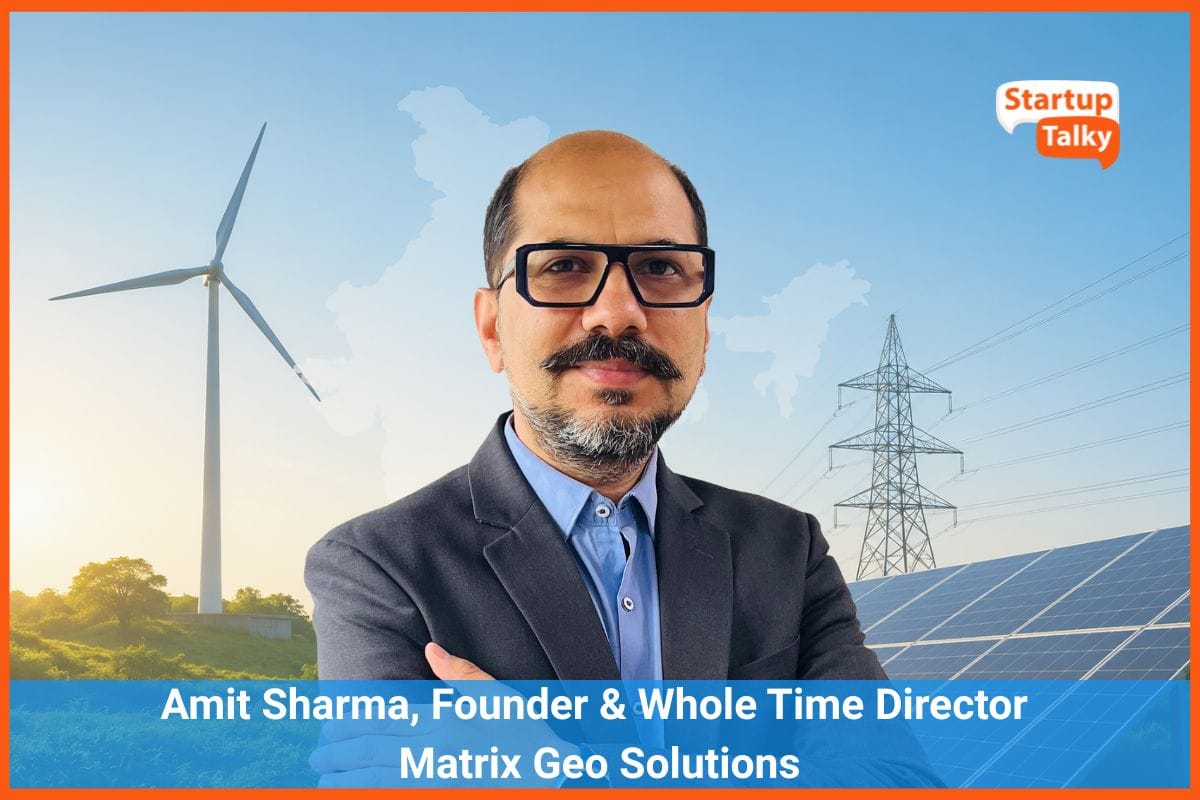
In this interview, Amit Sharma, Founder and Whole-Time Director of Matrix Geo Solutions, shares insights on the growing role of geospatial intelligence in India's energy transition, infrastructure development, and the company's future growth plans following its NSE SME listing.
How Geospatial Technologies Are Transforming Transmission Infrastructure Planning
StartupTalky: India's renewable energy buildout requires massive parallel investment in transmission lines, substations, and grid corridors. How does geospatial surveying using LiDAR, drones, and satellite imagery change the speed and accuracy of planning for power infrastructure, compared to conventional ground survey methods?
Amit Sharma: India's energy transition is often discussed in terms of renewable energy capacity, but moving that power efficiently is just as important. Without the right transmission infrastructure, adding generation alone does not solve the problem.
For a long time, transmission planning depended mainly on field surveys and walkover assessments. Those methods are still relevant, but they can take considerable time, especially in remote areas, forest regions, or difficult terrain where access is limited.
Over the last few years, we've seen project teams become much more comfortable using technologies such as drones, LiDAR, and satellite imagery during the planning stage. The biggest difference is that information becomes available much earlier. What once involved several rounds of site visits can now be assessed far more quickly.
The benefit is not only speed. Early visibility of terrain conditions, vegetation, nearby structures, and right-of-way constraints helps teams make better decisions before construction starts. In many cases, identifying a potential issue early is far easier than dealing with it later during execution.
One thing we hear regularly from utilities and transmission developers is that project risks reduce when reliable information is available upfront. That is probably why geospatial data is now being used for much more than traditional surveying.
As transmission networks continue to expand, digital planning tools are becoming a normal part of project development. From what we've seen, better information at the beginning usually leads to smoother execution later.
At Matrix Geo Solutions, we work with power and transmission companies across different stages of the project lifecycle. Whether it is drone surveys, LiDAR mapping, or geospatial analysis, the objective remains straightforward: help teams understand ground conditions better and plan with greater confidence.
Why Drone-Based Pipeline Monitoring Is Becoming Critical for Energy Security
StartupTalky: Matrix Geo has worked on drone-based pipeline monitoring for clients like GAIL. As India's oil and gas infrastructure faces geopolitical supply pressure from the Iran conflict, how important is real-time aerial monitoring of pipeline integrity, and what can it detect that ground inspection cannot?
Amit Sharma: Energy security is often discussed in terms of supply and capacity, but the reliability of the infrastructure carrying that energy is just as important. For pipeline operators, maintaining visibility across hundreds or even thousands of kilometres of assets has become a growing challenge, particularly as networks expand into remote and difficult-to-access areas. Traditional ground inspections will always have a role to play.
They provide valuable on-site verification and help teams assess conditions up close. However, relying only on manual inspections can make it difficult to achieve the level of coverage and inspection frequency that modern infrastructure demands. This is where drone-based monitoring is making a noticeable difference. Equipped with thermal sensors, high-resolution cameras, and advanced imaging systems, drones can survey long pipeline stretches in a relatively short period of time.
Areas that may require significant effort to access on foot can often be assessed safely and efficiently from the air. What many operators find valuable is not just the speed of data collection, but the additional perspective it provides. During aerial inspections, teams can identify issues such as erosion near the pipeline corridor, unauthorized excavation activity, vegetation growth patterns, encroachments, or changes along the right-of-way that might otherwise go unnoticed until they become larger concerns.
In several projects, we've seen how regular aerial monitoring helps shift the focus from finding problems after they occur to identifying risks much earlier.
That change may seem small, but it has a significant impact on maintenance planning, resource allocation, and overall asset reliability. Looking ahead, pipeline monitoring is likely to become increasingly predictive rather than reactive.
The combination of frequent data collection, geospatial analysis, and intelligent monitoring tools allows operators to spot trends over time and take corrective action before operational issues develop. As energy networks become more critical to economic activity and national resilience, the ability to make informed decisions based on timely infrastructure data will be an increasingly important part of pipeline management.
The Role of Geospatial Surveys in Critical Mineral Mining and Environmental Monitoring
StartupTalky: Mining is one of the sectors where Matrix Geo operates. India's transition to renewable energy requires a significant increase in domestic mining of lithium, cobalt, and rare earth minerals. What does a geospatial survey work for a mining project look like, and how does it contribute to both resource discovery and environmental impact assessment?
Amit Sharma: Demand for minerals such as lithium, cobalt, and rare earth elements has increased significantly over the last few years, and that has put greater focus on how mining projects are planned and managed. One change that stands out across the industry is the growing use of geospatial data.
A decade ago, many site decisions relied heavily on conventional surveys and periodic field assessments. While those methods are still important, the amount of information available today is very different. Drone surveys, LiDAR data, and high-resolution imagery allow project teams to see site conditions in far greater detail than was previously possible. In practical terms, this means engineers and mine planners can identify terrain constraints earlier, assess potential risks more accurately, and make design decisions with greater confidence.
The value of this information becomes even more apparent once operations begin. Mine sites are constantly changing, and having current spatial data helps teams monitor pit progression, track stockpile volumes, review haul road conditions, and keep an eye on slope stability. Small issues that might otherwise go unnoticed can often be identified before they become larger operational concerns.
Environmental monitoring is another area where these technologies have become increasingly useful. Most mining companies today are expected to demonstrate responsible land management, and reliable data plays an important role in that process. Regular monitoring of vegetation, drainage patterns, land disturbance, and rehabilitation activities provides a clearer picture of how a site is evolving.
What is interesting is that geospatial information is no longer used only by survey teams. Engineers, geologists, environmental specialists, and operations managers are often looking at the same datasets when making decisions. That shared understanding tends to improve coordination and reduce misunderstandings between different functions.
Regulators have also begun encouraging wider adoption of these technologies. In India, for example, annual drone surveys mandated by the Indian Bureau of Mines have helped bring greater transparency and consistency to the monitoring of mining activities. Technology alone does not make a project successful. However, better information usually leads to better decisions. That is perhaps the biggest reason geospatial tools have become such an important part of modern mining operations.
How Geospatial Intelligence Improves Renewable Energy Project Performance
StartupTalky: Large-scale solar and wind farm development requires detailed terrain analysis, shadow mapping, and vegetation assessment before a single panel or turbine is installed. How does geospatial intelligence at the planning stage affect the long-term energy yield and financial performance of a renewable project?
Amit Sharma: The success of a renewable energy project often depends on decisions made long before construction begins. Understanding the site properly helps avoid costly changes later. For solar projects, factors such as terrain, drainage, and shading can affect performance. For wind projects, elevation and local site conditions play a major role in turbine placement. In our experience, better site data leads to better decisions.
Geospatial tools help developers identify potential challenges early, improve project planning, and reduce uncertainty. Combined with AI-based monitoring and thermal inspections, they also support more efficient operations once the project is up and running.
What the NSE SME Listing Means for Matrix Geo's Future Growth
StartupTalky: Matrix Geo recently listed on the NSE SME platform. How does access to public capital change the ability of a geospatial services firm to invest in technology, talent, and new sector capabilities, and what business segments are you looking to expand into with the IPO proceeds?
Amit Sharma: Getting listed on the NSE SME platform is an important milestone for us. It gives us access to capital, but more importantly, it gives us the ability to plan further ahead.
The geospatial sector is changing quickly. New technologies emerge all the time, and keeping pace requires continuous investment in equipment, software, and people. Being listed allows us to make those investments with a longer-term view rather than focusing only on immediate business requirements.
We continue to see opportunities across sectors such as power, mining, railways, and urban infrastructure. At the same time, areas like digital twins and AI-driven analytics are attracting growing interest from clients. Our objective is to build stronger capabilities in these areas while continuing to focus on the core services that have helped us grow over the years.
For us, the listing is less about the event itself and more about what it allows us to do going forward.
Managing Working Capital in Long-Cycle Infrastructure Projects
StartupTalky: Government and PSU projects form a core part of Matrix Geo's client base, but public sector procurement is known for payment delays. How does a company in a capital and technology-intensive business manage working capital through the long cycles that come with infrastructure and energy sector contracts?
Amit Sharma: Infrastructure projects often test your patience. In many cases, project timelines are long, and payment cycles can be equally long, particularly on large public-sector assignments.
One thing we've learned over time is that managing risk is just as important as winning new work. That is why we focus on maintaining a mix of projects, sectors, and clients rather than relying too heavily on any single area.
We also pay close attention to execution. Projects that move smoothly tend to have fewer commercial issues later on. Good planning, clear milestones, and regular communication with clients can make a significant difference.
There is no single formula for managing long project cycles, but maintaining discipline in both project execution and financial planning has helped us navigate those challenges.
The Future of Geospatial Services in India's Energy and Infrastructure Expansion
StartupTalky: With the Iran conflict elevating the urgency of energy security globally, India is accelerating both its domestic resource extraction and its renewable energy deployment. How is demand for geospatial services across the energy and infrastructure sector changing, and where do you see the fastest growth in the next two years?
Amit Sharma: From what we're seeing, demand for geospatial services is becoming much broader than it was a few years ago.
Earlier, clients often approached us for surveys or mapping work. Today, they want information that helps them make decisions throughout the project lifecycle. Whether it is a transmission corridor, a mining project, a railway route, or a renewable energy development, there is growing interest in faster access to reliable data.
We expect power transmission, renewable energy, mining, and railway infrastructure to remain active areas over the next few years. These sectors are investing heavily, and accurate information is becoming increasingly important for planning and execution.
Another noticeable trend is the growing use of drones, AI, and geospatial analytics together. Clients are looking for practical solutions that help them understand what's happening on the ground and respond more quickly when issues arise.
India's infrastructure ambitions remain significant, and that is likely to create continued demand for technology-driven planning and monitoring solutions.
 Apoorva Bajj