Atmospheric Water Generation Is Entering a New Era: Navkaran Singh Bagga on Water Independence, Global Expansion, and Sustainable Growth
The Atmospheric Water Generator (AWG) market is growing as water scarcity and demand for sustainable solutions rise. Explore industry statistics, CAGR, key trends and the future outlook for 2026–2030.
The global atmospheric water generator (AWG) market is gaining momentum as businesses, governments and communities look for decentralized and sustainable sources of drinking water. The market is projected to grow from around $4.36 billion in 2025 to $4.96 billion in 2026, registering a CAGR of 13.7%, and is expected to reach $7.92 billion by 2030 at a CAGR of 12.4%. Rising water scarcity, demand for off-grid water solutions, renewable-energy integration and the need for greater water security are expected to drive the industry's future growth.
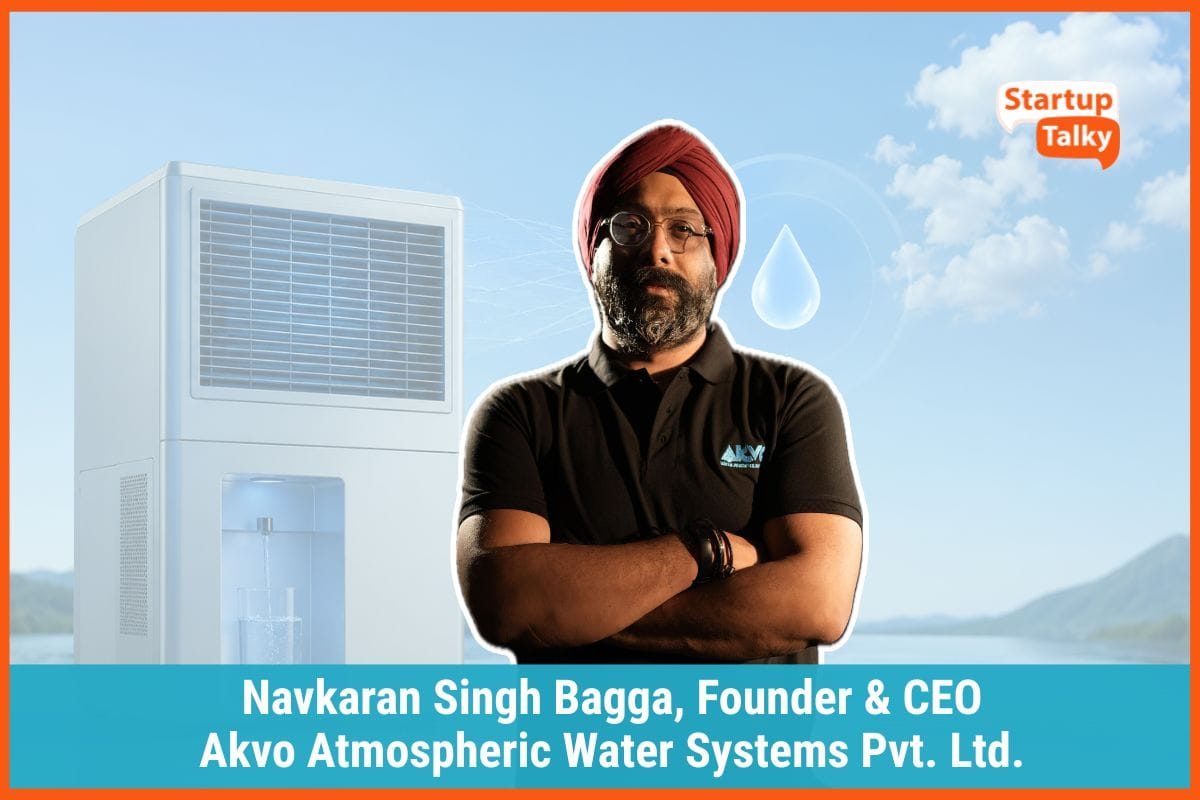
Against this backdrop, companies such as Akvo Atmospheric Water Systems are working to make water generation more decentralized by extracting moisture from the air. In this StartupTalky email interview, Navkaran Singh Bagga, Founder & CEO of Akvo Atmospheric Water Systems Pvt. Ltd., explains how Akvo's technology works, the company's journey since 2017, its expansion across international markets, the challenges of atmospheric water generation and his vision for the future of water independence.
How Akvo Turns Atmospheric Moisture Into Safe Drinking Water
StartupTalky: For readers who are new to Akvo, could you explain how your atmospheric water generators work and how they turn air into safe drinking water?
Navkaran Singh Bagga: Let me say this upfront, I'm not an engineer. I'm a finance student who ended up running a company that makes drinking water out of air. And the funny thing is, everybody has already seen how it works. You take a cold glass of water out on a hot day, droplets form on the outside of the glass. That water is not leaking through the glass. It's coming out of the air around it. Humidity touching a cold surface, condensing. That's it. That's the whole trick.
Our machines just do that deliberately, and at scale. Air comes in, passes over refrigeration coils that are chilled below the dew point, and the moisture in the air condenses out as water. Then that raw water goes through a proper treatment train, sediment filter, activated carbon, a mineralisation cartridge, and UV at the end. Only then does it reach the tap. Nothing goes into the machine except air and electricity. It makes the water, treats it, stores it and gives it to you.
Now, the condensation part is old refrigeration science, honestly. Nobody should get a patent for condensation, nature does it every morning as dew. Where the actual work is, is everything around it. The airflow design, how much energy you burn per litre, and the software. Every machine of ours runs on Nimbus OS, which is our own IoT platform, so we can see humidity, temperature, yield, filter life, all of it, in real time. A machine sitting on an island in the Philippines is as visible to me as one in Chennai. That visibility is what makes it infrastructure and not a gadget.
The Vision Behind Akvo’s Water Independence Mission
StartupTalky: What made you decide to build a company around atmospheric water generation, and what problem did you want Akvo to solve when you started in 2017?
Navkaran Singh Bagga: The honest answer is a movie. December 2016, I watched The Big Short. At the end of the film there's a line about Michael Burry, that he had put all his money into one commodity. Water. That line didn't leave me. I come from finance, I had spent years in steel and a few other businesses, and I'm the kind of person who gets restless every few years. So I went down the rabbit hole, and at the bottom of the rabbit hole was this technology that pulls drinking water out of air. I started working on it in 2017 and we incorporated in 2018.
And here's the thing, the problem I wanted to solve was not "water scarcity" the way most people say it. I actually don't think the world is short of water. The atmosphere alone is holding an enormous amount of it, and it refills itself constantly. The real problem is distribution. Pipes don't reach remote sites. Tankers are expensive and they don't always show up. Borewells run dry or turn bad. Bottled water is basically a logistics business wrapped in plastic. So many people, so many businesses, wake up every day depending on somebody else to deliver their water.
That dependency is what I wanted to attack. Make the water where it's consumed, from a source nobody owns. Not more water. Water where the people already are. We call it water independence, and everything we've built since sits on that one idea.
Global Markets Driving Demand for Atmospheric Water Generation
StartupTalky: Akvo's machines are now installed in more than 15 countries. Which markets have shown the strongest demand for your technology, and what is driving that demand?
Navkaran Singh Bagga: Three places, broadly.
The Gulf and West Asia have been strong for us. People assume the Gulf is dry, but the coastal belt is humid for most of the year, groundwater is under real stress, and everything runs on desalination and bottled logistics. The buyers there, research institutions, endowments, industrial facilities, take sustainability mandates seriously and they procure properly. We serve that region through direct deployments.
Then islands and coastal geographies. East Africa's hospitality belt, the Philippines. A safari lodge in Zanzibar and a fishing community on a small Philippine island actually have the same problem. Humid air everywhere you look, no freshwater infrastructure, and whatever alternative exists is brutally expensive. We've deployed under a national government programme for island communities in the Philippines, and right now we're building out a hospitality pipeline in East Africa.
And then India, but India works differently. Indian enterprises increasingly don't want to buy a machine, they want the water. So we built Water on Want, WoW, where Akvo puts up the plant on the customer's site, we own it, we run it, and they pay per litre. Factories, hospitals, campuses. Across all three markets the driver is the same and it's simple arithmetic. When you add up what people actually pay for tankers, bottles, borewell power, downtime, the real cost per litre is higher than most organisations think. And it keeps rising.
Making Atmospheric Water Generation More Efficient in Low-Humidity Climates
StartupTalky: How does Akvo's technology perform in areas with low humidity, and what have you done to make the machines more energy efficient?
Navkaran Singh Bagga: Let me answer with a failure, because that's genuinely how we learned it. Some years ago we put a machine into the Gulf in peak arid heat and it underperformed. Badly. Physics doesn't negotiate with you. Yield depends on humidity and temperature, and we had specified for conditions that were not the actual conditions. That one failure changed how we engineer and how we sell.
Today the machines work from about 25% relative humidity upward, and they're happiest above 60%. In dry climates we deliberately oversize. If a site needs 300 litres a day, we quote capacity above that, so the client gets his committed volume even in the driest month of the year. And we put that caveat in writing, in every proposal, for every low-humidity geography. Has it cost us orders? Yes. Has it ever cost us a relationship? No.
On efficiency, the only number that matters is energy per litre. Our current Water Blocks run around 0.29 to 0.35 kWh per litre depending on conditions, and bringing that down is a permanent line item in R&D. Compressor selection, coil geometry, and control logic in Nimbus OS that keeps adjusting the machine to ambient conditions instead of running blind.
We also went after the energy source itself. Akvo Helios is our solar-thermal machine. It uses a desiccant blend that gets regenerated by solar heat, working alongside conventional refrigeration, with rooftop solar and rainwater harvesting built into the same unit. For an off-grid site that changes the economics completely.
Scaling Akvo’s Technology to Generate 100 Million Litres of Water
StartupTalky: You have said that Akvo's systems generate around 100 million litres of water annually. How has the company reached this scale, and what does this figure look like in terms of the number of people or communities served?
Navkaran Singh Bagga: We have over 2,000 systems deployed, and the installed base together generates roughly 300,000 litres a day. Run that for a year and you're at around 100 million litres, produced on our customers' own sites, out of air.
How we got there, honestly, is by refusing the consumer market early. Everybody told us to make a home appliance. We went the other way, enterprise first. Industrial plants, government programmes, institutions, hospitality. Because one deployment there runs hundreds of litres a day, every day, for years. A single 500 litre-a-day machine gives you more than 1.8 lakh litres a year. Multiply that across fleets in 15-plus countries and the volume compounds quietly in the background.
WoW accelerated it too, because on those sites we own and run the plant ourselves. Every litre is metered and logged on Nimbus OS. We have skin in the game on uptime, so the machines run.
In human terms, take roughly three litres of drinking water per person per day. 300,000 litres a day is drinking water for about a lakh people, daily. But the picture I always give people is one refinery township in Haldia, where our machines have been supplying around 900 people continuously for six years now. Nine hundred people who haven't waited for a tanker or a municipality since 2020. Multiply that story out and that's what the 100 million litres actually means.
Akvo’s Key Customers and the Changing Demand for Water-as-a-Service
StartupTalky: Who are Akvo's main customers today, and how has the demand for atmospheric water generators changed since you first started the company?
Navkaran Singh Bagga: Today it's four groups. Manufacturing and industrial facilities. Government and municipal programmes. Institutions, so hospitals and campuses. And hospitality, especially remote and island properties. Geographically we're in India, the Gulf, Southeast Asia, East Africa, and we have distribution partnerships in the Americas.
How much demand has changed, I can tell you with one story. In the early days I demonstrated the machine to a government official. He watched the water come out, tasted nothing wrong with it, and then accused me of selling captured sweat. Sweat! That was the level of conversation in the beginning. We spent our first years just proving the physics wasn't a magic trick.
Today nobody asks me whether it works. They ask what a litre costs and what uptime I'll guarantee. Buyers put us next to their tanker contract and their bottled water invoice and compare per litre. Which is exactly the conversation I want to be in, because that's how you buy infrastructure. Nobody negotiates uptime with a gadget.
The other shift is from capex to outcomes. In India, enterprises increasingly prefer water as a service over owning a machine, which is why WoW anchors our domestic business now. Internationally it's still mostly capex orders and distribution partners. We run both on purpose. Exports pay for today, per-litre revenue compounds for tomorrow.
Overcoming the Challenges of Building Trust in Air-to-Water Technology
StartupTalky: What are the biggest challenges in convincing businesses, governments and consumers to adopt air-to-water technology instead of traditional water sources?
Navkaran Singh Bagga: The biggest one genuinely surprised me. You cannot sell into a crisis. In 2018 I flew to Cape Town during Day Zero. A city of millions literally counting down days to the taps running dry. I thought it would be the easiest sales trip of my life. I sold nothing. Zero machines. Because in a crisis people are in survival mode. They queue for rations, they pray for rain, they do not procure new infrastructure. I came back with an expensive lesson: this technology sells on daily economics, not on fear. We've never marketed doom since.
The second challenge is that most organisations don't actually know what water costs them. Tanker payments sit in one budget line, bottled water in another, borewell power and maintenance in a third, and downtime never gets costed at all. So our first job in most sales meetings is accounting, not engineering. Put the fully loaded per-litre number on one page. Once a CFO sees that number, the conversation usually moves our way on its own.
The third is scepticism, and frankly the category earned it. AWG worldwide has had its share of lab-condition claims that collapse in the field. Our answer is instrumentation, not adjectives. Every machine reports its actual yield, energy and water quality through Nimbus OS, and our contracts commit to numbers. There was a performance question raised on one of our government deployments, and we closed it with logged telemetry data, not with assertions. It's a slow way to build trust. It's also the only kind that lasts.
Lessons From Deploying Atmospheric Water Systems Across Global Markets
StartupTalky: Akvo has worked across different sectors and countries. What is one important lesson you have learnt from these deployments that has changed the way you build or sell your technology?
Navkaran Singh Bagga: The machine is the easy part. The site is the hard part. Every important lesson we've learned is some version of that sentence.
The Gulf failure I mentioned taught us to engineer for the climate we're actually deploying into, not the climate on the brochure. A remote island deployment in the Philippines taught us what distance really costs. A fault I can diagnose in minutes in Chennai takes weeks when the nearest technician is a boat ride away. Even something as boring as two monitoring systems logging in two different time zones can muddy a whole performance analysis, we've lived that. So the engineering priorities changed. Remote diagnostics in Nimbus OS, redundancy in critical circuits, and commissioning protocols that assume nobody is coming back to that site next week.
Haldia taught us the other side of it, what six years of uninterrupted running buys you. Nobody in that township thinks about our machines anymore. For water infrastructure, that's the highest compliment there is. On the commercial side, the lesson turned into contract structure. When we analysed our operating portfolio, committed-volume contracts beat pure metered billing for both sides. The customer gets a lower rate, we get predictable utilisation. So what we're really selling now is one thing, a litre of water that shows up every day without drama. The machine, the software, the contract, all of it has to serve that one sentence.
Making Air-to-Water Technology a Mainstream Source of Drinking Water
StartupTalky: You have spoken about making air-to-water technology a household name. What needs to happen for this technology to become a common source of drinking water in homes and businesses?
Navkaran Singh Bagga: Three things have to happen, and in this order.
Cost per litre has to keep falling. Every drop in kWh per litre is a permanent price cut, it never has to be negotiated again. Pairing machines with solar, which is what Helios does, takes the grid out of the equation for the right sites. We manufacture in Chennai and every generation of the Water Block has brought the energy number down. That has to continue.
Second, the category needs credibility it can prove. Standards, certifications, auditable performance data. This is also why I never bet the company on patents, and people find that strange for a technology founder. A few years ago an AI tool reproduced, in forty-five seconds, control code that had cost us six lakh rupees and months of work. That day only confirmed what I already believed. The moat in this business is not a filing sitting in an office. It's two thousand machines in the field, six-year deployments, arid-climate engineering learned the painful way, and per-litre contracts that customers renew. Households will adopt what the industry can prove. Not what it claims.
Third, the model has to meet people where they are. Most homes will not buy a water generator, the same way no home buys a mobile tower. But everyone buys the service. So I think the path to households runs through shared infrastructure first. One machine serving an apartment complex, a school, a village, people paying per litre. Decentralised, but shared. The day air-to-water becomes the boring, invisible utility behind a community tap, the household version follows on its own. Things become household names when they stop being interesting.
Akvo’s Three-to-Five-Year Growth and Expansion Roadmap
StartupTalky: Looking ahead, what are Akvo's biggest priorities for the next three to five years, and what would you like the company to achieve by the end of that period?
Navkaran Singh Bagga: Four things.
Scale the recurring base. WoW is our long-term compounder. These are plants we own, operate and meter, and each contract generates predictable per-litre revenue for a decade. Over the next three to five years I want operated capacity, not units sold, to be the headline number of this company.
Deepen the international footprint through committed partnerships. East Africa, the Gulf, Southeast Asia, the Americas. Market by market, with partners who build alongside us, not opportunistic one-off orders.
Keep pushing on energy. The next generation of machines has to be meaningfully more efficient per litre, and solar-integrated by default wherever the geography allows. Helios is the first step in that direction. It won't be the last.
And institutionalise the company itself. Team, processes, balance sheet. We built our discipline while bootstrapped, and the job now is to absorb growth capital without losing that discipline.
I've said this before and I'll stand by it, I chase value, not valuation. It's an operating rule, not a slogan. If in five years Akvo is the name that comes to a facility head or a government programme first when the question is "how do we make our own water," then the valuation takes care of itself. And so does the household name.
 Subham Kumar