Arvind Narayanan on Making Aeroponics Affordable, Scalable, and Sustainable for India
From ₹53-per-kg production to zero-pesticide farming, Arvind Narayanan reveals how Growize Farms is rethinking aeroponics for India and global markets.
The global Controlled Environment Agriculture (CEA) market is gaining momentum as farmers and agribusinesses adopt technologies such as aeroponics, hydroponics, automation, IoT, and precision farming to improve yields and resource efficiency. A 2026 industry report estimates the global CEA market at $118.2 billion in 2026, with the market projected to reach $200.07 billion by 2030 at a CAGR of 14.1%. In India, the hydroponics market alone is expected to grow at a CAGR of 12.2% between 2024 and 2030, reaching an estimated $159.6 million by 2030.
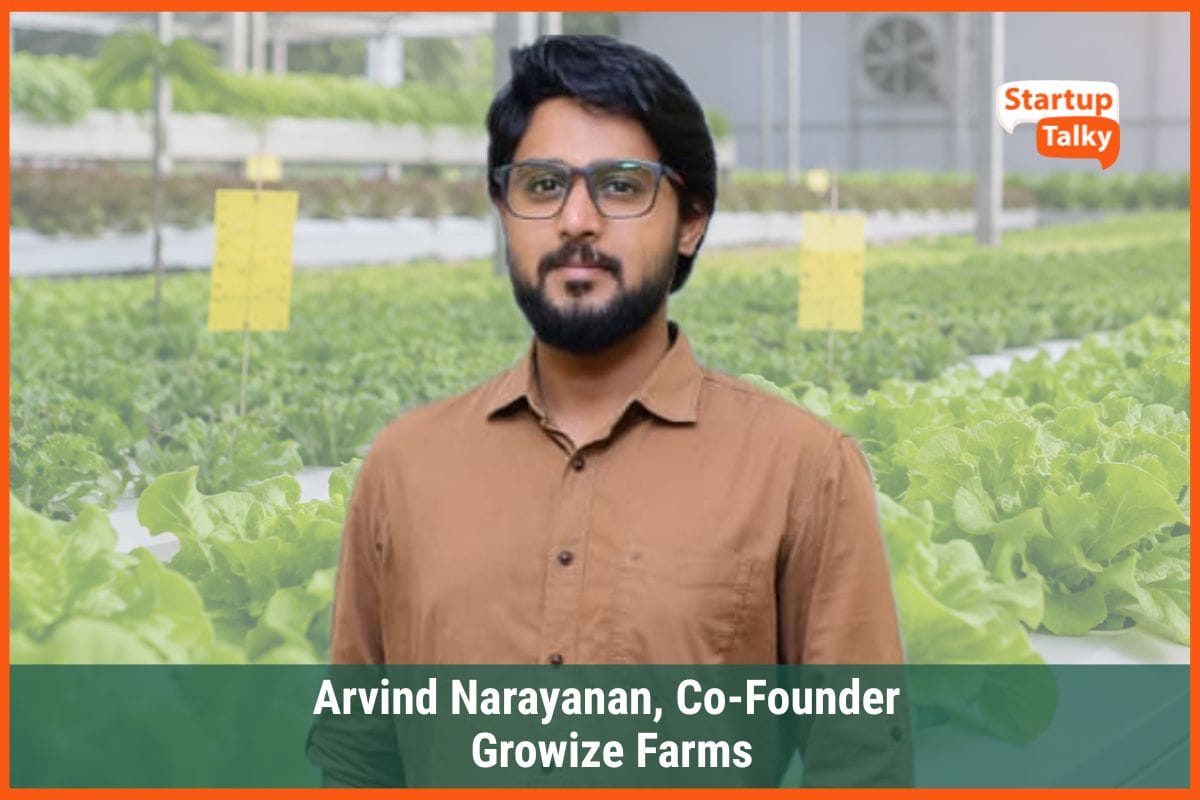
Against this backdrop, Arvind Narayanan, Co-Founder, Growize Farms, discusses how ARL has adapted aeroponic technology for Indian crops, climates, and price points. He explains the company's frugal innovation approach, high-yield farming system, guaranteed buyback model, export opportunities, automation strategy, and sustainability goals.
Key Takeaways
- ARL has adapted aeroponics for Indian conditions.
- In-house R&D keeps production costs highly competitive.
- Growize offers growers a guaranteed produce buyback.
- Zero-pesticide farming creates new export opportunities.
- Automation helps reduce crop risks and labour dependency.
ARL Re-engineered Aeroponics for Indian Crops, Climates, and Price Points
StartupTalky: Aeroponic systems used globally were originally built for Western climates and high-cost markets. What specifically had to be re-engineered in ARL's system to make it work for Indian crops, Indian climates, and Indian price points?
Arvind Narayanan: In cooler Western regions, most commercial aeroponic systems are set up so that a small amount of greens can cost as much as a full kilo in India. We therefore had to consider two factors: climate and cost. The systems used in the West are designed to heat and provide light for the crops, but in India we have to deal with heat stress and high humidity, which is why we have adopted polyhouses featuring natural ventilation and evaporative cooling - this has greatly reduced our energy consumption.
As for cost, if we had imported the growing systems developed for their needs, our vegetables would have been far too expensive. So, after 14+ years of R&D, we transferred almost all the components in-house from scratch. And that is the reason why our production costs remain competitive at about Rs 53 per kilo.
Consistent Misting, Crop Selection, and Operator Discipline Drive Higher Aeroponic Yields
StartupTalky: ARL claims 5 times higher yield per acre than NFT, DWC, and other hydroponic systems, and 36 times higher than conventional farming. What are the two or three conditions that must be consistently right for those numbers to hold in an actual production run?
Arvind Narayanan: For high yields, three factors must all work in unison.
The first is misting uptime: we use cocopeat as a buffer in our aeroponic system and ensure the nutrients are delivered in precise intervals without any interruption.
The second is the suitability of the crop for the system: the yield figures we give are specifically for leafy greens, the type of crop for which our system has been tuned having a lot more crop density than traditional hydroponic systems.
The third is operator discipline and know how: we need to build systems and processes that seamlessly control the variables of a plant’s growth like EC, the pH, temperature, humidity etc and have a rigorous crop monitoring protocols.
Growize Uses Guaranteed Buyback and Multi-Channel Distribution to Secure Produce Offtake
StartupTalkyYou use a guaranteed buyback model under the Growize brand. What does managing regular demand and offtake commitments for zero-pesticide leafy vegetables actually require on the sales and distribution side?
Arvind Narayanan: We have a buy-back program for the produce for growers or clients who independently operate our farms. This program is offered to ensure that the growers have no sales risks as the produce is highly perishable. Over the last decade, we have built a robust distribution network across different sales channels such as eCommerce, quick commerce, retail, HORECA, exports, etc. to ensure we have a ready market for our zero pesticide produce. We get into long-term sales arrangements with our clients to ensure that we are growing what they need and they are buying what we grow. We sell our produce even before seeding to ensure assured offtakes.
We also grow our market size by pricing our products for a value-conscious audience. Here's something that surprises many people: simply being healthy and pesticide-free does not ensure strong sales. We set the price of our produce at the same level as conventional greens, not as a premium, which means we open ourselves to a large market size to support large volume sales across sales channels and have to sell large volumes for the business model to succeed.
Frugal Innovation Helps ARL Make Aeroponics Affordable for Indian Growers
StartupTalky: ARL is bootstrapped and built on frugal innovation. What does keeping aeroponics affordable for Indian growers require that the standard global approach to controlled environment agriculture does not?
Arvind Narayanan: Most global CEA models are capital-heavy: vertical farms, indoor farms with full climate control, premium urban markets that are designed for Western countries to decrease their food import bills, and also the per capita GDP allows growers to sell their produce at high prices. These systems also address unfavorable weather conditions like less light and extreme cold. We had to solve for our problems in India. For our weather conditions, our market realities, and purchasing patterns.
Our numbers had to work from the start for our needs, so we chose polyhouses over closed indoor farms, sourced parts locally, and focused R&D on increasing yields to lower the cost of production. We aim for price equality with regular produce, not the luxury segment. For us, “frugal innovation” isn’t a slogan; it’s how we make aeroponics affordable in India.
Zero-Pesticide Farming Creates Export Potential but Requires Stronger Infrastructure
StartupTalky: India loses vast quantities of vegetables to pesticide rejections at export inspection. How big an opportunity does zero-pesticide certification open for ARL's growers in export markets, and what stands between them and that market today?
Arvind Narayanan: The problem that India faces with pesticide residues at its export borders is well documented; in 2025 alone, more than 50 shipments of Indian rice to the EU were rejected, mainly because of residue levels. The same issue occurs with vegetables and spices. In principle, leafy greens that contain absolutely no pesticides should have no difficulty passing these inspections. However, the real obstacle is not in growing clean crops but in the infrastructure.
In order to export, each batch has to be tested for pesticide residues and all the needed documentation prepared, cold-chain logistics must be in place for international shipping (not just for local distribution), and there must be a consistent volume of output to maintain an ongoing export relationship rather than merely entering into one-off arrangements. At present, with the number of farms that we have, export-scale logistics don't work out; it is a question of scale rather than quality.
Although our technology is capable of producing clean crops and we have serviced export orders, the challenge of getting into the export market is a completely different logistical one that many agri-tech companies fail to appreciate. Furthermore, the daily demand for our leafy vegetables with the quality we offer in Bangalore is 8 Tons per day as of today, and the number is increasing every day. This gives us an opportunity to service a large immediate market.
Automation Helps Growers Reduce Crop Risks and Improve Farm Economics
StartupTalky: Your system uses IoT, automation, and mechanisation to reduce labour dependency. In a country where farm labour is still cheap relative to technology, how do you make the economics of automation compelling to a first-time grower?
Arvind Narayanan: Cheap labor and reliable labor are not the same, and that is the message we give to new growers. Tasks that demand precision, such as dosing nutrients, maintaining the right growing environment, and detecting pests early- are subject to human errors that result in crop losses and production inconsistencies.
The real danger does not lie in the wage bill; it is in losing a whole crop because of a mistake. In the case of someone who has a buyback agreement, a single error due to human involvement can destroy the profits for an entire season. On the other hand, automation, despite its higher initial cost- helps to avoid this problem and has good cost-benefit.
Furthermore, as farm labor costs go up because more people are moving into construction and service occupations, the case for automation becomes stronger each year. The aim is not to "replace cheap labor" but rather to protect the grower against risks that could spoil a harvest and to achieve an equilibrium between human and AI work.
Measuring Carbon Reduction Remains the Biggest Challenge for ARL’s FY29 Sustainability Goals
StartupTalky: ARL's goal is to feed one million people, save six billion litres of water, and cut 1,000 tons of CO2e by FY29. Which of these three targets is hardest to actually measure and verify, and why does that measurement challenge matter?
Arvind Narayanan: Carbon is by far the hardest target to measure honestly. Water savings are easy; we can track our usage and compare to local benchmarks. People fed is a reasonable estimate based on harvest and average consumption. But CO2e avoided is tricky since soil-based farming’s emissions vary wildly depending on fertilizer, tillage, and even grid power. There’s no standard baseline, so “carbon saved” numbers are often unverifiable.
 Vivek Dev Jacob