Top AI Pricing Optimization Tools: Best Platforms for Retail & B2B Pricing in 2026
A complete guide to the best AI pricing optimization tools like Competera, Pricefx, 7Learnings, and more. Learn their key features, use cases, pros, and how they help businesses improve pricing decisions and profitability.

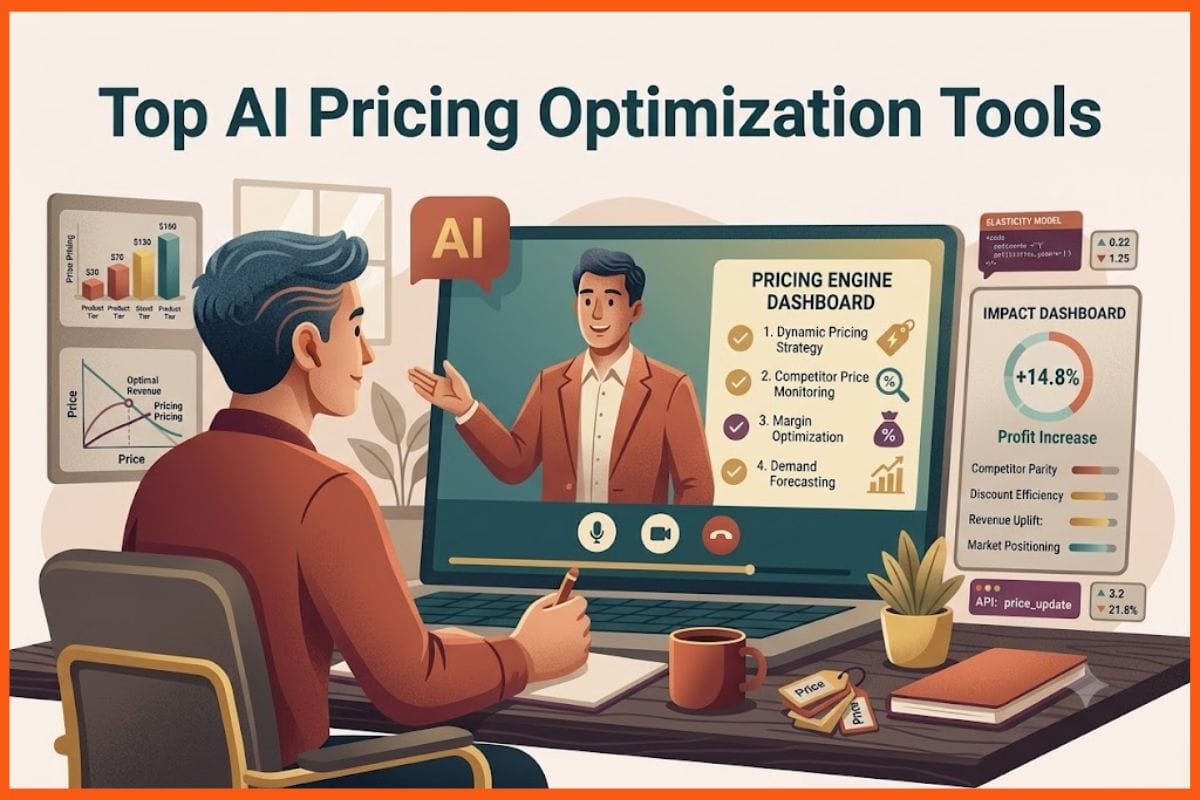
AI pricing tools help businesses turn messy data into smart pricing decisions. They study past sales, market trends, competitor prices, and customer buying habits to recommend the best price for each product or service.
Instead of relying on guesswork, businesses can make decisions based on real data. These tools also adjust prices in near real time, test different pricing strategies, and learn what works best for different customer groups.
This helps companies increase revenue, avoid unnecessary discounts, and protect profit margins. At the same time, they can keep prices fair and competitive, which builds customer trust.
Key Benefits of AI Pricing Tools
AI pricing platforms help businesses move from manual pricing to data-driven decisions. They improve speed, accuracy, and profitability.
- Better profit margins through optimized pricing
- Faster response to competitor price changes
- Reduced manual effort in pricing updates
- Improved customer satisfaction with fair pricing
- Data-backed decision making instead of guesswork
Compare the Best AI Pricing Tools
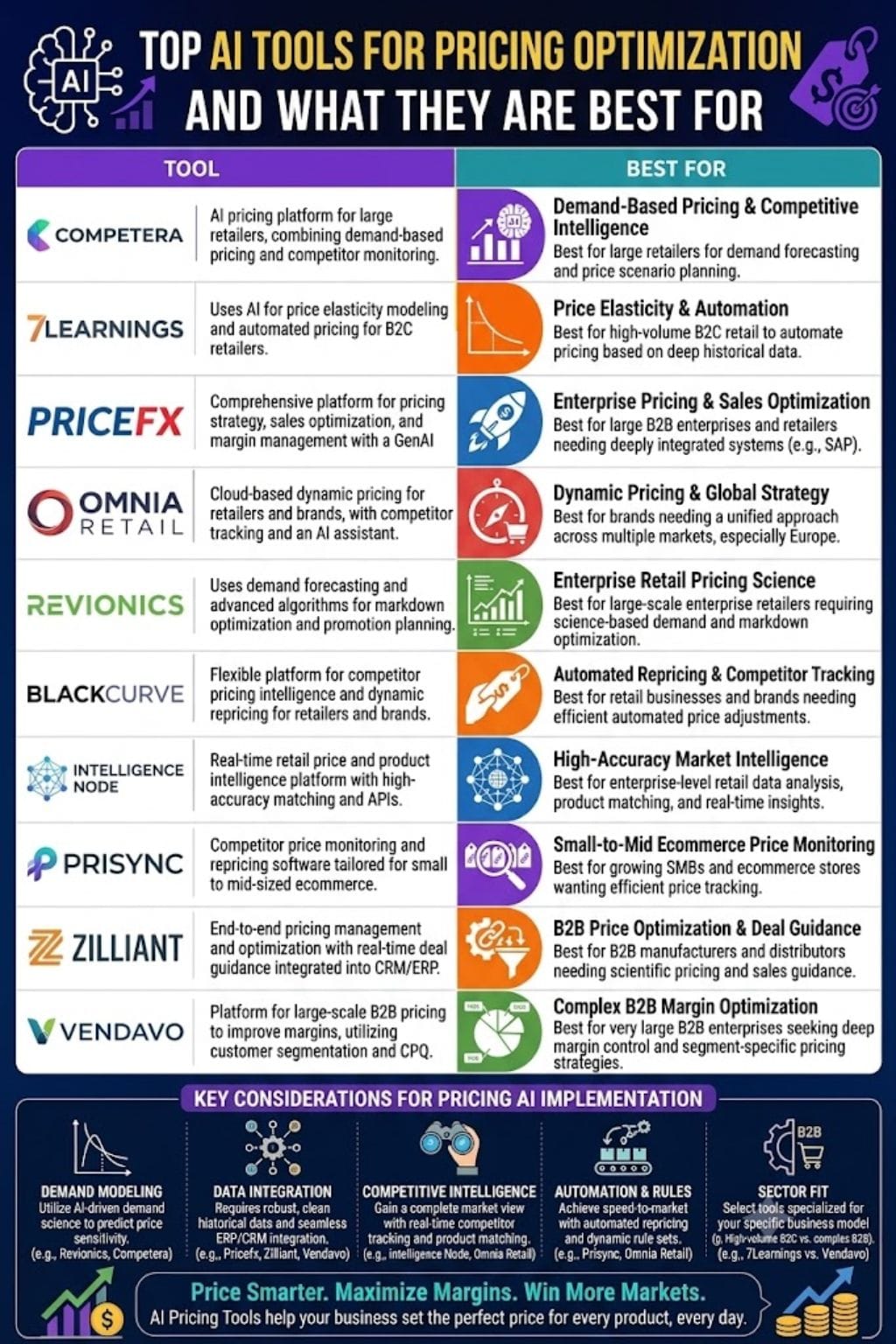
| Tool | Best For | Key Features | Drawbacks |
|---|---|---|---|
| Competera | Large retailers using demand-based pricing | AI pricing, competitor monitoring, scenario planning, demand forecasting | Best suited for large retailers; requires clean data |
| 7Learnings | B2C retailers with large product catalogs | Price elasticity, demand forecasting, KPI simulation, automated pricing | Mainly focused on retail; depends on historical data |
| Pricefx | Large B2B enterprises and retailers | AI pricing, GenAI assistant, sales optimization, SAP integration | Complex implementation for legacy businesses |
| Omnia Retail | Retailers and brands | Dynamic pricing, competitor tracking, AI assistant, pricing rules | Primarily focused on European markets |
| Revionics | Enterprise retailers | Demand forecasting, markdown optimization, promotion planning | Steeper learning curve for new users |
| BlackCurve | Retailers and brands needing competitor pricing | Dynamic pricing, competitor tracking, pricing automation | Limited advanced analytics |
| Intelligence Node | Retail price intelligence | 99% product matching, real-time price tracking, APIs | No free plan; enterprise-focused |
| Prisync | Small and mid-sized ecommerce businesses | Competitor monitoring, automated repricing, price history | Daily updates instead of real-time |
| Zilliant | B2B manufacturers and distributors | Price optimization, deal guidance, CRM & ERP integrations | Requires quality business data |
| Vendavo | Large B2B enterprises | Margin optimization, AI pricing, customer segmentation | Time-consuming implementation |
Competera
Competera is an AI-powered pricing platform built for large retailers. It uses machine learning to study demand by looking at more than 20 factors, including customer behavior, market trends, and competitor prices.
Based on this data, it recommends the best prices to help businesses increase sales, improve profit margins, and grow customer loyalty. The platform also supports online and in-store pricing, tracks competitor prices in real time, automates price updates, and provides detailed analytics.
Retail teams can test different pricing strategies, keep prices aligned with their brand, and respond quickly to changing market conditions with less manual effort.
Pros
- Customer-centric, demand-based pricing that goes beyond simple elasticity.
- Strong competitive data and product matching for accurate market insight
- Scenario planning and human-in-the-loop control for governance and trust
Cons
- Best suited to large or complex retail portfolios
- Requires clean data and change management to realise full uplift.
Pricing
Request for pricing (RFP)
7Learnings
7Learnings is an AI-powered pricing platform that helps retailers make smarter pricing decisions. It predicts how customers will respond to price changes, forecasts demand, and recommends the best prices to meet business goals such as higher profit, more revenue, or faster inventory movement.
The platform brings pricing, marketing, and inventory planning into one system, making it easy to test different scenarios before taking action. Retailers can also automate discounts and pricing updates across large product catalogs.
Most customers are up and running in less than six weeks and often see strong profit growth through more accurate pricing.
Pros
- Built for B2C retail with complex assortments and fast demand shifts
- Clear price elasticity and KPI simulations instead of black-box outputs
- Fast onboarding, self-service optimisation, and low reliance on data science teams.
Cons
- Geared mainly to retail, so other industries may see less fit.
- Requires solid historical data for the best forecasts and uplift.
Pricing
Request for pricing (RFP)
Pricefx
Pricefx is an AI-powered pricing platform that helps large B2B companies and retailers make better pricing decisions. It uses machine learning, agent-based AI, and generative AI to recommend the right prices based on market trends, customer demand, and business goals.
The platform helps sales teams during negotiations by suggesting target prices and relevant products. It also improves price waterfalls, making it easier to protect margins and close deals faster.
Pricefx fits into existing sales workflows and explains how its recommendations are made, so teams can trust the results. This gives businesses a practical way to price smarter.
Pros
- Strong AI coverage across optimisation, forecasting, and GenAI co-pilot
- Fast time-to-value with productised “Accelerator”
- Deep enterprise integrations, including SAP-endorsed app
Cons
- Best suited to mid–large enterprises; may be heavy for small teams
- Implementation and change management can be complex for legacy stacks.
Pricing
Request for pricing (RFP)
 Vivek Dev Jacob
Omnia Retail
Omnia Retail is an AI-powered pricing platform built for retailers and brands. It helps businesses set the right prices by combining dynamic pricing, live competitor tracking, and automated pricing rules.
A visual strategy tree makes it easy to create, manage, and update pricing strategies. The platform also includes an AI assistant that explains why prices change and what those changes mean for the business.
Every pricing decision is transparent and easy to track, giving teams full control. By using real-time market data, Omnia Retail helps companies protect margins, stay competitive, and keep pricing consistent.
Pros
- Clear, visual pricing rules that non‑technical users can manage.
- Strong European focus with deep retail and brand expertise.marketplace
- Agentic AI that explains pricing insights instead of acting as a black box.
Cons
- Primarily tailored to European markets, so global coverage may be limited.
- Requires clear pricing strategy input; it will not “fix” weak pricing logic on its own.
Pricing
Request for pricing (RFP)
Revionics
Revionics is an AI-powered retail pricing platform that helps retailers make smarter pricing decisions. It uses data, demand forecasting, and shopper behavior to recommend the best prices for products across stores and online channels.
The platform analyzes factors such as price sensitivity, competitor pricing, and customer demand to improve sales and profitability. It also helps businesses plan promotions, optimize markdowns, and test different pricing strategies before making changes.
With built-in analytics and a cloud-based platform, Revionics enables retailers to respond quickly to market trends and changing customer needs. This helps them stay competitive while improving revenue, margins.
Pros
- Strong science-based pricing and demand modelling
- Handles complex assortments, price zones, and lifecycle pricing
- Transparent recommendations that help pricing teams trust the system
Cons
- Complexity and breadth of features may require training and change management
- Not ideal for very small merchants needing a simple, plug-and-play tool
Pricing
Request for Pricing (RFP)
BlackCurve
BlackCurve is an AI-powered pricing platform that helps retailers and brands make better pricing decisions using real-time data. It tracks competitor prices, suggests smarter pricing, and helps businesses protect their profit margins across different sales channels.
The platform combines dynamic pricing, simple pricing rules, and centralised price management in one place. Teams can test pricing strategies, update price lists, and roll out changes without relying on manual work.
It also supports quote and deal pricing for more complex sales. Built-in dashboards and alerts give clear insights into pricing performance, helping businesses react faster and improve results over time.
Pros
- Strong focus on competitor insights for online sellers
- Helpful for both B2C and B2B scenarios
- Reduces manual spreadsheet work on pricing
Cons
- Less suited for very advanced data science teams
- May feel limited for deep, custom modelling needs
Pricing
Request for pricing (RFP)
Rishabh Rathi
Intelligence Node
Intelligence Node is an AI-driven price intelligence and optimisation platform that helps retailers track competitor prices, benchmark assortments, and set smart prices in real time.
It uses patented product matching with 99% accuracy, rapid 10-second data refresh, and plug-and-play APIs to feed insights into existing ERP or eCommerce systems, so teams can react fast to market moves while protecting margins.
Dashboards show SKU-level pricing, stock status, and promotions across categories and regions, making it easier to run dynamic pricing, avoid price gouging, and keep offers sharp and fair for shoppers.
Pros
- 99% accurate product and price matching across global sites
- 10-second refresh rates for near real-time decisions
- Large retail database (1B+ products) with channel and language agnostic coverage
Cons
- No free plan; positioned for enterprise budgets
- Best suited to retail and e-commerce, so other sectors may see less fit
Pricing
Request for Pricing (RFP)
Prisync
Prisync is an AI-powered pricing platform built for online retailers that want to stay competitive without spending hours tracking the market. It monitors competitor prices and stock levels across multiple websites in real time, giving businesses a clear view of market trends.
The platform also provides price history, smart pricing suggestions, and automated repricing based on custom rules. This helps stores react quickly to market changes while protecting profit margins.
With an easy-to-use dashboard and integrations with leading ecommerce platforms, Prisync makes dynamic pricing simple. It is a practical choice for brands that want faster decisions.
Pros
- Easy setup and simple interface for quick onboarding
- Multi-channel support and API for major ecommerce platforms
- Budget-friendly for small and mid-sized brands that are new to pricing optimisation
Cons
- Daily, not real‑time, updates may limit very aggressive pricing plays
- Fewer advanced analytics than some enterprise rivals
Pricing
| Plan | Pricing |
|---|---|
| Professional | $99/month |
| Premium | $199/month |
| Platinum | $399/month |
Zilliant
Zilliant is an AI-powered pricing platform built for B2B businesses. It helps companies set better prices by using data, analytics, and machine learning. The platform brings all pricing data into one place, making it easier to manage products, customers, and sales channels.
It studies customer demand and price sensitivity to suggest the best price for every deal. Zilliant also connects with ERP, CRM, and CPQ systems, so sales teams get real-time pricing guidance while creating quotes.
It can test different pricing scenarios, track discount leaks, and reduce manual work. This helps businesses improve margins, speed up pricing decisions.
Pros
- Strong focus on B2B industries like manufacturing and distribution.
- Deep price analytics and elasticity modelling.
- Tight integration with quoting and sales systems..
Cons
- Best suited to mid‑market and enterprise, may be heavy for small firms.
- Needs solid data to get full value from the AI.
Pricing
Request for Pricing (RFP)
Vivek Dev Jacob
Vendavo
Vendavo is an AI-powered pricing platform built for B2B companies. It helps businesses make better pricing decisions by turning large amounts of pricing data into clear, useful insights. The platform uses machine learning and business rules to recommend target, stretch, and floor prices for products.
It also highlights risky discounts, spots margin leaks, and shows where profits are being lost. Sales, pricing, and finance teams can use these insights to act quickly and improve results.
With features like customer segmentation, real-time price optimization, and detailed analytics, Vendavo helps manufacturers and distributors price products with greater accuracy and protect margins.
Pros
- Strong focus on B2B and complex pricing.
- Native AI assistants built into pricing and deal workflows.
- Scales to millions of SKUs with explainable recommendations.
Cons
- Setup and customization can be time-consuming.
- Steep learning curve for non-technical users.
Pricing
Request for Pricing (RFP)
How AI Pricing Optimization Works
AI pricing tools use large datasets and machine learning models to suggest the best possible price.
- Collects data from competitors, customers, and markets
- Analyzes demand patterns and price sensitivity
- Runs pricing simulations and scenarios
- Recommends optimal price points
- Continuously learns and improves from outcomes
Key Features to Look For
When choosing a pricing optimization platform, businesses should look for:
- Real-time competitor price tracking
- Demand forecasting and elasticity modeling
- Automated price updates
- Scenario planning tools
- Integration with ERP, CRM, or eCommerce systems
- Transparent AI recommendations (not black-box outputs)
Who Should Use AI Pricing Software?
These tools are best suited for:
- Large retailers with big product catalogs
- E-commerce brands competing on price
- B2B companies with complex negotiations
- Marketplaces managing multiple sellers
- Businesses with frequent price changes or promotions
Future of AI in Pricing
AI pricing is moving toward more automation and intelligence. Future systems will:
- Use generative AI for pricing recommendations
- Predict demand with higher accuracy
- Personalize pricing for individual customers
- Fully automate pricing decisions in real time
- Combine pricing with marketing and inventory systems
Conclusion
AI tools for pricing optimisation are no longer a nice-to-have; they sit at the heart of modern profit strategy. They turn raw data into clear price actions, test every move, and learn with each sale. With them, teams move from gut feel to proof, from slow updates to live price shifts. They help trim wasteful discounts, protect margin, and keep loyal buyers on side. As markets change fast and rivals move in hours, not months, these systems give brands a calm edge: sharper, fairer prices, set with speed and backed by facts.
FAQs
What are AI pricing optimization tools?
AI pricing optimization tools use machine learning and data analytics to suggest the best product prices based on demand, competitors, and market trends.
Who should use pricing optimization software?
These tools are mainly used by retailers, e-commerce brands, and B2B companies that manage large product catalogs or frequently change prices.
Do AI pricing tools increase profit?
Yes. They help businesses reduce unnecessary discounts, react faster to competitors, and set data-driven prices, which improves overall profit margins.
Are AI pricing tools suitable for small businesses?
Some tools like Prisync and BlackCurve are suitable for SMBs, but many enterprise platforms are better suited for large companies with complex pricing needs.